

[비즈한국] With Polish President Andrzej Duda recently concluding his state visit to South Korea, expectations for winning the ‘Orka Project,’ Poland's conventional submarine procurement program, are rising. However, there is concern that the overheated competition and legal battles between the domestic companies bidding for the project, HD Hyundai Heavy Industries329180 and Hanwha Ocean042660, are acting as negative factors in the eyes of Polish military authorities.
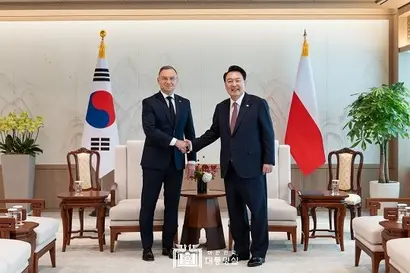
During his recent state visit, Polish President Andrzej Duda met with President Yoon Suk Yeol and agreed to support defense industry cooperation. This has created a positive atmosphere surrounding Poland's 'Orka Project' (a naval modernization program), fueling anticipation for a successful bid.
Currently, Hanwha Ocean and HD Hyundai Heavy Industries are among those competing for the Polish submarine contract. The Orka Project is a program for Poland to purchase three submarines to strengthen its naval capabilities, with an estimated project cost of 8 trillion won. Global submarine manufacturers such as Germany's ThyssenKrupp Marine Systems, France's Naval Group, Spain's Navantia, Sweden's Saab, and firms from Japan have also entered the fray.
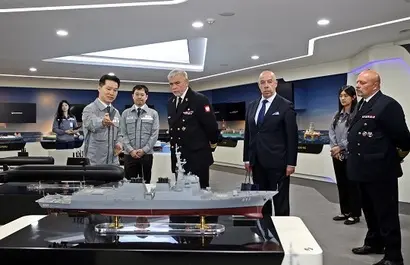
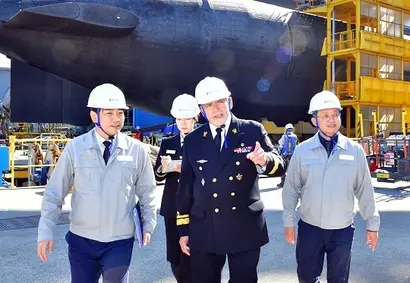
Tomasz Szubrycht, Rector-Commandant of the Polish Naval Academy, who is visiting Korea with President Duda, visited Hanwha Ocean's Geoje shipyard on the 23rd to inspect the construction site of the Jangbogo-III Batch-II submarines, their technical training institute for human resource development, and research facilities for automated equipment. On the 24th, Rector-Commandant Szubrycht visited HD Hyundai Heavy Industries' Ulsan headquarters to examine the solutions proposed by the company, including the latest Shin Chae-ho submarine (3,000-ton class) and the Yun Bong-gil submarine (1,800-ton class).
Hanwha Ocean signed a Memorandum of Understanding (MOU) for cooperation on the submarine project with the WB Group, a leading Polish defense group, at the International Defence Industry Exhibition (MSPO) held in Poland last month. HD Hyundai Heavy Industries is the only one among the 11 global shipbuilders that submitted an expression of interest for the Orka Project to offer two distinct platforms: a 3,000-ton class submarine (KSS-III P) and a 2,300-ton class submarine (HDS-2300).
Amidst this, it is reported that the Polish government recently conveyed a message to the South Korean government expressing concern that the involvement of two Korean shipbuilders in the submarine project could lead to contract failures due to overheated competition. Although the South Korean government hopes to support the project as a 'One Team,' the reality is difficult. Even after In Sung-hwan, Second Deputy Director of the National Security Office, emphasized cooperation while presiding over the '6th Defense Export Strategy Evaluation Meeting' on the 17th, the emotional rift between Hanwha Ocean and HD Hyundai Heavy Industries remains unhealed.
Hanwha Ocean and HD Hyundai Heavy Industries have been in a war of nerves for the past 10 years, clashing over various defense projects. Their conflict has become particularly acute, even escalating to legal battles over the Korea Next-Generation Destroyer (KDDX) project. An official who requested anonymity explained, "Regarding the submarine-related business, there was an opinion that HD Hyundai should join the bid as part of a 'One Team' because Hanwha Ocean has past delivery records, but Hanwha Ocean refused, stating that working with their own partners is what constitutes a 'One Team.'"
Unlike domestic defense firms, advanced defense companies in Germany, France, Sweden, and Spain engage in bidding strategically with full state support. The German government actively supports corporate R&D by mobilizing naval experts and test submarines to improve submarine performance. Meanwhile, France's state-owned shipbuilder, Naval Group, is targeting the Orka Project with its Scorpène-class submarines.
Experts suggest that since advanced European defense companies are participating in this bid as a 'One Team'—uniting the public and private sectors with state support—the Korean government must act as a control tower to resolve internal corporate fighting and compete effectively against European nations. Kim Min-seok, a research fellow at the Korea Defense and Security Forum (KODEF), explained, "Currently, Western defense industries have consolidated into single entities within each country through large-scale M&As. To secure export competitiveness, Korea should consider forming a defense export consortium similar to Russia's Rosoboronexport (a state-owned company). For that to happen, the government must take an active role."