

[비즈한국] When viewed in visible light, the Hercules A galaxy appears to be an ordinary elliptical galaxy where stars are gathered in a loose, round shape. However, this galaxy's true allure is revealed when observed in the radio spectrum. By adding radio observation data, a unique structure extending far out to both sides of the galaxy emerges. This is the trace left behind by the galaxy's central black hole as it actively spews out powerful energy jets. The scale of these black hole jets alone reaches one million light-years. Galaxies that harbor black holes emitting such powerful energy jets, visible through radio observations, are called radio galaxies. While this scale—extending well beyond the entire galaxy—is massive, it is now considered mere child's play.
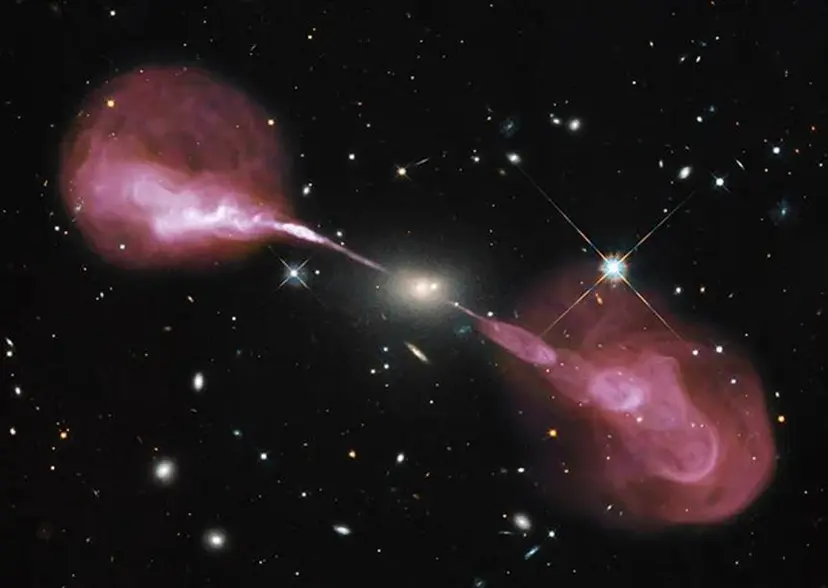
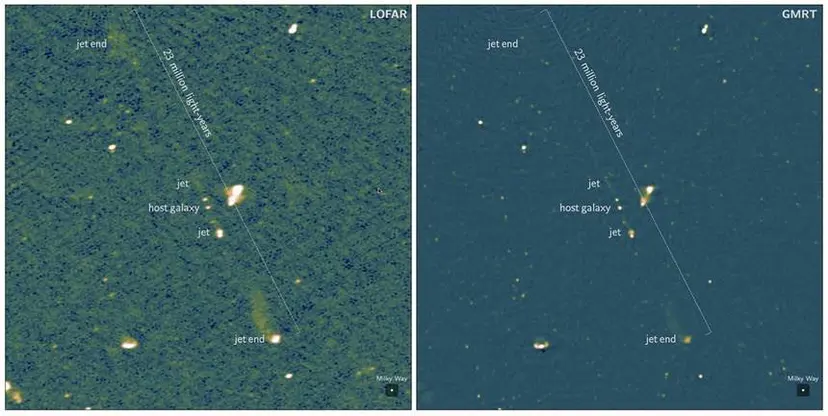
Surprisingly, astronomers recently discovered a galaxy that spews out energy jets on a gargantuan scale, with a total length reaching a staggering 23 million light-years. The total scale is so immense that one would need to line up 140 Milky Way galaxies to match it. It is hard to believe that this is a trace left by a black hole living in the center of just one galaxy. It is almost equivalent to the scale of filaments in the cosmic web, the massive structure that connects galaxies over vast distances!
In truth, astronomers did not set out to find such monster radio galaxies from the start. Originally, they were conducting a survey of the entire universe using low-frequency radio waves to map the filaments of galaxies within the sprawling cosmic web. While it was known that galaxies harboring violent black holes and emitting vast energy jets existed in various parts of the universe, it was assumed they were not very numerous. However, the LOFAR observations revealed that there were as many as 8,000 galaxies hidden away that emit such powerful energy jets.
Among them was a site emitting jets of an overwhelmingly massive scale—23 million light-years in total! It is truly a scale comparable to the cosmic web. Astronomers named this entity emitting these giant radio jets "Porphyrion," after one of the Titans from mythology. Before the discovery of Porphyrion, the largest known radio galaxy was Alcyoneus, discovered by the same research team in 2022. Now, that record has been broken by the same group.
Astronomers, finding it hard to believe such massive energy jets existed, collaborated with India's GMRT radio telescope and the DESI project observation team—which measures distances to far-off galaxies across the universe to create maps and uncover the nature of dark energy—to identify the galaxy emitting these giant jets. The culprit is a massive galaxy with a mass 10 times greater than our own. It is located 7.5 billion light-years away from the Milky Way. In other words, it is a galaxy as it existed when the universe was 6.3 billion years old. Considering the universe is 13.8 billion years old, it is a very young galaxy, less than half the current age of the universe.
The fact that galaxies actively leaving behind giant radio jets existed in the early universe implies that, provided we haven't found them yet, there is a high possibility that other radio galaxies of this scale are hiding throughout the cosmic web.
For a long time, astronomers believed that no matter how violent the jets emitted by a black hole at the center of a galaxy might be, they would struggle to exceed 5 million light-years in scale. As the jet travels further, its intensity inevitably weakens, and it is thought to lose energy and scatter after colliding with other gas particles filling the intergalactic space. However, the radio jets of the Porphyrion galaxy confirmed this time are spewing out on a massive scale exceeding 20 million light-years, enough to pierce through the filaments of the cosmic web. How, then, can the energy jets travel straight out to both sides for such a vast distance without scattering?
One possibility is that, by sheer luck, there was a vast, empty void where almost no other galaxies existed in the direction the black hole jets were emitted. If the jets had been pointed toward a filament of the cosmic web, they would have long since scattered after colliding with other galaxies and gas materials; thanks to being emitted into a giant, empty void, they were able to spread far without losing energy. Even so, for the jets to maintain such a massive scale, the central black hole must have been "binge-eating" and spewing out powerful energy consistently for over billions of years. However, how a black hole can continue to spew out such energy for billions of years without exhausting its food source remains an unsolved mystery.
Black hole energy jets are excellent tools for tracing the flow of intergalactic magnetic fields spread across the cosmic web on scales of hundreds of millions of light-years. This is because the flow of electrically charged particles inevitably follows the magnetic fields of outer space. The black hole jets extending far out to both sides serve as a kind of cosmic compass. While often overlooked, magnetic fields are a crucial element in the process of galaxies being "kneaded" and the cosmic web forming its skeleton. This is because all particles existing in the universe carry an electric charge. Much like scattering iron filings around a magnet to determine the shape and distribution of the surrounding magnetic field, we can confirm the existence of the magnetic fields that formed the skeleton of the cosmic web through the form in which black hole jets and their traces have spread.
You may have seen videos of various cosmological simulations that vividly depict the process of early particles in the universe—which were randomly scattered right after the Big Bang—gradually increasing in density and forming galaxies as they followed each other's gravity and the magnetic fields of the surrounding space. You might think these are just animations made to look pretty, but that is not the case at all. They are visualizations of rigorous calculation results produced by running supercomputers for months or even years. If you were to perform these calculations on a standard laptop, it would take nearly 2,000 years.
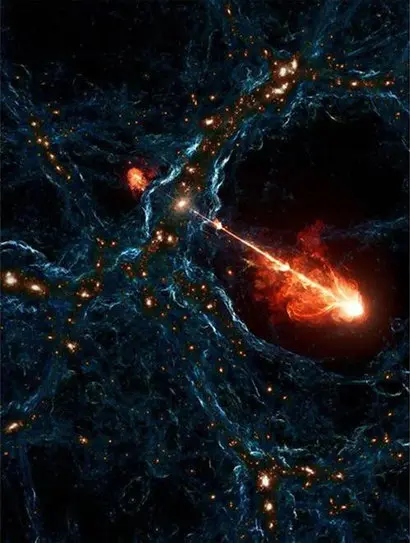
There is one interesting scene that always appears in the process of such cosmological simulations. It shows powerful energy that looks like an explosion radiating in all directions from a massive galaxy located in the knots of the dense cosmic web. These are the traces of galaxies harboring black holes that would have been actively "binge-eating" and spewing out powerful energy in all directions in the early universe. As a large amount of gas material pours into the black hole at the center of the galaxy in an instant, the "gluttonous" black hole spews energy in a circle in all directions. Consequently, the density or temperature distribution of the surrounding gas changes drastically in an instant. This process is very important in the evolution of the entire universe. Not only does the galaxy that underwent such a violent outburst lose gas, but neighboring galaxies that were accidentally hit by this outburst also rapidly lose the gas material they held. Once a galaxy suddenly loses its supply of fresh gas, it becomes a galaxy that has lost its vitality, unable to create new young stars.
When I study the evolution of galaxies, I am often asked this question: Just as stars finish their evolution and end their lives with a supernova explosion, do galaxies also die or explode at some point? Strictly speaking, unlike individual stars, galaxies do not "burst" in an explosion. And unlike stars, galaxies do not disappear simply because they get old. They only gradually become darker and weaker as their ability to create new stars diminishes over time. However, if we accept the definition of the word "explosion" a bit more broadly? For example, if we define it as a phenomenon that radiates powerful energy in an instant across various wavelengths such as radio, visible light, infrared, and ultraviolet, then galaxies are indeed capable of exploding. This is because the active black hole at the center of a galaxy can cause a nuisance to its surroundings and leave traces behind.
How far can a black hole at the center of a galaxy reach? And what effect does this activity have on the cosmic web and the individual galaxies living within it? We now have a new compass—black hole jets—that can directly trace the magnetic fields of the universe, which have long been an unknown territory. Humanity is using it to find clues.
Who is the author, Ji Woong-bae? He loves cats and the universe. After watching 'Galaxy Express 999' as a child, he dreamed of sharing the beauty of the universe. He is currently researching the evolution of galaxies through their interactions at the Yonsei University Galaxy Evolution Research Center and the Near-Field Cosmology Laboratory, and is engaged in various science communication activities such as lectures and writing. He has authored books including 'Astronomy for Lovers,' 'Thinking About the Universe All Day,' and 'Stars, The Science of Light.'