

[비즈한국] K-Defense is seeing rapid growth over the past few years as it carries out large-scale exports to global markets, including Poland and Australia. However, a controversy over "reverse discrimination" regarding domestic products has emerged due to the widening technical gap between the weapon systems used by the South Korean military, such as the K2 tank, and the versions produced for overseas export. There are growing calls that the equipment used by our military should also have its performance improved to match export versions.
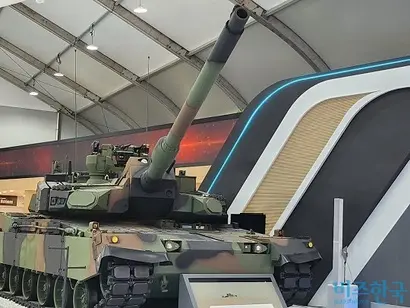
On the 24th, after their summit, President Yoon Suk Yeol and Polish President Andrzej Duda stated in a joint press announcement that “both governments have agreed to provide active support to ensure the success of South Korea-Poland defense cooperation, including the ‘K2 Tank 2nd Executive Contract,’ which is currently being negotiated with the goal of finalizing it within the year.” President Duda's state visit has created a favorable environment for the additional export of domestic weapons, such as the K2 Black Panther tank. It is widely assessed that the possibility of successfully concluding negotiations for the 2nd K2 tank export contract within the year has significantly increased.
The K2 Black Panther, the main battle tank of our military, is most notably characterized by its Active Protection System (APS), designed to defend against attacks from enemy drones and anti-tank missiles. The K2 tanks to be exported to Poland are also expected to be equipped with the APS. However, our own military, the country of origin for the K2 tank, does not possess a single tank equipped with the APS.
The performance-enhanced K2 tank features reinforced survivability to protect the crew from various external threats. On each of the four corners of the turret, an octagonal APS radar, a 360-degree battlefield situational awareness system, and a Laser Warning System (LWS) are installed. Two "hard-kill" type APS systems capable of firing interceptor rounds are mounted on the left and right sides of the turret. A Remote Controlled Weapon Station (RCWS) is installed on top of the turret, designed to allow for precise shooting without exposing the crew to the outside of the vehicle. A rectangular "drone jammer" capable of a "soft-kill" is also installed in front of the RCWS.
Recently, most advanced defense nations are expected to demand and install APS as a standard specification. The "Leopard 2A8," set to be introduced by countries like Norway and Italy, is known to be equipped with an APS. Although our military plans to deploy about 150 additional units by 2028 with a total budget of 1.94 trillion won for the 4th mass production of K2 tanks, it is reported that there are no plans to install the APS system.
The biggest reason our military is hesitant to install the APS system is the increase in unit procurement costs. Domestic defense companies, including Hanwha Systems272210, had already developed an APS system 10 years ago during the K2 tank development process, but its adoption was indefinitely postponed due to cost issues.
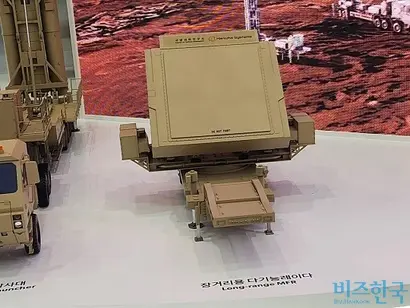
The Multi-function Radar (MFR) series for air defense produced by Hanwha Systems is also known to have better performance in the version exported to Saudi Arabia than in the version for domestic use. Hanwha Systems supplies the MFR for the "Medium-range Surface-to-Air Missile (M-SAM) II (Cheongung-II)," for which an export contract was signed with Saudi Arabia this past February.
Hanwha Systems developed the Cheongung-II MFR in collaboration with the Agency for Defense Development (ADD) and completed its deployment in 2020, and is now supplying a performance-improved version of the Cheongung MFR (Cheongung-II MFR). The Middle East export version of the Cheongung is equipped with an AESA radar to enhance detection and tracking performance, and was developed with consideration for the high temperatures and sandstorms of the desert.
Kim Min-seok, a researcher at the Korea Defense and Security Forum, explained, “When creating export versions, the Defense Acquisition Program Administration provides development funding. However, there is no plan for the South Korean military to utilize them. It is up to the companies to link these to domestic use or conduct follow-up projects. Because companies create these without considering domestic demand, such gaps can occur. It is an area that authorities need to deliberate on so that our own military can also upgrade to better versions of these weapons.”