

[비즈한국] Concerns are growing that the "Participatory Budgeting System," which allows citizens to participate in the process of drafting the national budget, is effectively becoming a dead letter as the budget allocated to it continues to dwindle. This is because the budget for the Participatory Budgeting System this year has fallen to less than half of what it was in its first year of implementation.
As budget allocations have plummeted, the number of participating citizens has also declined, further fueling these concerns. Critics point out that if the focus shifts solely to the efficiency of budget formation and execution, the country risks repeating a cycle where the voices of the public are excluded from the national budget, leaving room only for the influence of large interest groups.
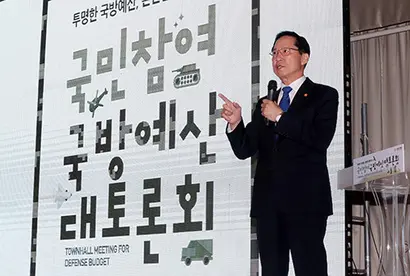
The government established the "Participatory Budgeting System" in 2017 in accordance with Article 16, Paragraph 4 of the National Finance Act, which states, "The government shall endeavor to enhance the transparency of the budget process and public participation in the budget process." This was designed to allow citizens to directly participate in the budget process to propose projects, review them, and determine priorities.
The Participatory Budgeting System consists of a "proposal type," where citizens' suggestions undergo eligibility checks by government ministries or are reviewed by a Citizens' Budget Participation Group before being put to a preference vote, and a "discussion type," where citizens participate in debates on key national fiscal issues to help shape the budget. Upon its launch, the system received a strong response, particularly for the proposal-type projects. While it gained popularity and saw its budget scale increase significantly, it has been rapidly shrinking since 2023.
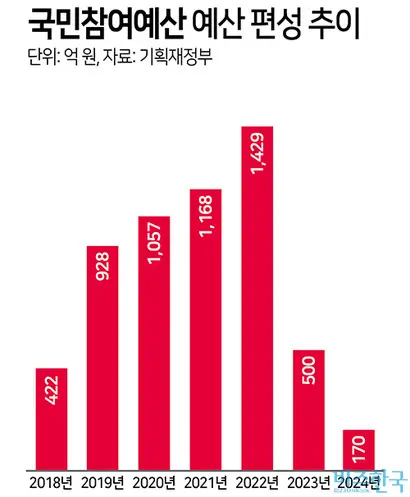
When the system first began in 2018, 42.2 billion won was allocated to 6 projects. The following year, in 2019, the number of projects jumped to 38 with a budget of 92.8 billion won. In 2020, it surpassed the 100 billion won mark, with 105.7 billion won allocated to 38 projects. By 2021, the number of projects grew to 63 with a budget of 116.8 billion won, and by 2022, it reached nearly 150 billion won with 142.9 billion won allocated to 71 projects.
However, in 2023, the number of projects dropped to 51, and the budget plummeted to 50 billion won. This year, it decreased further, with only 13 projects receiving a total of just 17 billion won. Six years after the system began, the budget for citizen-participatory projects has been slashed to less than half of its inaugural year.
Projects conducted under the Participatory Budgeting System last year included initiatives that were uniquely inspired by the general public, such as the Ministry of Employment and Labor’s expansion of national qualification examination centers and diversification of youth job experience programs, the Ministry of Science and ICT’s strengthened software education support for information-isolated areas, the Ministry of Education’s survey on student growth support, and the National Police Agency’s private security service support for high-risk crime victims. The average execution rate for these projects was 93.1%, showing significant engagement. Notably, the National Police Agency's private security service for high-risk victims was so popular that it actually exceeded its initial 700 million won budget, with 723 million won being executed.
However, as the budget allocated through the Participatory Budgeting System has plummeted, public participation is also cooling. Public proposals, which stood at 1,206 in 2019, saw a slight increase to 1,399 in 2020, 1,164 in 2021, and 1,589 in 2022, before surging to 2,043 in 2023. But as the number of applicable projects fell to 51 in 2023, the number of public proposals this year decreased to 1,191. The rate at which ministries deem public proposals eligible is also declining. In 2021, out of 1,164 proposals, 145 were deemed eligible by ministries, a rate of 12.5%. By 2023, out of 2,043 proposals, only 82 were deemed eligible, causing the rate to plummet to 4.0%.
This year, the ministries’ eligibility determination rate remained below 10%, at 7.0%. Among the projects deemed eligible by ministries, the rate of those actually receiving budget allocations has also fallen. Out of 83 projects deemed eligible by ministries this year, only 13 received actual funding, resulting in a budget reflection rate of just 15.7%. This is the lowest budget reflection rate since the Participatory Budgeting System was first introduced.