

[비즈한국] A cold wind is blowing through the online investment-linked finance (P2P lending) market. It has been confirmed that Together Funding, recently considered the second or third-largest firm in the industry, has suspended new loans. Although financial authorities eased regulations earlier this year to promote industry growth, it appears difficult to overcome the prolonged downturn.

The P2P lending firm Together Funding (operated by Together Apps) suspended new loans as of September 30. Through a notice on September 27, Together Funding announced it would terminate its mortgage loan service. It will continue to manage existing loans and handle repayment processes. While the reason for the suspension was not explicitly stated, it is known that it has become difficult to continue offering new loans due to deteriorating business conditions.
Online investment-linked finance, often referred to as P2P finance, refers to financial transactions where individuals and companies trade directly through an online platform. Because it is utilized by those who struggle to obtain loans from traditional financial institutions due to low credit ratings, interest rates and delinquency rates are high, but investor returns are also commensurately high. P2P firms aggregate loan amounts from lenders, distribute them to borrowers, and collect repayments to return to the investors. While P2P investments can yield returns of over 10% if repayments are made normally, they do not guarantee the principal or interest.
Product types handled by P2P firms include real estate project financing (PF), real estate collateral, trade receivables collateral, other collateral, personal credit, and corporate credit loans. According to September statistics from the P2P Center (the central recording agency for the industry), where 48 firms are registered, real estate collateral loans account for the largest share of outstanding loan balances at 55%.
Together Apps was established in 2015 when the domestic P2P finance market began to grow, and it officially registered as a P2P firm with the Financial Services Commission in August 2021. Together Funding has focused on residential real estate-backed loans, such as those for apartments, villas, and houses, which are considered safe assets. By loan balance, it has maintained a spot among the top 2-3 firms in the industry, with cumulative real estate-backed loans exceeding 1 trillion won since 2021.
The news of Together Funding's loan suspension has caused significant concern among investors. Notably, Together Apps had expanded its size by acquiring Hello Fintech (Hello Funding), an SME-focused P2P firm, last February; however, it is now in the process of shutting down operations just eight months later. Nevertheless, Hello Funding operates independently from Together Funding and has been expanding its business, launching non-face-to-face apartment mortgage loans starting in October.
It appears that Together Apps could no longer bear its long-accumulated deficits. According to the Financial Supervisory Service, Together Apps recorded operating losses of 5.8 billion won in 2020, 7.7 billion won in 2021, 3.2 billion won in 2022, and 5.2 billion won in 2023. During the same period, operating revenue showed a downward trend, coming in at 7.9 billion won, 9.2 billion won, 11.5 billion won, 10.1 billion won, and 3.4 billion won, respectively.
With even top-tier companies faltering, the situation for the rest of the industry is equally bleak. Busan-based P2P firm "Titan Invest" ceased operations on October 4. Titan Invest primarily handled real estate-backed loans; it stopped accepting new loans and new investors after June 18 and decided to dissolve on September 19. The SafeNet Cooperative Fund, which handled cooperative collaboration funds, also registered as a P2P firm in November 2022 but effectively stopped operations after announcing its business closure last February.
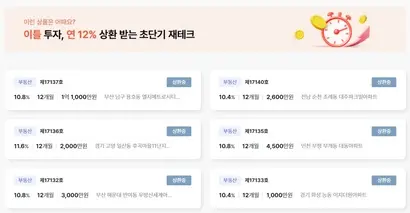
The P2P industry's existential crisis began in 2022 when the global economic downturn intensified. The stagnation of the real estate market following the fallout from the real estate PF crisis is also a major factor. Titan Invest cited "business sluggishness caused by the rapidly changing domestic and international financial market environment and the downturn in the real estate market" as the reason for its business suspension. Although financial authorities introduced deregulation measures early this year to revitalize the industry—such as allowing institutional investment and increasing the individual investment limit for social infrastructure projects from 5 million won to 30 million won—these efforts have yet to show effect.
Growing distrust in the industry is another problem. In April of this year, a financial accident involving 6 billion won occurred at The Asset Fund, which handled meat collateral, and in August, a non-repayment crisis of 70 billion won broke out at Cross Finance, which provided early settlement loans from payment gateway (PG) companies.
Soaring delinquency rates are also a potential risk. According to the supervision regulations for online investment-linked finance, if the delinquency rate exceeds 15%, companies must disclose the fact of delinquency and the contract details of the delinquent loans. If the rate exceeds 20%, they must prepare a management plan and report it to the Financial Supervisory Service (FSS). The FSS can sign a memorandum of understanding (MOU) with firms deemed unable to improve their financial soundness to establish and implement improvement plans.
Currently, the delinquency rates of some firms have surged beyond the legally defined risk level of 15%, reaching as high as 30%. In the case of Together Funding, the delinquency rate rose to 30.1% in September. Oasis Fund, which handles real estate and copyright-backed loans, recorded a staggering delinquency rate of 42.4%. Hello Funding's delinquency rate was 29.9% as of September, though it had reached as high as 43.7% last July.
An FSS official stated, "We do not separately disclose companies with a delinquency rate exceeding 20%," adding, "Because the target borrowers for P2P firms are different from those of general financial companies, delinquency rates are bound to be higher. However, since product information is being disclosed as regulated so that investors can be aware, they can refer to that to mitigate risks."