

[비즈한국] The Agency for Defense Development (ADD) unveiled a physical test model of a 'supersonic air-to-surface missile' currently under development for the first time at the Sacheon Air Show, which opened on the 24th. With concerns rising over the export competitiveness of domestic fighter jets due to delays in weapons integration, this new missile, which is highly attractive to international buyers, has been revealed to the public. It is expected to become a new 'popular item' for defense exports by bolstering the competitiveness of our fighter jets in the future global market.
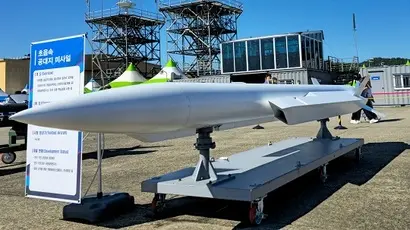
The 'supersonic air-to-surface missile' is a long-range precision-guided missile carried by aircraft to strike key enemy ground targets. Its mission is fundamentally the same as that of the 'Cheonryong' currently being developed by LIG Nex1079550 or the German 'Taurus' missile. However, the supersonic air-to-surface missile differs from the Cheonryong and Taurus in that it flies at supersonic speeds. Other air-to-surface missiles fly at subsonic speeds (700–1,100 km/h, similar to jet airliners), making them easier for the enemy to detect and providing a long window for interception. In contrast, the supersonic air-to-surface missile can strike ground targets 300 km away at Mach 2.5, or 3,000 km/h. With a flight time of only about five minutes from launch to impact, it is difficult to intercept and exerts lethal force. Furthermore, stealth technology will be applied to reduce the probability of detection by enemy radar.
The secret behind the supersonic air-to-surface missile's high speed is a new propulsion system called a 'ducted ramjet.' Combining the best features of jet and rocket engines, this propulsion system inhales atmospheric air instead of using an onboard rocket oxidizer, then operates as a ramjet after combustion. Since it does not require an oxidizer, it can burn longer and achieve higher speeds than conventional jet engines, yet the structure remains relatively simple.
Another feature of the supersonic air-to-surface missile is that it is a multi-purpose modular missile. By creating modules for both air-to-surface missions against ground targets and air-to-ship missions against enemy vessels, it is possible to practicalize a missile capable of performing multiple functions in a short period of time.
In addition, it is expected to be able to overcome adverse weather conditions and enemy jamming to strike targets precisely by employing a composite seeker equipped with both radar and electro-optical/infrared (EO/IR) seekers.
However, the supersonic air-to-surface missile displayed at the air show is not the final version. Because aircraft-mounted weapons require extensive preparation and costs for flight testing—as well as software work for integration—test vehicle models of the same weight and size are produced first to be used in drop and flight tests before the final missile is completed. The test model was the one on display at this air show.
According to data released by the ADD, the supersonic air-to-surface missile has been under research and development led by the ADD from 2022 to 2026, with a total of three flight tests scheduled starting in 2025. Domestic defense companies such as Hanwha Aerospace012450 are participating in prototype production. The FA-50 light combat aircraft will participate in the flight tests, with system integration handled by Korea Aerospace Industries (KAI)047810.
With the integration of the supersonic air-to-surface missile, the FA-50 will possess a "poison needle" weapon that is the best in its class. Furthermore, as both the KF-21 and FA-50 will be able to carry the same air-to-surface armament, the export competitiveness of South Korean fighter jets is expected to rise.
Competitors to the FA-50 and KF-21 in the overseas market, such as the F-16V and JAS-39E Gripen, can only operate subsonic air-to-ship/surface missiles. While the French Rafale, a rival to the KF-21, can operate supersonic air-to-surface missiles, it is unavailable for export due to its nuclear-armed configuration. Thus, the supersonic air-to-surface missile is effectively a "poison needle" weapon unique to South Korea's FA-50 and KF-21.
Nations that have purchased the FA-50 are also expected to take an interest in the supersonic air-to-surface missile. At the Sacheon Air Show, a group of Polish journalists attended the air show as part of their visit to KAI. Given that the integration and supply of armaments for the FA-50 recently delivered to Poland have been a concern, the Polish journalists expressed significant interest in the supersonic air-to-surface missile as a potential armament for their FA-50s.
As the practicalization of the supersonic air-to-surface missile is imminent and it represents a promising export product, I believe this missile will contribute to curbing production costs through multi-purpose modularization while enhancing the military's overall capabilities. For example, one could consider a plan to create a simple rocket booster for the supersonic surface-to-surface missile to replace subsonic anti-ship missiles currently operated from warships and ground-based missile trucks, much like Taiwan's Hsiung Feng III supersonic missile. I look forward to seeing this "poison needle" weapon excel in both force enhancement and defense exports.