

[비즈한국] A few days ago, the new Europa probe, "Europa Clipper," which everyone had been waiting for, departed Earth. Europa Clipper is heading into space to seek an answer to the greatest mystery we have long held about the universe: Does life exist only on Earth?
It was commonly believed that if we were to find traces of life elsewhere in the solar system, Mars would be the most likely candidate. However, astronomers are now looking beyond Mars to the outer reaches of the solar system, focusing on the icy moons orbiting Jupiter and Saturn. Surprisingly, it appears that there is more liquid water beneath their frozen surfaces than on the surface of the Earth.
Of course, given the vast distance and the thick icy crusts, very little sunlight likely reaches the subsurface oceans of these moons. But just as there are deep-sea ecosystems on Earth where sunlight barely penetrates, perhaps these underground oceans on icy moons might harbor their own unique ecosystems.
Until now, such stories have been mere imagination, speculation, and hope based on ambiguous observational data. There is only one way to confirm the truth: to see it firsthand. And so, the great journey to go to Europa and confirm the traces of life has finally begun.
The fact that moons orbit around Jupiter, much like the moon orbits Earth, was discovered by the astronomer Galileo in 1610. His discovery showed that celestial bodies do not all orbit Earth, and it provided the catalyst for overturning the idea that the Earth was the center of the universe. Thus, the moons orbiting Jupiter discovered by Galileo brought about a major shift in humanity’s paradigm for viewing the universe.
Traditionally, Jupiter, the largest planet in the solar system, was named after the king of the gods, Zeus (Jupiter). Therefore, the four moons Galileo discovered near Jupiter were named after those coveted by the Zeus of mythology: Ganymede, Io, Callisto, and Europa. According to mythology, Zeus fell in love with Europa while she was picking flowers, transformed into a bull, and abducted her. It is said that the region through which Zeus traveled while abducting Europa was named the continent of Europe after her.
Europa is the sixth-largest moon orbiting a planet in the solar system, following the other three Galilean moons of Jupiter, Saturn's Titan, and Earth's Moon. Our Moon's surface is very rugged, with craters left by meteorite impacts. In contrast, Europa has an almost smooth icy surface. While there are large and small craters from occasional meteorite impacts, it is much smoother than the Moon. This indicates that Europa’s surface has been resurfaced much more recently.
Previously, several probes like Voyager and Pioneer briefly passed by Jupiter while using its gravity to travel to the outer reaches of the solar system. However, these were only brief encounters; they did not stay to observe Jupiter consistently. Therefore, in the 1990s, astronomers planned an orbiter that would be captured by Jupiter’s gravity and remain there. This probe was named after Galileo, the astronomer who first revealed the existence of Jupiter's moons. At the time, the Galileo probe explored not only Jupiter’s cloud surface but also several moons, including Europa. It accidentally passed through water plumes erupting from cracks in the icy surface.
In fact, the astronomers of that time did not realize this amazing fact. Much later, in 2018, astronomers re-analyzing the archive data from the Galileo probe realized belatedly that it had already confirmed the existence of water on Europa. According to the data from that time, Europa formed a secondary, smaller magnetic field alongside the massive Jupiter. This meant that charged particles were leaking from Europa and flowing along Jupiter's powerful magnetic field. What could it be? Astronomers estimate it is saltwater containing ionized salts erupting into space.
The reason this fact was revealed so late was thanks to the work of the Cassini probe, which was operating around Saturn. Cassini captured actual photos of water plumes erupting from the icy moon Enceladus near Saturn, and confirmed that the surrounding magnetic field changed as it passed through the plumes. Astronomers realized that the data Cassini showed while passing through the Enceladus plumes was very similar to the pattern Galileo displayed when passing by Europa long ago. Thus, they were able to uncover the amazing treasure hidden in Galileo’s long-buried data. According to that data, water plumes appeared to erupt up to 160km above the surface of Europa.
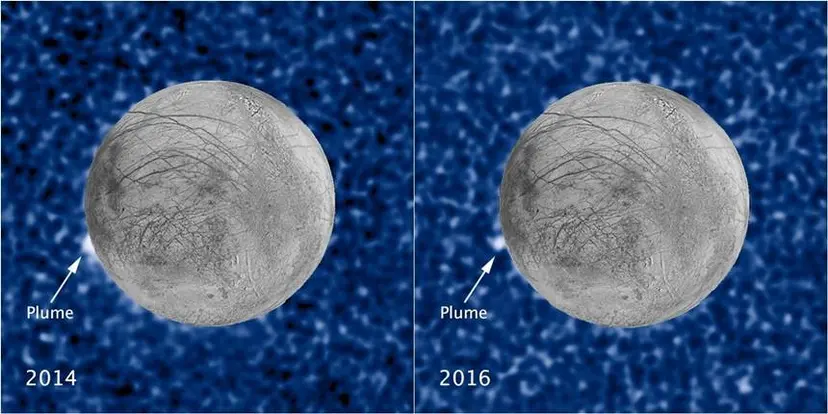
More recently, the water plumes of Europa were re-confirmed via the Hubble Space Telescope. In 2014, while Europa passed in front of Jupiter’s disk, Hubble targeted its surroundings. By comparing the light of Jupiter that traveled without passing through Europa's plumes with the light that did, they were able to compare traces of light absorbed at certain wavelengths by water molecules ejected from Europa. Through this, astronomers confirmed that a large amount of water was erupted from Europa while it crossed in front of Jupiter. Geysers are erupting on a celestial body other than Earth!
Even more recently, the James Webb Space Telescope observed Europa once again. It confirmed the presence of various molecules, including water, carbon dioxide, and methane, in the region where the plumes are thought to originate. Through successive space telescope observations, the speculation that Europa has water and even cosmic geysers erupting into space is now considered almost certain.
How can a liquid ocean exist beneath the surface of the icy, frozen moon of Europa at such a great distance? The secret lies in Jupiter's strong gravity and magnetic field.
Europa, orbiting very close to Jupiter, is subjected to its intense gravitational pull. Specifically, the side facing Jupiter and the side facing away experience slightly different distances from the planet, so the intensity of Jupiter's gravity felt by different regions of Europa varies. This difference in gravity acts on Europa as a force pulling it from both sides.
Furthermore, Europa orbits Jupiter in a highly elliptical path. Every 3.5 days, it moves closer to and then further away from Jupiter, causing the intensity of gravity it receives to change constantly. To put it interestingly, Jupiter is constantly "kneading" Europa with its powerful gravity. In the process, the interior of Europa’s ice is heated, allowing the interior beneath the icy crust to exist as an unfrozen liquid ocean.
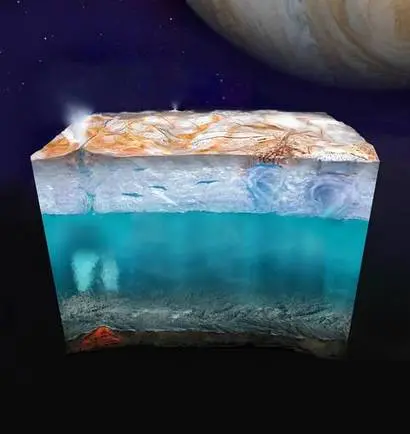
Because of this gravitational torment from Jupiter, Europa’s icy surface is left with many long, distinctive scars. The complex traces on Europa’s surface, known as "Chaos Terrain," are believed to have been created by the icy crust floating on the slightly melted subsurface ocean, colliding and cracking. Through these cracks, some of the liquid seawater hidden below erupts into space. In particular, Europa, being smaller than the Moon, also has weak gravity. This allows the water plumes leaking out from the surface to erupt violently up to hundreds of kilometers into the sky.
Although Europa itself is smaller than our Moon, interestingly, the amount of liquid water stored inside is estimated to be much greater than all the seawater on Earth combined. In fact, people often think Earth has a lot of water, but the ocean covering 70% of Earth’s surface is literally just a thin layer pooled on the surface. If you gathered all the seawater thinly spread on the surface, the amount isn't actually that large. The wettest world in the solar system, holding the most water, is no longer Earth. It is Europa.
Then, could an unknown alien deep-sea ecosystem exist in Europa's ocean? To find that answer, NASA chose Europa. Some might wonder why they chose Europa over Saturn’s Enceladus. Of course, Enceladus is also a very interesting place. However, historically, humanity has explored Jupiter and its surrounding moons more, and we know more about Europa than Enceladus. Also, Saturn is much further away than Jupiter. Since it takes more time to send a probe, Europa was chosen as the first target.
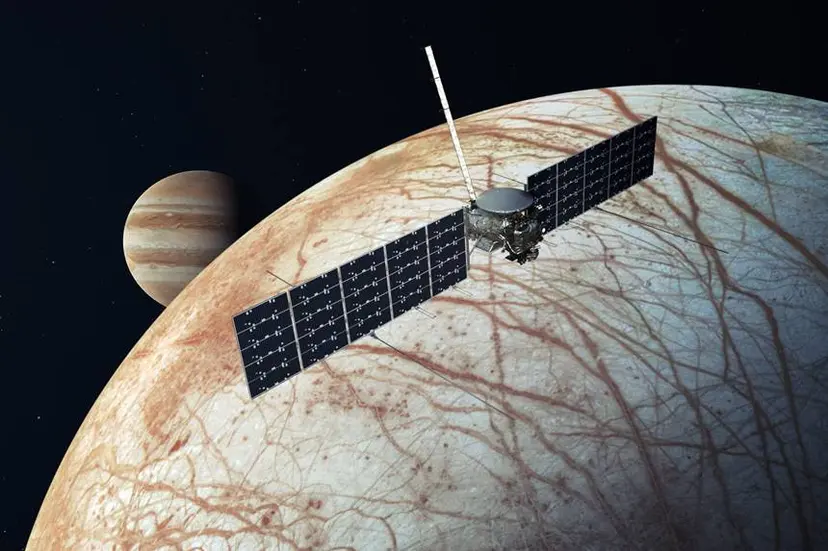
The Europa Clipper that left Earth this time will sail through space for the next five years. It will arrive at Jupiter and its surrounding moons in 2030. Europa Clipper is equipped with 10 exploration instruments to investigate Europa's subsurface ocean. First, there is a visible-light camera that takes high-resolution images. Second, an infrared camera will penetrate Europa's thick ice to understand how internal temperatures are distributed. Europa’s sea temperature will likely vary by region. By identifying which seas are warmer or colder, we can find candidates for deep-sea volcanoes where the possibility of life is relatively higher.
There are also instruments to explore Europa’s magnetic field. Just like with the previous Galileo probe and the Cassini probe that passed by Enceladus, it will determine how Europa’s magnetic field changes as it passes by Jupiter, and whether there really is a liquid ocean beneath and what its salinity level is. Europa Clipper will also detect changes in the gravitational field to determine the volume or location of the ocean beneath the icy surface. Finally, the various spectrometers on the probe will identify which chemical components are dissolved in the water every time the probe passes directly through a plume, searching for signs of biological activity.
This Europa Clipper mission can be seen as a preparatory process for future Europa explorations. Ultimately, astronomers are considering missions that would land a probe directly on Europa’s icy surface, drill through the ice, and send a deep-sea exploration robot into the subsurface ocean. NASA has already begun full-scale preparations by producing various prototypes on how to safely land a probe on Europa’s rugged icy surface. If these future missions are realized, we will be able to travel through alien oceans—not Earth's—and confirm for ourselves whether alien squids or alien plankton exist within them.
Do alien life and alien ecosystems really exist outside of Earth? We might finally be able to answer this question clearly before long. Even with just the exploration results from within our own solar system, and not even from outside it!
Who is the author, Woong-bae Ji? He loves cats and the universe. After watching "Galaxy Express 999" as a child, he dreamt of sharing the beauty of the universe. Currently, he researches evolution through galaxy interactions at the Center for Galaxy Evolution and the Near-Universe Cosmology Laboratory at Yonsei University, and engages in various science communication activities such as lectures and writing. He has authored books including "Some-tasting Observatory," "Thinking About the Universe All Day," and "Stars, the Science of Light."