

[비즈한국] There is a saying, "The value of being together." This phrase appeared in a corporate image advertisement over a decade ago. It is a brilliant catchphrase that carries the meaning that the power of togetherness can change the world. "Being together" signifies empathy or communication, and this power can create a new paradigm. Art also gains value when it earns the empathy of the people. Empathy arises from the spirit of the times and a universal artistic language. The 'Korea Art Promotion Project' also aims to showcase the thoughts of various people through an accessible artistic language. As we enter our 10th season, we are supporting artists who strive to practice Confucius's idea that "good art must be easy to understand."
The meaning of space in painting began to be clearly revealed once landscape became the subject matter. In the case of Western art, various methods of expressing space on a flat surface have been developed over the past 500 years. A prime example is the emergence of perspective.
As a result, it became possible to realistically transfer space onto a flat surface. Experts called this the "technique of optical illusion," as it is a method that makes maximum use of visual distortion effects.
It makes things look a certain way even if they are not actually so. It is the result of efforts focused on the visible world. This has established itself as the aesthetic that forms the core of painting. Thanks to this, Western art was able to make leap-and-bound progress. Therefore, the space appearing in Western landscape painting deals with the physical world unfolding before our eyes. It is, in other words, a physical space.
In contrast, the space appearing in Eastern painting, including that of Korea, did not deal with the realistic. This was natural for the East, which was more interested in the world hidden behind the visible than in the visible world itself. They strived to express the invisible world by likening it to the visible world.
If painting the visible world is an interpretation of the material realm, capturing the invisible world is the work of analyzing the spiritual realm. The spiritual realm refers to things such as emotions, reason, thoughts, memories, imagination, the unconscious, and the soul. Expressing this through visible landscapes is not easy. Because it is a staged landscape mixed with metaphors and allegories, it is difficult to gain public empathy.
Experts refer to this as 'sa-ui' (painting the meaning or intent). The space appearing in the landscape paintings that form the backbone of Eastern art is psychological or philosophical.
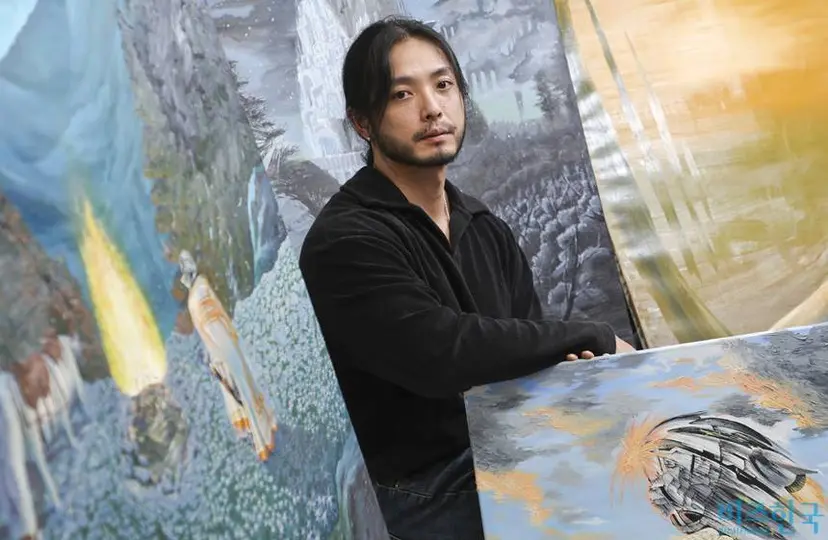
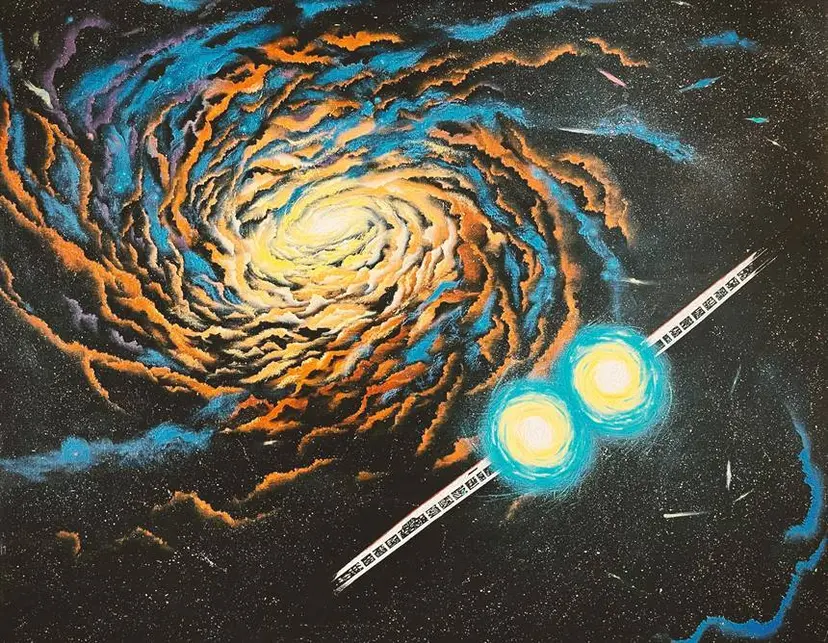
Artist Han Saem's paintings are imaginary spaces depicted as landscapes of 'sa-ui'. They are filled with fantasy, much like scenes from a game featuring medieval knights. Like a landscape from a movie such as 'Avatar,' medieval knights ride horses through fields where glowing wildflowers bloom, or castles appear from which intense light erupts through cliffs. Sometimes, an Arab knight sits by a campfire with his horse, taking a rest.
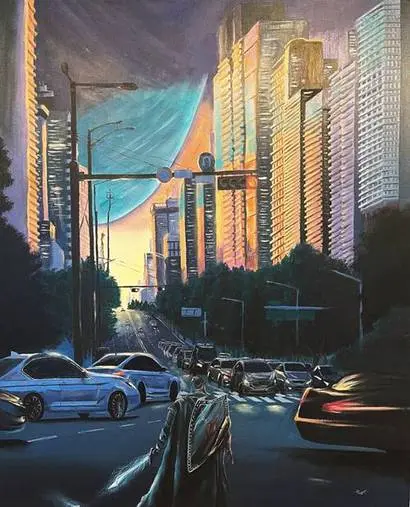
Flying objects that look like spaceships appear among moonlit clouds and fall into a forest of apartments, or mysterious figures stand in front of images that look like doors leading to other dimensions. What is the artist trying to say through these imaginary spaces?
"I think about how I want to change the absurdity and contradictions we experience in our daily lives. It is my desire to challenge them in the only way I can. That is through painting."
The fantastical atmosphere held within the lyrical landscapes or the whimsical situations of daily life are metaphors for the absurdity and contradictions the artist perceives, and the images of medieval knights or Arab warriors are the artist's desire to change them. If the situations in Han Saem's imaginary spaces were to become reality, wouldn't a better world come to be?