

[비즈한국] While the Yoon Suk-yeol administration emphasizes fiscal soundness and has been tightening its belt by reducing budget increases, critics point out that money is leaking from unexpected places. Tax exemptions (government tax expenditures), which provide financial support to households and companies through income deductions or tax credits, are increasing rapidly every year. However, it turns out that tax exemptions for high-income earners and large corporations are growing faster than the benefits provided to low-income earners or small and medium-sized enterprises (SMEs). This adds weight to criticism from some political circles that the current tax revenue shortage is a result of tax cuts for the wealthy.

The Ministry of Economy and Finance (MOEF) announced the '2024 National Tax Revenue Estimation Results' at the Government Complex Sejong on September 26. At the briefing, the ministry stated that this year’s national tax revenue is expected to be 337.7 trillion won, which is 29.6 trillion won short of the 367.3 trillion won budget. Regarding the large-scale tax deficit for two consecutive years following 2023 (a 56.4 trillion won deficit), Jeong Jeong-hoon, Deputy Minister for Tax Affairs, explained, "In an environment where external uncertainty has increased due to factors like trade dependency, estimating corporate tax is particularly difficult." He added, "The national tax revenue shortfall is due to the decline in corporate operating profits last year caused by the global complex crisis and the sluggishness of the asset market following prolonged high interest rates."
However, critics argue that the role of national tax exemptions in the tax revenue shortage cannot be ignored. This is because tax exemptions for high-income earners and large corporations have been increasing under the Yoon Suk-yeol administration. According to the MOEF, among individual national tax exemptions from 2020 to 2025 (2024 and 2025 are government projections), the growth rate of tax exemptions for high-income earners has significantly outpaced that of middle- and low-income earners. The national tax exemption amount for middle- and low-income earners grew from 23.9 trillion won in 2020 to 33.2 trillion won in 2025, an average annual growth rate of 6.8%.
In contrast, the national tax exemption amount for high-income earners saw an average annual growth rate of 10.1%, rising from 10.4 trillion won to 16.7 trillion won during the same period. This trend was mirrored in the comparison between SMEs and large corporations. For SMEs, the national tax exemption amount grew from 12.9 trillion won in 2020 to 18.9 trillion won in 2025, an average annual growth rate of 8.0%, while for medium-sized enterprises, it grew from 700 billion won to 1 trillion won, an average annual growth rate of 7.9%. However, for large corporations, the national tax exemption amount surged from 2 trillion won in 2020 to 4.9 trillion won in 2025, reaching an average annual growth rate of 37.6%. These growth rates for high-income earners and large corporations are higher than the 8.1% average annual growth rate of total national tax exemptions from 2020 to 2025.
The increase in tax exemptions for high-income earners and large corporations is a hallmark of the Yoon Suk-yeol administration. During the previous Moon Jae-in administration, tax exemption benefits were increasing for middle- and low-income earners and SMEs, but this trend has reversed under the current administration.
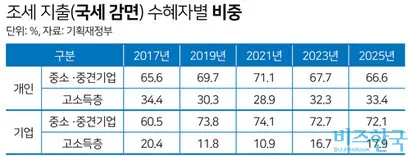
In 2017, the year the Moon Jae-in administration launched, middle- and low-income earners accounted for 65.6% of individual national tax exemptions. This figure gradually increased to 71.1% by 2021, effectively the last year of the Moon administration. Similarly, the share of benefits for SMEs increased from 60.5% in 2017 to 74.1% in 2021. Conversely, during the same period, the share of benefits for high-income earners fell from 34.4% to 28.9%, and the share for large corporations dropped from 20.4% to 10.9%.
However, the situation has reversed under the Yoon Suk-yeol administration. The share of national tax exemptions for middle- and low-income earners fell to 68.3% in 2022 and further dropped to 67.7% in 2023. This share is expected to fall to 66.8% this year and 66.6% next year. The share of benefits for SMEs also recorded 72.1% in 2022 and 72.7% in 2023—lower than in 2021—and is expected to remain at 72.1% in 2025. On the other hand, the share of benefits for high-income earners exceeded 30% again, reaching 31.7% in 2022. It subsequently recorded 32.3% in 2023, and is projected to rise to 33.2% in 2024 and 33.4% in 2025. The share for large corporations also jumped to 16.5% in 2022, recorded 16.7% in 2023, and is expected to climb to 17.9% by 2025.