

[비즈한국] Kyobo Life Insurance has established a new subsidiary dedicated to its healthcare business. The healthcare sector has been identified as a new growth engine for the insurance industry, which is grappling with existential concerns due to demographic changes. However, attention is turning to why Kyobo Life, having launched a separate company to enter the healthcare market, has decided to shut down the digital healthcare platform it had operated for the past five years.

Kyobo Life recently announced that it established a new subsidiary, 'Kyobo Dasom Care,' on October 11. The move aims to bring healthcare services, previously handled by third-party providers, under direct management. The stated business purpose of Kyobo Dasom Care includes the "maintenance and promotion of health or the prevention of diseases." Won Hyeong-gyu, an executive who previously served as the head of the New Business Research TF and CEO of Kyobo Life Asset Management (Japan), was appointed as its first CEO.
Kyobo Life has been providing healthcare services to its policyholders, such as professional health consultations, hospital guidance and appointment booking, and nurse accompaniment for hospital visits. Depending on the type of insurance plan, customers can utilize value-added services such as disease care, education care, and dementia care. A company official explained, "We determined that customer satisfaction and demand are high, so we intend to take a leading role in operations through the subsidiary, which will enhance the level and professionalism of management."
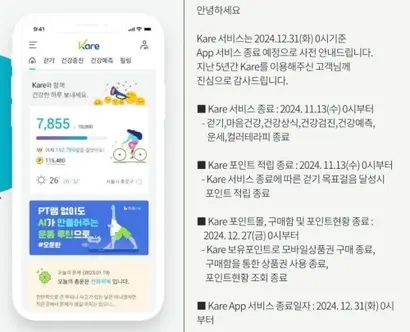
Even as Kyobo Life shifts into high gear with its healthcare business, it is simultaneously winding down the digital healthcare platform it introduced in the past. Kyobo Life recently announced that it would terminate its health management app, 'Kare.' While the official end date is December 31, most services will be discontinued starting November 13. Opened in August 2020, Kare provided health management features such as step counting, health checkup result analysis, psychological assessments, and color therapy.
Since 2021, Kyobo Life has been pushing to build platforms as part of its group-wide digital transformation (DBS) strategy. In September 2022, it launched an integrated app (Kyobo Life) that encompasses both financial and non-financial services. The integrated app includes financial services such as retirement pensions, loans, funds, and asset management in addition to insurance, and was the first in the insurance industry to introduce open banking. Kyobo Life currently operates services like the employee healthcare platform 'My Balance' and the habit-tracking app 'Haru,' and the functions of these have also been integrated into the main app.
Although Kyobo Life is discontinuing the Kare app, it appears there are no plans to build a new health management platform to replace it. This applies to the Kyobo Dasom Care platform as well. According to the company, instead of increasing the number of separate platforms, it is focusing on consolidating its scattered digital healthcare services into the integrated app.
The healthcare business is considered a new growth engine in the saturated insurance market. It allows for expansion into various new business areas and makes it relatively easy to acquire customer health-related data. For healthcare services targeted at the general public rather than just policyholders, it also serves as a channel to acquire potential customers.
In particular, life insurance companies facing survival issues are compelled to eye the healthcare business. The flagship product of life insurance companies is whole life insurance, which pays out upon the death of the policyholder; however, as society enters an era of low birth rates and an aging population, it has become difficult to attract new subscribers. This is because the younger generation, who are choosing not to have children, are not purchasing death insurance, while the rising average life expectancy has increased the demand for insurance for the chronically ill, which can be joined even by those with a history of disease or treatment.
Kyobo Life was a frontrunner in the industry in starting digital healthcare services through Kare. It was from 2021 that insurance companies began to fully dive into digital healthcare, as the government initiated deregulation to foster the industry. In December 2020, a task force composed of financial authorities and major insurance companies was formed to promote policies to revitalize healthcare in the insurance sector. The government expanded the scope of ancillary duties for insurance companies, allowing them to provide health management services to the general public. It also established legal grounds for insurance companies to own healthcare companies as subsidiaries and utilize public data from the Health Insurance Review & Assessment Service.
However, as digital healthcare platforms that sprouted up in the past are disappearing one by one, questions are being raised about market viability. Shinhan Life terminated its AI home training app 'Howfit' in September 2023. Howfit was a digital healthcare app launched in March 2021 and operated by Shinhan CubeOn, Shinhan Life's healthcare subsidiary, but it folded the service just two years and six months after its launch.
Furthermore, Shinhan CubeOn, the first healthcare subsidiary of a life insurer, struggled with deficits and eventually shifted its business direction toward nursing care, even changing its name to 'Shinhan Life Care' last January. In this context, Kyobo Life, one of the top three domestic life insurers (Samsung, Kyobo, and Hanwha Life 088350), has effectively shut down an app it operated for five years. An industry official remarked, "It seems too early to generate performance through healthcare services," adding, "There likely isn't a viable way to achieve profitability through digital platforms alone."