

[비즈한국] “Withdraw the wage cuts, benefit rollbacks, and the hastily prepared reorganization plan immediately.” On the afternoon of the 16th, at 4:00 PM, a rally was held in front of the KT030200 Gwanghwamun branch in Seoul to protest the company’s restructuring decision. Hundreds of executives from the KT Labor Union (the first union) gathered from across the country to call for the retraction of the unilateral reorganization plan. The workforce redeployment plan, which had begun as a ‘notice’ from the company, was settled shortly after through a labor-management agreement. Just 12 hours after the rally began, in the early hours of the 17th, the two sides reached an agreement adjusting compensation and workforce reduction targets for employees transferring to the new subsidiary. The settlement is interpreted as the union showing some consensus on the need for management efficiency. However, concerns remain that the potential impact on telecommunications infrastructure has not been sufficiently considered.
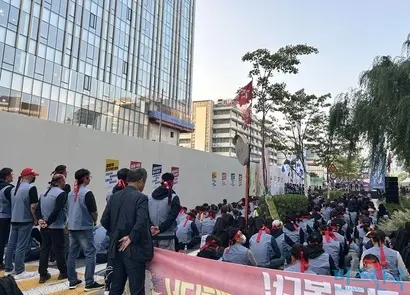
One-third of Headquarters Staff to be Restructured, a Tense '10 Days'
KT has been in chaos for ten days over a plan to "spin off subsidiaries and redeploy personnel," which would affect one-third of its entire workforce. After the company first delivered its "Human Resources Structure Innovation Plan" to the first union, the KT Labor Union, on the 8th, the union held emergency meetings daily, and a round-the-clock struggle began on the 14th. The conflict reached its peak immediately after KT’s board of directors approved the innovation plan on the 15th. On the afternoon of the 16th, a rally opposing the reorganization plan was held in front of the KT Gwanghwamun building in Seoul, with 288 executives from 235 KT Labor Union branches across the country participating.
Just one day after the union engaged in large-scale collective action, the labor-management conflict is on a path to resolution. According to KT and the union, labor and management reached a consensus on the 17th regarding the establishment of a network subsidiary and the workforce restructuring plan, agreeing to proceed with the redeployment plan. This came after Kim In-kwan, Chairman of the KT Labor Union, met with KT CEO Kim Young-shub the previous day and conveyed that employees must be treated accordingly so they can freely choose whether to transfer; KT accepted this, agreeing to modify some of the existing plans. Compared to the company's initial proposal, special early retirement packages and subsidies for those transferring to the subsidiary were increased, and working conditions for contract workers were improved.
According to a previously leaked internal KT document titled "On-Site Workforce Structure Innovation Plan," the target for personnel adjustment is 5,750 employees in the headquarters' network management division. This scale amounts to 30% of all KT employees. KT pushed for a plan to establish two new subsidiaries: KT OSP, which handles telecommunications line facility design, related construction, and customer transmission work; and KTP&M, which manages power facility design, maintenance, and maritime wireless communication operations, and then transfer headquarters staff to these entities. The plan involves moving 3,400 and 380 employees respectively from the headquarters, while the remaining 1,900 who are not targeted for the new entities would either be transferred to other roles within the group or take early retirement.
The agreement removed the specific numerical targets for subsidiary transfers or early retirements. It was also agreed that the career transition subsidy for those with over 10 years of service transferring to a subsidiary would be increased from 20% to 30% of the headquarters base salary, in addition to the existing 70%. Benefits for those transferring will be maintained at the headquarters level, and the guaranteed employment period for contract workers was extended from 2 years to 3 years. The special early retirement compensation will be increased by up to 100 million won more than originally planned.
KT explained, "This is part of our workforce structure innovation to transition into an AICT (AI + ICT) company, aimed at streamlining on-site work through the establishment of specialized field companies," adding that "the decision-making system for the new entities will be more efficient, allowing for flexible and swift task performance optimized for on-site conditions."
Background of Criticism Over “Hasty Agreement” and Weakened “Communication Stability”
However, some are criticizing the union for compromising with the company less than a day after holding a protest rally against the unilateral reorganization plan. The KT New Union and members of the KT National Democratic Comrades Association, composed of those opposing the current KT Labor Union leadership, have voiced unanimous opposition to this agreement. The second union, the KT New Union, issued a statement saying, "We strongly condemn the hasty labor-management agreement on the restructuring plan," while the KT Democratic Comrades Association criticized it, stating, "They signed an agreement that does not change the core of the restructuring at all. It is only a 'progressed' agreement in that they will pay in full what they previously claimed they would only partially pay as the difference from the previous annual salary based on remaining retirement age, and maintain current benefit levels to match KT's."
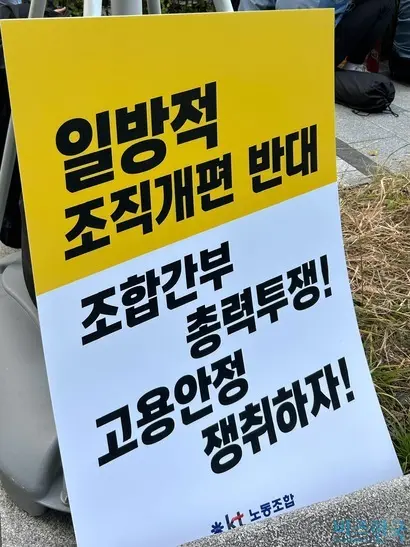
At the rally on the 16th, the two minority unions pressured KT Labor Union Chairman Kim In-kwan, who had stated, "I will stake my chairmanship on stopping this restructuring, just like in 2003, 2009, and 2014," by shouting slogans such as "Keep your promise." With past distrust between labor and management, as well as within the unions, resurfacing, internal strife is expected to continue for the time being, as the KT New Union announced it will begin a hunger strike in front of the KT Gwanghwamun building starting on the 21st.
Concerns are also being raised about the impact of the restructuring on telecommunications infrastructure. While the issue of employee compensation has been settled, the problem regarding the stability of network operations remains. As Kim Jun-hyun, head of the KT Labor Union’s Gangbuk Regional Headquarters, remarked at the rally, "The line and power sectors are the bedrock of KT. I have never handled telecommunications without these sectors." These concerns are a common critique. The tasks targeted for reorganization are closely related to core telecommunications functions, such as installing and maintaining communication networks. Their profitability is low compared to costs. An industry official said, "These are not tasks that should be spun off so easily. There is criticism that internal reviews on the impact on telecommunications were not sufficiently conducted."
The KT New Union argues that based on the 2014 restructuring case, this "outsourcing" of the network sector will lead to inefficient results. The restructuring under former KT Chairman Hwang Chang-gyu focused on outsourcing field sales, activation, after-sales (AS) services, and branch sales window operations to seven subsidiaries, including KT M&S, KTIS, and KTCS. An official from the KT New Union stated, "After internet modem and TV installation work was converted to a subsidiary system, wages and subcontracting unit prices dropped, leading to increased workloads per employee and causing issues with smooth service. Because these are outsourced tasks, in principle, headquarters staff shouldn't handle them, but ultimately, KT employees have to go and handle them anyway. Limitations in service quality also persist." As of the end of 2015, the salary gap between these subsidiaries and KT headquarters staff was more than three times.

Political circles are also paying close attention to this matter. It is expected that questions will be raised regarding KT CEO Kim Young-shub, who is scheduled to attend the comprehensive audit by the Ministry of Science and ICT on the 25th. Representative Lee Hoon-ki of the Democratic Party of Korea emphasized, "Following the Ahyeon-dong fire incident, we have been supplementing and building infrastructure to respond to potential crises. If this plan cannot be stopped, we will face another telecommunications disaster."
Having completed discussions with the bargaining representative, the 1st Union, KT will receive applications for those wishing to transfer to the new entities and group companies in two rounds, from the 21st-24th and 25th-28th. Applications for special early retirement will be accepted from the 22nd to the 4th of next month. A KT representative stated, "Investment in the network sector will not be reduced and will be maintained. It is our natural duty as a telecommunications company, and we will make our best efforts to dispel concerns."