

[비즈한국] Gone are the days when space was viewed merely as a physical object. Today, space is a platform where consumers experience a brand and a communication channel through which companies can form emotional bonds with their consumers. The pop-up stores appearing throughout the city are prime examples of designs that embody brand values. Speaking as a presenter at the Brand Biz Conference 2024 on the 17th, Jung Yeon-jin, CEO of Collective B, emphasized that in spatial design, "the message that the space intends to convey must reach the user."

Jung Yeon-jin, CEO of Collective B, co-founded the space branding firm Urbantainer in 2009, served as its creative director, and later established the spatial design consulting firm Collective B in 2018. CEO Jung has led various spatial design and branding projects, including Episode’s ‘Suyu 838’, the club ‘Octagon’, Common Ground, and the Naver035420 pop-up store.
CEO Jung describes spatial design as "interpretation." She introduces her work by saying, "I handle all experiences occurring at the touchpoint between the brand and the user through design thinking," adding, "We don't just approach space from a design perspective; we play the role of an interpreter, delivering the essence of the brand to the user."
One of the projects that reflects CEO Jung’s philosophy is the club Octagon. "Based on experience, I focused on two main points in the design," she explained. "First is the sound. Aiming for the 'opera house' of the club scene, we invested three months just into sound design. Second is the differentiation of food. We introduced an open kitchen for the first time in a club, raising the level of food compared to standard clubs."
Even so, she says, "In 20 years, nothing has ever gone exactly as planned." She notes that numerous clients have their own set of needs, but it is impossible to get them all on the same boat. CEO Jung pointed out that setting needs with a "supplier mindset" is the problem. "Demands like 'I want to target Gen Z' or 'Make it an Instagrammable space' lack essential 'why' or 'how' reasons. These are needs that exclude the user," she noted.
According to her, a space is like a living organism. It consists of the business owner who holds the rights, the operator who manages the space, and the content which acts as the software. The purpose of spatial design is for these three entities to deliver the brand's message and experiential programs to users through the medium of space.
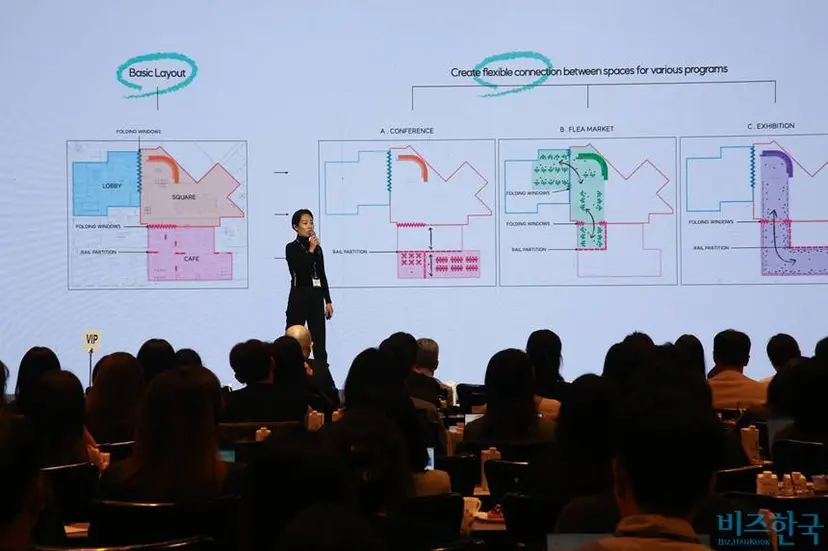
Episode Suyu 838 was created with a rigorous focus on the 'user.' Episode is SK D&D's co-living brand, which creates single-person residential spaces with community elements. Tenants have their own rooms while sharing common spaces and community facilities. Collective B designed Suyu 838 with three goals: 'conveying brand value,' 'connecting people,' and 'flexible space.' The user was defined as 'a bold individual who invests time and money into community and space rather than just saving on rent.'
To convey brand value, recycled panels and furniture were used, and to facilitate user connection, movable partitions were used to eliminate fixed purposes for common areas. This allows users to reconfigure spaces according to their needs at any time. It wasn't just about the tenants; the laundry room, delivery storage, and waste disposal areas—essential spaces in residential facilities—were built with 'operational staff' as the primary users. For example, the delivery storage room was designed without door thresholds for easy transport, and a separate space was provided in the laundry room to store lost items. This user-centric design was well-received. Suyu 838 reached a 90% occupancy rate and achieved encouraging results, winning five design awards.
This philosophy is also evident in exhibition spaces. Collective B showcased a new product and the brand's history at an Adidas store. However, while displaying 130 pairs of shoes, they focused on ensuring the message resonated with the users (visitors). The users were defined as 'the public with a high desire for cultural experience,' and shoes were used as a communication tool. The shoes were displayed year by year; products released in the 90s were placed near old CRT TVs, while palmsized, state-of-the-art beam projectors were installed around new products. Lighting and screens were used to naturally distinguish between the past and the present.
CEO Jung emphasized that pop-up stores, which are popping up everywhere, need to consider their purpose. "You must set your purpose accurately. You need to set priorities among increasing visitor numbers, recording maximum sales, or enhancing brand awareness," she advised. "I feel many brands create stimulation just for the sake of stimulation. But I hope brands consider if those stimulating elements are truly necessary. There is no space that can achieve every single objective."
She concluded her lecture by quoting Professor John Heskett: "Design is to design the design that creates the design." She added, "Spatial design is not just a task of deciding which finishing materials to use. I believe it is about conveying the brand's message to users through a 'unified language' called space."