

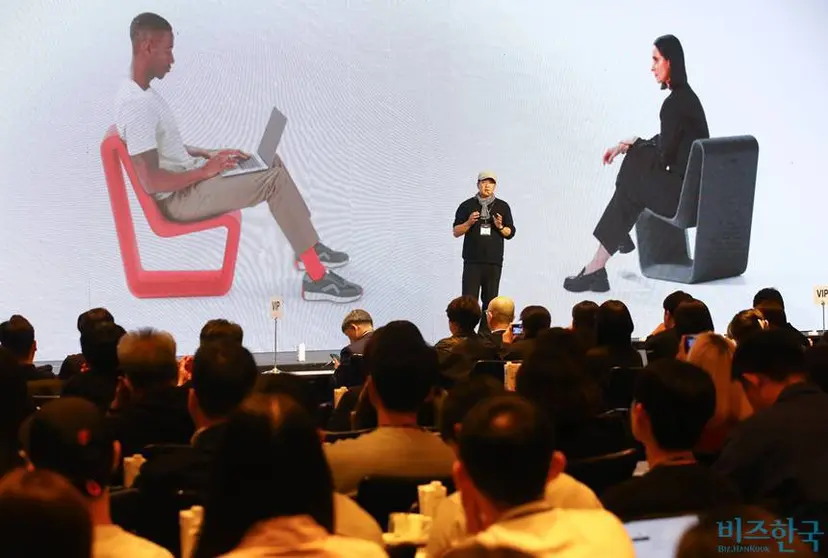
[비즈한국] As the first speaker at the ‘Brand Biz Conference 2024,’ Song Bong-kyu, CEO of BKID, defined how objects acquire brand identity under the theme, ‘From Object to Brand, Material to System, and Craft to Technology.’

CEO Song shared his insights on industrial design gathered over a decade of running his studio. “I am constantly contemplating how to expand industrial design, which is fundamentally about the practical use of objects, into brand identity,” he said. He emphasized, “Driving brand differentiation through the selection and combination of materials and design engineering, and shifting from a craft-based approach to technical innovation, can serve as key factors in shaping brand identity.”
As a case study, he cited a public chair project created in collaboration with the Seoul Metropolitan Government. Designed for use in Seoul’s green spaces for a specific duration, the chairs were made using EPP (Expanded Polypropylene). The public chairs were designed in three variations: Sit, Lean, and Lean Low. This design was tailored to the characteristics of Seoul, where the experience of strolling through a park along the Han River contrasts with the urban landscape of skyscrapers. “Because these chairs are for temporary use, we chose a lightweight, stackable form, while also considering the recyclability that comes with using a single material,” Song explained.
Song noted that this public chair, which combines the inherent beauty of materials with the unique characteristics of Seoul, serves as an example of branding identity that delivers new value to users, including the citizens of Seoul.
CEO Song also expressed his efforts to incorporate cultural attributes into brand identity. A subject he has been approaching from a cultural perspective recently is the ‘plate.’ “Korean plates are smaller in shape compared to those in other countries. In foreign countries, food is served on large plates and shared, whereas in Korea, we serve a variety of foods on many small plates,” Song explained. “It seems this culture is imbued in our plates because Korean characteristics encompass traits like ‘neatness’.”
Using this characteristic, he is currently working on branding tableware designs for the Italian brand ALESSI and Korean Air003490. “By creating several small compartments on plates sized to fit the limited space of an airplane tray table, I aimed to combine efficient space utilization with Korean culture,” he said.
He also noted that he pays attention to the fact that everyday items like cans, plastic bottles, and paper cups share similar dimensions. “Upon noticing that the diameter of cans and plastic bottles is universally 82mm, I realized that this is the ideal diameter for a human hand to hold comfortably. I am working on applying this rule more broadly throughout daily life, as I continue to explore branding by approaching everyday objects in various ways,” he added.