

[비즈한국] It is more burdensome to talk about the "guns" I've actually fired in the military than about the latest precision weapons costing tens of billions of won. Unlike high-tech precision weaponry, it is extremely difficult to explain the superiority or compare the pros and cons of firearms. Which gun is better depends on the situation and conditions, and even the most mediocre gun can become a powerful combat tool in the hands of a marksman.
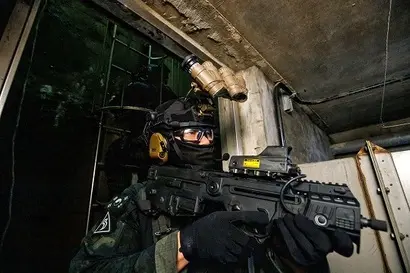
Comparing the performance of automatic rifles or submachine guns used in modern warfare should be based on criteria such as accuracy, reliability, convenience, and expandability, but even then, there is no single "correct" answer. Yet, South Korea, which prides itself on "K-Defense" as a powerhouse in the defense industry, is uniquely suffering from mistakes and failures in personal firearms. The special operations submachine gun program is plagued by problems whether the weapons are imported from abroad or produced domestically.
The first news involved the Israeli-made "X95" submachine gun. According to information raised by Rep. Park Sun-won of the Democratic Party of Korea during the recent National Assembly audit of the Joint Chiefs of Staff, the special forces conducted test evaluations for counter-terrorism operations and adopted the weapon despite defects—such as ejected shell casings getting blocked by gas mask canisters when fired while wearing a mask, or accessory cables getting snagged on personal gear.
Domestic weapons are also facing issues. According to the office of Rep. Choo Mi-ae of the Democratic Party, another submachine gun for special operations, the "K-13," is also problematic. An accident occurred during training where a gun exploded in the chamber, leading the manufacturer to recall the deployed weapons. Although they were re-deployed after corrections, issues with overheating and jamming during suppressor-equipped firing still persist.
Why is this happening? First, I will explain the causes by distinguishing between domestic and imported weapons.
In the case of imported weapons, the South Korean military is at a disadvantage. While the ROK military is among the top 10 in the world in terms of size and equipment, its scale of firearm imports is smaller than that of many European or smaller nations with significantly smaller militaries. Since hundreds of thousands of our primary rifle, the K-2, have already been produced, we only import small quantities of rifles and submachine guns for special units that require precision and specialized features, which significantly weakens our "purchasing power."
Because of this low purchasing power, overseas manufacturers have little interest in our special warfare weapon programs. Prices are high, and maintenance and repair parts are slow to arrive, making it difficult to fix broken firearms. Even weapons famous for their role in operations like "Dawn of the Gulf of Aden" and the killing of Osama bin Laden have faced difficulties due to a lack of spare parts and poor after-sales service.
Furthermore, since the scale of firearm import programs is small, the companies selling special warfare weapons to our military are often small-scale. They lack the administrative capacity to properly handle requests for modifications or fixes, which exacerbates the problem. Conversely, domestically developed firearms have the advantage of faster supply of parts and modifications. Since domestic gun manufacturers struggle to export, they have no revenue outside of the Korean military's orders, so they do their best to fix and improve problems.
The issue is that due to a lack of export records, they don't get feedback from overseas users to modify the weapons before supplying them to our military; instead, our military discovers the problems, and then modifications are made. While equivalent overseas firearms are sold in the tens of thousands and modified based on thousands of reviews and feedback, we only get feedback from the few hundred guns used by our military, resulting in slow improvement and a low capacity for "bug fixing."
There are also loopholes in the system. To eradicate corruption in the defense industry, military officers of the rank of Lieutenant Colonel or higher who have worked on acquisition-related tasks at agencies like the Defense Acquisition Program Administration (DAPA) are restricted from re-employment in related industries after their discharge. However, Majors who handle the actual working-level tasks are not subject to such restrictions. In the case of the Israeli X95 submachine gun, it was confirmed that the Army Major who handled the working-level operations was hired by the X95 importer after leaving the service.
The problem is that these incidents are not merely individual deviations or crimes but are caused by structural problems and a lack of resources. For example, it is claimed that the importer, lacking expertise, suggested the "bullpup" style of firearm, which is currently being shunned for rifles and submachine guns; however, this is a misguided critique. No illegal activities by the importer have been uncovered to date, and they didn't exclusively import bullpup weapons. Rather, to meet the military's demand for rapid deployment, they chose from among available guns the one that could be delivered the fastest, which happened to be a bullpup submachine gun.
Domestic manufacturers are not causing defects to line their own pockets either. It is easy to identify and correct problems with a gun only if it is tested for a long time in various environments and situations. However, domestic weapons are difficult to verify, and there is no leeway in the budget and schedule required for thorough testing, making it difficult to correct issues with submachine guns.
Therefore, to fundamentally resolve the current "special warfare submachine gun crisis," we must accurately diagnose the problems in the current system, budget, and schedule, and devise policy-based solutions rather than just investigating involved individuals from a perspective of defense corruption.
The first solution is to close loopholes in project management as soon as possible, leaving no room for corruption. The purpose of restricting re-employment for military personnel is to ensure the fairness of projects. As it stands now, with restrictions only on Lieutenant Colonels and above, it will not prevent working-level staff from joining related companies, leading to even bigger problems. There was once an attempt to limit the re-employment of retired Majors in similar industries, but it did not go through. It is necessary to expand the rank threshold for employment restrictions to include Majors across the Ministry of National Defense, the Joint Chiefs of Staff, the service headquarters, and DAPA.
The second solution is to change the acquisition method for imported firearms to "Test first, select bidders later." Unlike the current system, a new organization should be established within the Ministry of National Defense to analyze and evaluate domestic and foreign firearms, purchase small quantities of weapons appearing on overseas civilian markets (like the US), and continuously evaluate them. When a project arises, we should identify the candidates ourselves and then designate a supplier for the chosen gun. While this has the disadvantage of increasing the size of the project management organization, it has the benefits of removing unrealistic elements from ROC (Required Operational Capability), discovering accurate evaluation criteria, and accumulating technical information on personal firearms. I believe this will be as effective as the cost invested.
The final solution is to introduce the concept of "lifecycle-long continuous performance improvement" for domestic R&D firearms. The K2 rifle, the ROK military's main rifle, was used without improvement from 1984 until 2015. It was only in 2015 that the improved K2C1 was produced. Because we acquire rifles the same way we do tanks or fighter jets—which take nearly 10 years to improve performance—it takes a long time to modify even a completely new rifle like the K13.
In the future, acquisition systems for personal firearms like rifles and submachine guns should be improved to allow for year-by-year upgrades and improvements based on the concept of continuous performance enhancement throughout their lifecycle. Manufacturers must also move away from mass production of a single specification and develop the ability to adapt to rapid specification changes. Instead of just criticizing companies for producing defective products, we should provide R&D funding for improvements even after development is complete so that they can consistently fix issues, which will enable our personal firearms to reach world-class performance levels.
While boasting about the achievements of K-Defense, it is frankly disappointing that the special warfare submachine guns, which are core assets for frontline troops, have such problems. This is not only a technical issue of the Korean defense industry but also a result of choosing the easy path of buying a new model whenever a problem arises, instead of fixing or improving the guns we import. Both the domestic R&D and overseas acquisition systems for personal firearms, as well as the employment restriction system to prevent project corruption, must be improved.