

[비즈한국] Astronomers use various methods to measure distances to distant galaxies. If we can determine the actual brightness of a celestial object through known astrophysical characteristics—regardless of distance—and trust those findings, we can use that object as a "standard candle" to calculate distance. However, there is a significant and inherent problem here: the applicable range of distance varies depending on the measurement method.
Cepheid variable stars, which are ordinary stars that periodically expand and contract, causing their brightness to fluctuate at regular intervals, are just stars. They are not very bright. Therefore, once an object is too far away, it is nearly impossible to isolate and observe individual Cepheid variables within a galaxy. As a result, Cepheid variables are only useful for measuring distances reliably up to a few tens of millions of light-years.
Beyond that distance, we need new, brighter standard candles that can be seen from further away. Type Ia supernovae are one such example. Although it is merely the explosion of a single star, its flash is incredibly bright, appearing almost as luminous as an entire galaxy containing hundreds of billions of stars. Thanks to this, Type Ia supernovae can be used to measure distances to galaxies billions of light-years away. Naturally, as the range increases, the margin of error also grows.
Usually, when the "cosmic distance ladder" is taught in school, this is where the discussion stops. But in actual astronomy, the methods used to measure distance are incredibly diverse. It reveals the immense efforts astronomers have put into determining the intrinsic brightness of celestial bodies when their distances are unknown. Seeing how these complexly intertwined measurement methods relate to one another, one might wonder if "cosmic web" is a more appropriate term than a simple, linear "distance ladder."
The distance ladder has been one of the fundamental philosophies of astronomy since the late 20th century, serving as the basis for measuring the scale of the distant universe. However, with the James Webb Space Telescope (JWST) recently observing various galaxies with unprecedented clarity, this ladder is beginning to crack. This is precisely where the sparks of a new 21st-century version of the great astronomical debate (introduced in the previous column) are igniting.
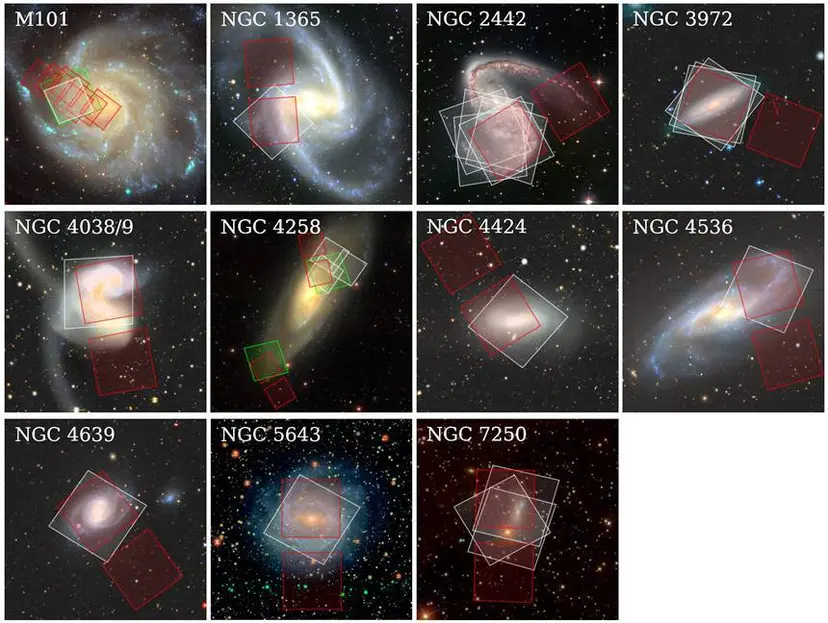
Astronomer Wendy Freedman of the University of Chicago wanted to verify more systematically and objectively whether there were problems with the distances to the galaxies we are measuring. First, she selected 10 galaxies observed by the JWST. These galaxies contain various standard candles, including Cepheid variables, and all of them also host Type Ia supernovae. Thus, based on the analysis results, she could verify the validity of the methodology used to calculate distances to more remote galaxies using Type Ia supernovae.
In this study, Freedman's team utilized two primary standard candles in addition to Cepheid variables. One is the TRGB (Tip of the Red Giant Branch) method. If you resolve all the stars within a galaxy one by one, you can determine the brightness and temperature of each. These can be represented on a single graph. Just like a color-magnitude diagram that shows how the brightness and temperature of stars in a cluster are distributed, a galaxy can be plotted in the same way.
There are several interesting features in a galaxy's color-magnitude diagram, one of which is the Red Giant Branch. Red giants are a stage where stars evolve, expand significantly, and cool down. As the star continues to expand, its temperature gradually drops. However, because the star itself becomes so bloated, its brightness increases. Yet, a red giant cannot get bright indefinitely. Eventually, the bloated star cannot sustain the limit and sheds its outer shell.
Interestingly, the limit at which red giants remain most stable is known to be fixed. In other words, the brightness of the brightest red giant visible in a star cluster or galaxy can be considered roughly similar. When plotting the stars in a cluster or galaxy, one can see the Red Giant Branch where stars are distributed vertically at the far right end. Astronomers estimate that the maximum brightness at the very top of that branch is constant. The brightest red giant at the tip of the Red Giant Branch acts as a sort of standard candle. This method is called the TRGB method.
Another standard candle used in this study is the J-AGB (J-region Asymptotic Giant Branch) star. These stars have accumulated a large amount of carbon over a long period of nuclear fusion. Looking at the chemical composition, the carbon content is higher than oxygen. That is why they are also called carbon stars. Because of their chemical characteristics, carbon stars shine particularly brightly in the near-infrared region, which has longer wavelengths than visible light. Since they are very bright, it is not difficult to capture them even if they are in distant galaxies.
Although the brightness of carbon stars is not perfectly uniform, looking at the brightness distribution of observed carbon stars, they form a fairly clean normal distribution based on a specific average brightness. Therefore, astronomers sometimes use carbon stars as a secondary standard candle to infer actual brightness, accounting for minor statistical errors. Carbon stars are particularly advantageous for JWST observations because it is a telescope designed to observe in the near-infrared range.
Freedman divided the research team into three, based on the three standard candles: Cepheid variables, TRGB, and carbon stars. She instructed each team to pick one standard candle and calculate the distances to the 10 galaxies anew. Interestingly, Freedman managed the teams strictly to ensure no information sharing. To ensure a fair comparison, a kind of "blind test" was conducted where researchers could not see each other's progress until the final results were unveiled. The teams finished their calculations and gathered to reveal their results. The findings were quite fascinating.
The result for the expansion rate of the universe based solely on Cepheid variables was 72.5 km/s/Mpc. This result is similar to the universe's expansion rate estimated from the recession of galaxies for a long time. On the other hand, the results measured by the other two standard candles are significantly different. The result from TRGB was 69.85 km/s/Mpc, and the result from carbon stars (J-AGB) was 67.96 km/s/Mpc. The average of all three values is approximately 69.96±2 km/s/Mpc.
What is interesting is that the results calculated from TRGB and carbon stars—not Cepheid variables—fit perfectly with the universe's expansion rate of 69 km/s/Mpc, which is estimated from cosmic microwave background observations!
Initially, the mystery of the "Hubble Tension" became controversial because of the discrepancy between the expansion rate derived from the cosmic microwave background and the rate calculated by comparing the distances and recession velocities of galaxies. However, as Freedman's research shows, if one uses the distances of galaxies calculated from the two standard candles other than Cepheid variables—TRGB and carbon stars—the Hubble Tension neatly disappears! Whether estimated using galaxies or cosmic microwave background observations, the expansion rate of the universe comes out to around 69 km/s/Mpc. The value only jumps when we infer the distance to galaxies using Cepheid variables.
To put it simply, depending on which standard candle is used to calculate the distance to the same galaxy, the distance obtained varies slightly. Isn't that truly baffling? Why on earth does such a problem arise?
Regarding this, Freedman raised the possibility that there might be some problems with the distance measurement method using Cepheid variables. If there are many dust clouds surrounding the variable star that block starlight, it can have a significant impact on the observed brightness. Also, if too many Cepheid variables are clustered together, two or three stars might be observed as a single blurred entity, and there is also a risk that the brightness or temperature of the star could change depending on its metallicity (the content of heavy elements). She explained that by accepting Cepheid variables as overly convenient standard candles without considering such detailed stellar physics, large errors could occur in the distances to galaxies we have inferred.
Freedman's challenge needs to be taken quite seriously. In the distance ladder that allows us to measure the scale of the universe step by step, Cepheid variables effectively hold an overwhelming status that corresponds to almost the very first step. If there is a non-negligible problem with the methodology of using Cepheid variables to calculate distances, then the calibrations of other measurement methods built upon them must also be adjusted more carefully.
However, as soon as Freedman's paper was published, astronomer Adam Riess of Johns Hopkins University immediately raised a rebuttal. He is one of the three physicists who won the Nobel Prize in Physics for discovering the accelerated expansion of the universe through Type Ia supernova observations. Currently, he leads the SHOES (Supernovae and H0 for the Dark Energy Equation of State) project, which aims to more precisely determine the expansion rate of the universe by observing more galaxies and supernovae.
Riess raised the issue that Freedman was over-interpreting the results derived from comparing only 10 galaxies. For example, he claimed that if one gathers more data and analyzes the results up to the 42 galaxies his team observed with the Hubble Space Telescope, the results obtained using Cepheid variables would not be significantly different from those obtained using other standard candles.

On the other hand, Freedman issued a rebuttal to Adam Riess's counter-argument, explaining that their team had analyzed only the 10 galaxies that were successfully observed by both the JWST to ensure a statistically fair comparison. However, Riess then issued a counter-rebuttal, providing evidence that his own SHOES team had previously confirmed that the galactic distances calculated using Cepheid variables and TRGB were in agreement.
The debate between Freedman and Riess is even more confusing than the classic Hubble Tension that sparked this study. This is because the two research teams are making completely different claims based on the same data observed by the same telescope.
If Freedman's claim is true, the mystery of the Hubble Tension that has plagued astronomers could be solved much more simply than expected. There is no need for a massive change in physics that shakes the foundations of dark matter and dark energy. It was simply that the distance to the galaxies measured by Cepheid variables had some errors, which is why it didn't match the expansion rate estimated from the cosmic microwave background. But this actually brings up an even more difficult dilemma: it creates the problem of having to recalibrate the distances to all the galaxies measured by Cepheid variables thus far.
Conversely, if Riess's claim is true, the Hubble Tension will ultimately remain unsolved. The frustrating situation will continue without any real change. However, fortunately, we can rest assured that there were no major problems with the distances to galaxies calculated using Cepheid variables. We can continue to measure the scale of the universe and adjust the rungs of the distance ladder as we have done in the past.
A situation where two specific astronomers are at the forefront, fiercely exchanging papers and responses. Whose imagination of our universe will prove closer to reality? How will this new 21st-century great debate, which is unfolding even more intensely than in the 20th century, come to a conclusion?
References
https://ui.adsabs.harvard.edu/abs/2024arXiv240806153F/abstract
https://ui.adsabs.harvard.edu/abs/2024arXiv240803474L/abstract
https://ui.adsabs.harvard.edu/abs/2024arXiv240800065L/abstract
https://iopscience.iop.org/article/10.3847/1538-4357/ad2e0a
https://iopscience.iop.org/article/10.3847/2041-8213/ad1ddd
https://www.quantamagazine.org/the-webb-telescope-further-deepens-the-biggest-controversy-in-cosmology-20240813/
Who is the author, Woong-bae Ji? He loves cats and the universe. After watching "Galaxy Express 999" as a child, he dreamed of sharing the beauty of the universe. Currently, he researches galaxy evolution through galaxy interactions at the Yonsei University Galaxy Evolution Research Center and the Near-Field Cosmology Laboratory, while engaging in various science communication activities such as lecturing and writing. He has authored books including "Observatory for Thumb-teasers," "Thinking About the Universe All Day," and "Stars, the Science of Light."