

[비즈한국] The conflict between the industrial and labor sectors over 'special employment' workers—who work like regular employees while being legally excluded from labor laws—is intensifying in the home appliance rental industry. It has surfaced most prominently at Coway021240, the industry leader. Recently, over 2,600 "Cody" and "Kodoc" staff filed a lawsuit against the company to confirm their status as employees, and the labor union is now set to testify regarding minimum wage application at the upcoming parliamentary audit. Meanwhile, in the United States, the Department of Labor has filed a lawsuit against the local subsidiary over the failure to pay overtime wages for travel time and mandatory training. Risks surrounding personnel management practices are escalating both domestically and internationally.

Are the treatments of 'special employment' Cody and Kodoc appropriate? Facing legal scrutiny at home and abroad
Home appliance rental visiting service personnel, who periodically visit customer homes to manage products, are special-type labor workers who receive commissions per job. Instead of a standard employment contract, they maintain an agency relationship with the company as 'individual business owners.' Their income consists of the sum of commissions set for each inspection task rather than a salary including a base pay. Because their income fluctuates based on performance, they are not covered by the four major social insurance plans or the minimum wage system.
On the other hand, they possess characteristics of wage workers in that they receive work instructions from the company. Their operational procedures are codified into manuals, and they undergo detailed performance evaluations, including sales records. While it varies by company, they attend weekly meetings, and are supervised and controlled by regional office managers who have the authority to distribute work under a management structure connecting the headquarters, regional offices, and branch offices.
Movements to crack the long-standing employment and wage systems in the appliance rental industry are expanding. Since the formation of visiting service personnel unions at major companies like Coway, SK Magic, and LG Electronics066570 HiCare Solution, demands for improved treatment have been intensifying. Among them, discussions are becoming full-scale, led by Coway, which has the largest number of visiting service personnel.
In particular, Coway is currently facing a domestic lawsuit filed by visiting service personnel for unpaid weekly holiday and annual leave allowances, and has been sued by the U.S. Department of Labor regarding unpaid overtime wages at its U.S. subsidiary.
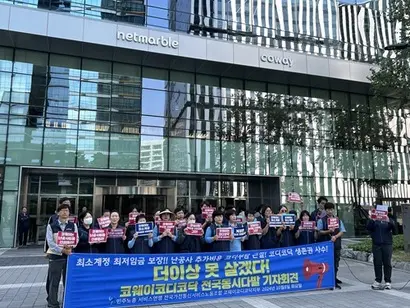
At the end of last August, 2,663 Coway Cody (Coway Lady) and Kodoc (Coway Doctor) staff filed a lawsuit against Coway to claim weekly holiday and annual leave allowances. Since these allowances are rights granted only to workers under the Labor Standards Act, the core of the lawsuit rests on whether their status as "workers" is recognized under the Labor Standards Act. While Coway's Cody and Kodoc were recognized as workers under the Trade Union Act following a Seoul Administrative Court ruling last year, they were not recognized as workers under the Labor Standards Act. According to the legal community, if their status as workers is recognized, it could potentially expand to lawsuits over severance pay. Kim Sun-ok, head of the Coway Cody/Kodoc branch of the Home Appliance Communication Service Labor Union, said, "We decided that ensuring our legal status is necessary to fundamentally improve the treatment of visiting service personnel, so we gathered a group of plaintiffs and filed the lawsuit."
Coway explained that it has been complying with the agreements reached with the labor union based on a 2012 Supreme Court ruling that judged Cody and Kodoc not to be workers under the Labor Standards Act. A Coway official stated, "As confirmed multiple times by the Supreme Court, they are direct sales workers (freelance income earners) who receive commissions for sales and inspections of entrusted work, so the same systems or standards as regular employees do not apply. We are faithfully following the court's judgment and will strive to prepare win-win plans with our visiting service personnel."
Sued by U.S. Labor Department: Will the verdict impact South Korea?
Coway, which is expanding its reach globally to the U.S., Thailand, Indonesia, and Vietnam, recently faced a setback with its U.S. subsidiary being sued by the U.S. Department of Labor. On the 24th of last month (local time), the U.S. Department of Labor announced it had sued Coway USA for violating the Fair Labor Standards Act (FLSA), alleging that the company failed to pay overtime wages to over 180 employees. Coway USA is a subsidiary based in California, and the case was filed with the U.S. District Court for the Central District of California.
The U.S. Department of Labor determined that Coway manipulated working hours and intentionally reduced wages, seeking hundreds of thousands of dollars in unpaid overtime wages and an equivalent amount in damages. It also stated that employees were not properly compensated for time spent on customer calls, driving time while carrying products, and time spent on inventory pickup and mandatory training.
This appears to have come to light as the U.S. Department of Labor conducted investigations to grasp the reality of working conditions at Coway USA, while LA-area Cody staff, who are considered "independent contractors" in the U.S., were in the process of forming a local union over the past two years. Coway drew a line, stating that the allegations of work record tampering and non-payment of overtime at its U.S. subsidiary are untrue. A Coway official stated, "The company has been paying overtime based on work records created through the staff's own confirmation process of their actual working hours. We are already in discussions with the U.S. Department of Labor to establish reasonable overtime standards without disagreement, and we are doing our best to reach a prompt settlement with a strong will to resolve the issue."
Although not directly related to domestic personnel, if compensation obligations are established at an overseas subsidiary for tasks that were previously taken for granted as unpaid, it could potentially be cited as grounds for demands for improved treatment in Korea. The labor union, which filed the lawsuit about a month ago, has recently been expanding the scope of its activities to the National Assembly and beyond. They plan to attend the parliamentary audit as witnesses to testify about the issue of low wages, which average about 1.3 million won per month after deducting business expenses.
Kim Jong-jin, a researcher at the Korea Labor & Society Institute, noted, "Court rulings are not permanent; they reflect social constructs and circumstances," adding, "The ripple effects of the domestic worker status lawsuit and the U.S. subsidiary's overtime pay lawsuit are unlikely to be minor."