

[비즈한국] Demand for military 'secondary batteries'—the core power source for advanced equipment like torpedoes, submarines, and armored vehicles, as well as unmanned systems like drones and robots—is expected to surge. However, with heavy dependence on China for everything from core materials to raw ingredients, voices are calling for increased government and corporate investment and support to secure a stable supply chain.
Future warfare is highly likely to become a 'battery war,' where the outcome depends heavily on how efficiently and powerfully advanced weapons and equipment are supported by batteries. Countries around the world are currently racing to invest in and secure military-grade secondary batteries.
Currently, the U.S. Department of Defense, through its Defense Innovation Unit (DIU), is developing military electric vehicle battery systems with GM Defense. It is known that GM Defense is conducting additional research to adapt the Ultium battery platform, used in GM Group's flagship electric vehicles, for military applications. As soldiers' portable equipment becomes increasingly digitalized, the U.S. military has also developed the CWB (Conformable Wearable Battery), a personal portable secondary battery, to provide additional power.
Japan is also utilizing secondary batteries, such as lithium-ion batteries, in its latest submarines. Japan's Taigei-class submarines operate on lithium-ion batteries; when switching to battery power during underwater operations, they are virtually silent, making them difficult for enemy submarines to detect. China is also conducting research to apply lithium batteries to its future submarines.
German defense company Rheinmetall has applied secondary batteries to its amphibious unmanned armored vehicle, the 'Mission Master XT.' The Mission Master XT is equipped with lithium-ion batteries that allow for up to 6 hours of silent surveillance operations, and it can travel up to 750 km without needing a diesel engine recharge.
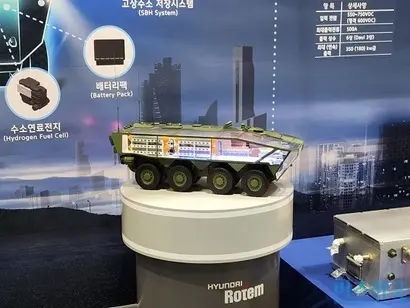
Our military has also begun using secondary batteries as power sources for various weapon systems, including torpedoes, submarines, and tanks. The 'Hong-Sang-Eo' (Red Shark) electric-propulsion lightweight torpedo and the 'Beom-Sang-Eo' (Tiger Shark) heavyweight torpedo are known to use secondary batteries such as lithium batteries. The 'Jangbogo-III Batch-II' submarines, which Hanwha Ocean042660 will begin building in 2025, are scheduled to be the first to feature lithium-ion batteries developed by domestic companies. Hanwha Ocean's next-generation submarines, which will begin construction next year, will be the first to use lithium-ion batteries. Hyundai Rotem is developing a power pack for wheeled armored vehicles that integrates hydrogen fuel cell systems with secondary batteries like lithium-ion.
Although the importance of 'secondary batteries' as a power source for weapons is growing in the military, critics point out that the high dependence on China necessitates future stability. In particular, the reliance on China for artificial graphite and hydrogen fluoride, both core materials for secondary batteries, reaches 90%, leaving the supply chain in an unstable state.
To stabilize the parts supply chain, the military plans to conduct regular inspections and analyses of the supply chains for its top 100 weapon systems. The Defense Agency for Technology and Quality (DTaQ) has decided to survey and analyze the supply chains of the top 100 weapon systems currently operated by the Army, Navy, Air Force, and Marine Corps over a five-year period from next year until 2029. The Defense Industry Promotion Research Institute (DIPR) plans to identify and manage new economic security items that require proactive supply chain management and support the stabilization of the domestic supply chain by selecting lead companies for these items. Targets include aircraft engine materials and parts, non-memory semiconductors for defense, amplifiers for radar and electro-optics, high-explosive propellants, and armor materials for armored equipment. In connection with this, the range of stockpiled materials and parts will be expanded from the existing 43 types, such as gunpowder and ammunition, to 60 types by adding electronic parts such as semiconductors, image intensifier tubes, and vacuum tubes, and quality checks on raw materials in stock will be conducted.
However, it is reported that since secondary batteries have not yet been widely applied to weapons, they were not included in these current supply chain measures. An industry official explained, "The government should boldly support the development of secondary batteries—the future power source for military use—and secure 'super-gap' technology. We must achieve 'energy security' by creating military-grade batteries that can provide stable power."