

[비즈한국] Following President Yoon Suk Yeol’s emphasis on pension reform in August, all eyes are on whether the government’s proposed National Pension reform plan will undergo full-scale deliberation in the National Assembly. In its proposal, the government suggested raising the mandatory National Pension contribution age from the current 59 to 64 to ensure the fiscal stability of the fund. However, since the retirement age in Korea is 60 and the age for receiving pension benefits is being delayed to 65, citizens could be driven into a situation where, rather than receiving a pension, they are forced to contribute more while having no income after retirement.
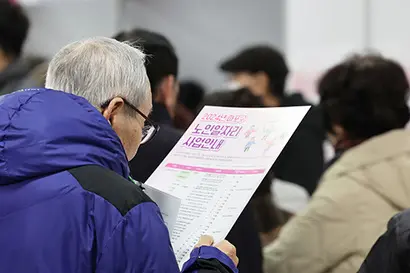
As the actual pension receipt age is pushed back, the number of elderly people aged 60 to 64 seeking employment is increasing every year. This has led to arguments that discussions on extending the retirement age must take place in tandem with raising the mandatory contribution age and delaying pension receipt. However, because this pension reform plan, which was intended to resolve intergenerational conflict, could itself become a trigger for such conflict, controversy appears inevitable.
On August 30, at a media outlet's anniversary ceremony, President Yoon Suk Yeol clearly stated his intention to pursue pension reform, saying, "Reforms are tasks that involve pain, but they are things that must be done right now for the sustainability of the Republic of Korea and for sustainable growth." Following the President’s remarks, the government released its National Pension reform plan on September 4.
The core of the plan involves differentiating premium rate increases by generation (an annual 1% point increase for those in their 50s, 0.25% point for those in their 20s) to address the dissatisfaction and anxiety of the younger generation, introducing an automatic adjustment mechanism that links pension amounts to demographic changes and economic conditions, and raising the mandatory contribution age from 59 to 64. The government emphasized that since the age to start receiving the pension continues to be delayed to 65, it is desirable to raise the mandatory contribution age to align with the end of the premium payment period.
The problem is that raising the mandatory contribution age could turn the National Pension reform into a "hot potato" that no one wants to touch. With the amendment of the 'Act on Prohibition of Age Discrimination in Employment and Aged Person Employment Promotion' in May 2013, the retirement age of 60 or older became mandatory in Korea. The extension of the retirement age was expanded to large companies and public institutions with 300 or more employees starting in January 2016, and to companies with fewer than 300 employees, as well as state and local government agencies, in January 2017.
According to the Ministry of Employment and Labor, the proportion of companies with a retirement age of 60 or older, which was 51.5% in 2013 when the law was amended, increased to 94.8% in 2017 when the law was expanded. This trend continued to grow, reaching 96.6% in 2023, effectively making 60 the retirement age for almost all companies. However, most companies set 60 as the exact retirement age to comply with the legal minimum. In fact, 80.9% of all companies have a retirement age of 60. This means most employees must leave their jobs the moment they turn 60.
In contrast, the age for receiving the National Pension is being pushed back. The current pension receipt age is 63, and people born in 1961 are eligible to receive it this year. While those born up to 1964 can receive the pension at 63, those born between 1965 and 1968 can receive it at 64, and those born in 1969 or later must wait until they are 65. This forces people into a situation where, even if they retire at the full retirement age, they must live without a salary for 3 to 5 years until they reach the pension receipt age. As a result, an increasing number of people are choosing to receive their pensions early, despite the reduction in benefits. The number of new early pension recipients, which was 43,544 in 2018, rose to 51,883 in 2020 and 59,314 in 2022, before surging to 112,031 last year.
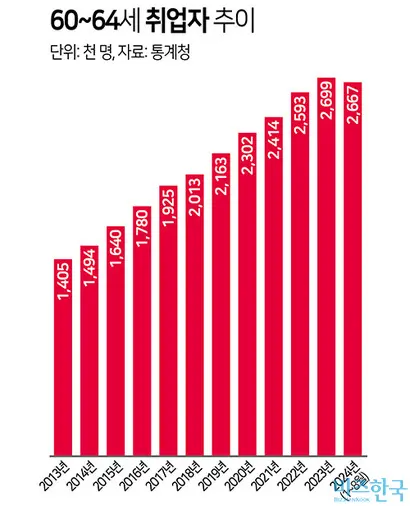
As the pension receipt age is delayed, more elderly people are searching for jobs after retiring. According to Statistics Korea, the number of employed people aged 60–64 was 1,405,000 in 2013, surpassing 2 million in 2018 with 2,013,000. Last year, the number of employed people aged 60–64 reached 2,699,000, nearly double the 2013 figure. This year, the number of employed people in that age group reached 2,667,000 as of August.
In this situation, the government has proposed delaying the mandatory pension contribution age from 59 to 64. In attempting to increase the sustainability of the pension, the government may end up dealing a heavier blow to the elderly, who already have the highest poverty rate among OECD countries. The elderly poverty rate in Korea is 40.4%, which is nearly four times the OECD average of 14.2%.