

[비즈한국] Can ‘Uprising’ become the first original Korean film on Netflix to capture both mass popularity and critical acclaim? While Netflix has showcased outstanding content in dramas and variety shows, it has been notably weak when it comes to films. ‘Uprising’, set to be released on October 11, is a historical drama that has garnered high expectations, with director Park Chan-wook participating in its production and screenplay, and starring Gang Dong-won and Park Jeong-min. It also attracted attention as the first OTT film in history to be selected as the opening feature for the 29th Busan International Film Festival, and the consensus after its screening is that it is well-deserved.
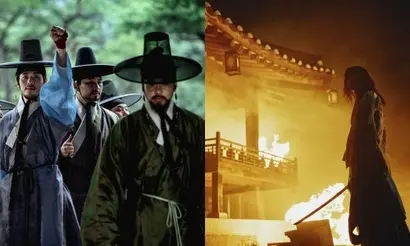
‘Uprising’ is the story of Jong-ryeo (Park Jeong-min), the son of the finest military family in Joseon, and his manservant Cheon-yeong (Gang Dong-won), who grew up together, only to reunite as enemies—one as a close military officer to King Seonjo (Cha Seung-won) and the other as an insurgent—during the chaos of the Imjin War. Although born as a commoner, Cheon-yeong is reduced to a slave overnight due to his parents' debts, living a life where he takes beatings on behalf of his master, Jong-ryeo. Unlike the resolute Cheon-yeong, Jong-ryeo, who must succeed the military household, possesses a warm personality and a desire not to harm anyone. Having grown up together, the two share a bond that transcends their social class.
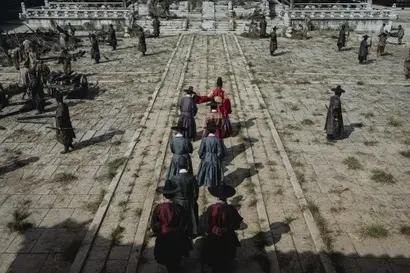
However, Joseon is a country defined by a strict caste system. The relationship between Cheon-yeong, who longs to be freed from slavery, and Jong-ryeo, who tries to help him, becomes increasingly difficult due to external pressure, and they cross a point of no return when the Imjin War breaks out. Following the war, slaves from Jong-ryeo's household revolt and kill his family; Jong-ryeo mistakenly blames Cheon-yeong for leading the uprising, causing him to turn to the "dark side." In the past, when Cheon-yeong sparred with Jong-ryeo and remarked, "There is no anger in your sword," Jong-ryeo replied, "Don't worry. When I meet a true enemy, my sword will be filled with anger." Ironically, his friend Cheon-yeong becomes that enemy.
One should note the deliberate comma placed in the title (in Korean, ‘Jeon, Ran’), separating the words for "war" and "rebellion." The film is divided into four chapters: "War," "Battle," "Uprising," and "Rebellion." Unusually, it only shows the beginning of the seven-year Imjin War, jumping to "7 years later" to look at the period immediately following the conflict. While an external invasion triggers the war, the focus is placed on the rebellion born from internal division. The catalyst for this rebellion is the harm caused by the caste system.
From the start, the film shows Seonjo infuriated by Jeong Yeo-rip’s Daedong ideology, which posits that "the world belongs to everyone, so it has no master, and anyone can serve as a king." Young Cheon-yeong, who lived as a commoner, suddenly becomes a slave because his mother was sold into servitude to pay a debt, following the state law of "ilcheon-jeukcheon" (if one parent is of the lowest status, the child is also of the lowest status). While the caste system remains solid during peacetime, the chaos of war brings a wave of rebellion and a thirst for change. As the war begins, a faint hope spreads that serving the country will result in rewards for commoners and liberation for the enslaved, but the ruling class is stingy about giving up even a fraction of their power.
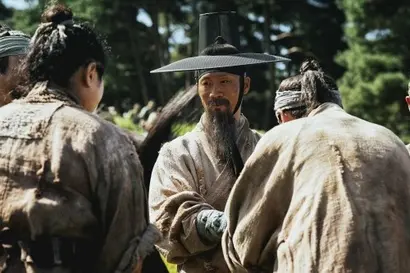
For this reason, ‘Uprising’ can be read as a historical drama depicting the 16th century, while also functioning as a social film that remains relevant in modern times, where the ruling class still views the public as "dogs and pigs." The sight of Seonjo abandoning the capital and his people to flee to Uiju, and the citizens burning Gyeongbokgung Palace in their fury, is highly significant. There is a chilling contrast in the scene where Jong-ryeo mercilessly cuts down the commoners who, unable to endure any longer, attack the king's party, while Cheon-yeong cuts down Japanese soldiers to protect the people (even if motivated by a desire for liberation).
The film captures a deep sense of rage against those who call themselves leaders: Seonjo, who is more concerned with rebuilding the fallen palace and restoring royal authority than caring for the devastated nation, or who feels jealous of the popular righteous army leader Kim Ja-ryeong (Jin Seon-kyu); and the magistrate of Cheongju, who shamelessly holds a banquet after the war despite having collaborated with the invaders.
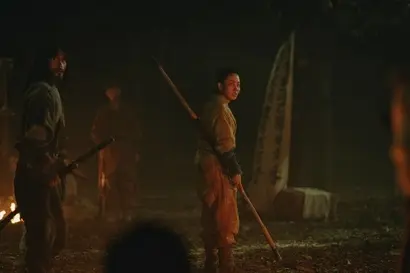
However, ‘Uprising’ is not merely heavy. While it carries significant socio-political messages, it remains faithful to the basics of a grand historical action epic. The quality of the action is excellent; Gang Dong-won, playing Cheon-yeong, who displays graceful swordsmanship despite being a slave, fully utilizes his physicality in his performance. The action has distinct styles: Jong-ryeo uses horizontal strikes that defend and attack simultaneously, while the Japanese commander Kikkawa Genshin (Jung Sung-il) showcases the disciplined stances and sword-drawing techniques characteristic of traditional Japanese swordsmanship. The three-way action sequence in the fog, where Cheon-yeong, Jong-ryeo, and Genshin clash, is a highlight. The action of Beom-dong (Kim Shin-rok), who swings her flail, and Kim Ja-ryeong (Jin Seon-kyu), who displays restrained swordsmanship, are also noteworthy.
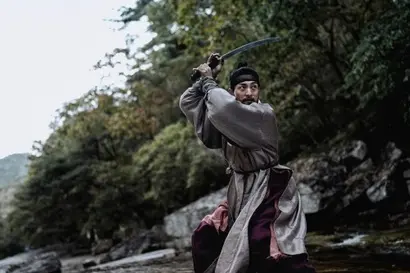
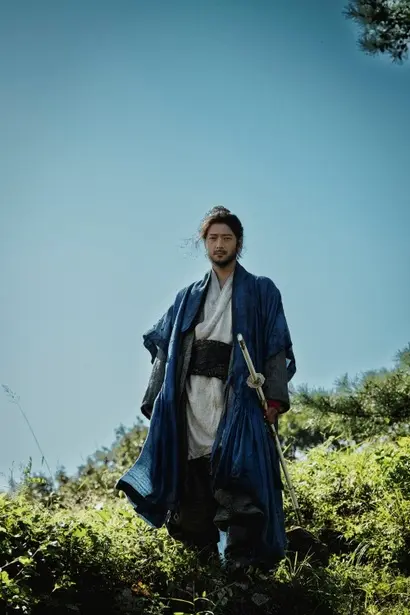
The visuals are also excellent. Director Kim Sang-man, who majored in visual design and served as the art director for ‘Joint Security Area (JSA)’ and designed the poster for ‘Parasite’, takes the helm to create a sensuous cinematic look. From the contrast in color between Cheon-yeong’s blue cheollik (a traditional garment) and Jong-ryeo’s red one, to the landscape of the ruined Gyeongbokgung Palace, the film is visually arresting. The state of Joseon in ruins is truly worthy of being called a "Joseon Apocalypse." The sophisticated soundtrack, which shifts between rock and pansori, is another strength of the film.
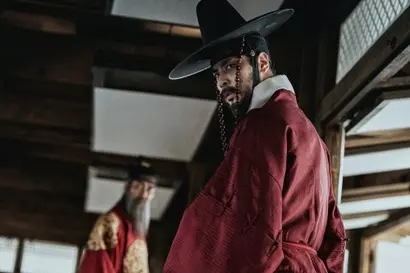
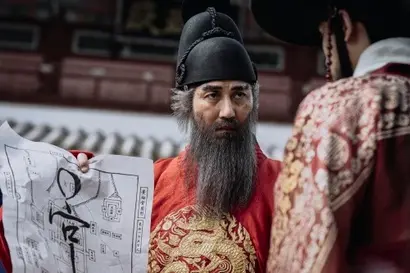
As for the acting, I must first praise Cha Seung-won, who chillingly embodied the incompetent and pathetic King Seonjo. With his appearance—beard straggling like the portrait of Yun Du-seo—he captivates the viewer, inducing anger and pulling the audience into the story. The performances of Jung Sung-il, who shows quiet charisma as Genshin, and Kim Shin-rok, who portrays the hot and pure rage of Beom-dong, are also standouts.
‘Uprising’ is released today, October 11. It has a running time of 128 minutes. I look forward to seeing if it can leave a distinct mark on the history of original Korean films on Netflix.
Who is writer Jung Soo-jin?
She has worked at several magazines, covering and writing about film, travel, and pop culture. She doesn't want to be left behind by trends, but she has become an "old soul" who predicts the obvious clichés in the next scene while watching the latest dramas. Drifting through the vast world of OTT, she is trying to regain her lost edge, and her current wish is for the release of an integrated OTT subscription plan.