

[비즈한국] The Aerospace Division of Korean Air003490 is faltering due to a string of failed bids in the defense sector. Although Korean Air Chairman Cho Won-tae has earmarked the "aerospace sector" as a future growth engine and has invested continuously, there have been no significant achievements in areas such as unmanned aerial vehicles (UAVs). The division has recorded operating losses for five consecutive years, with revenue now half of what it was in 2015, and operating losses in the first half of this year alone have reached the 10 billion won range. Industry insiders attribute this slump to quality issues with Korean Air's UAVs, which have caused the company to fall behind rivals like Korea Aerospace Industries (KAI)047810 and LIG Nex1079550 in major projects, such as division-level UAV programs. Consequently, experts point out that the company must win upcoming large-scale contract bids to turn the situation around.
According to Korean Air’s business reports, revenue for its Aerospace Division dropped from 650.5 billion won in 2018 to 564.7 billion won in 2020 and 366.7 billion won in 2021. While it rebounded slightly to 491 billion won in 2022 and reached 540.7 billion won last year, it remains a disappointment that the division accounts for a negligible portion of the company's total revenue. The Aerospace Division’s share of total revenue was a mere 3.6% in 2022 and 3.7% in 2023. In the first half of this year, it recorded 292.5 billion won in revenue, accounting for only 3.4% of the total. Operating profit has also failed to escape the red. After posting a profit of 38.5 billion won in 2018, the division turned to an operating loss of 12.8 billion won in 2020 and has remained in the red ever since. Losses were 36.9 billion won in 2021, 600 million won in 2022, and 11.3 billion won last year. In the first half of this year, it recorded an operating loss of 16.2 billion won.
This sluggish performance is due to the failure to secure new, large-scale weapon system contracts. In particular, assessments suggest that Korean Air’s technical competitiveness is not high in the military UAV sector, which is considered one of its future growth pillars.
The division-level UAV, which Korean Air promotes as a flagship product, was deployed to frontline units but was treated as a nuisance by the military due to issues such as low operating altitude, poor performance, and frequent breakdowns. The multi-purpose medium-altitude UAV 'KUS-FS,' which began full-scale mass production in January this year, suffered from airframe icing issues at high altitudes during development, delaying its deployment by seven years from the original 2017 target. With 15 years taken from development to mass production, the price per unit has soared to over 40 billion won, sparking controversy over its high cost. In the subsequent next-generation division-level UAV program, the company competed against LIG Nex1 but lost the bid. This implies that revenue could potentially dry up completely after 2028, when the current mass production project (KUS-FS) concludes.
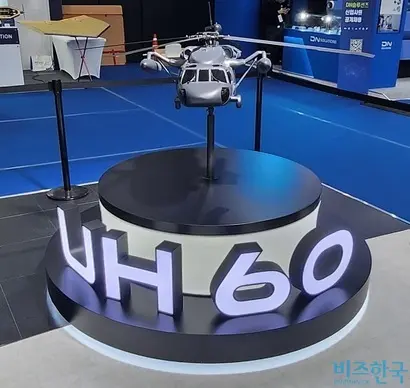
To reverse this slump, Korean Air has jumped into the bid for the medium-sized rotorcraft (helicopter) performance improvement project. This project aims to enhance the operational capabilities and ensure the continued operation of aging electronic devices and engines for the South Korean Army and Air Force's special operations helicopters (UH-60 Black Hawk and HH-60). It is known that approximately 130 of these two models are currently operated by the Army, Navy, and Air Force. The total project scale is expected to be around 1 trillion won once all models are upgraded.
Korean Air will face off against KAI for the Army's medium-sized rotorcraft performance improvement project. Both companies have formed their own respective consortiums and expressed their intent to participate. Korean Air has signed a cooperation agreement with LIG Nex1 for the 'UH-60' performance upgrade and is pushing for the contract. Korean Air first produced the UH-60, a mainstay helicopter of the Korean military, under license in 1991. It also holds strengths in depot maintenance, modifications, avionics performance upgrades, and full restoration. By forming a "one-team" with LIG Nex1, which has strengths in avionics, electronic warfare, communication equipment, and sensor technologies, it is preparing all-out efforts to win the contract.
KAI signed an MOU with Hanwha Systems272210 and Elbit (Israel) at the KADEX 2024 venue on the 3rd to prepare for the bid. As the only domestic aircraft developer, KAI has strengths in all areas of aircraft development required for performance upgrades, including design, analysis, manufacturing, airworthiness, testing, and follow-up support, having developed cutting-edge rotorcraft like the 'Surion' and 'LAH.' Hanwha Systems will be responsible for avionics system development, and Israel's Elbit will handle modification development and avionics systems.
Since the end of 2022, Korean Air has also been collaborating with U.S. defense company L3Harris to prepare for the '2nd project to introduce Airborne Early Warning and Control (AEW&C) aircraft' for the ROK Air Force. The project is worth 2.92 trillion won, with Korean Air responsible for aircraft modification and parts production. A Korean Air official stated, "We will lead future core technologies and serve as a driving force for the development of South Korea's aerospace and defense industries."