

[비즈한국] In 1920, the greatest debate in the history of astronomy took place at the Smithsonian Museum of Natural History in Washington, D.C. The question was, "What is the true size of our universe?" The debate, which was sparked by the question of whether other galaxies exist outside of our own, evolved into a more fundamental inquiry into the actual dimensions of the cosmos. The protagonists of this "Great Debate" were Heber Curtis and Harlow Shapley. Interestingly, the two men encountered each other on the train to Washington, D.C. before the debate. Fearing that their respective strategies might be exposed, they reportedly exchanged only cautious greetings before returning to their seats. It must have been quite awkward.
Many astronomers and reporters gathered, expecting a heated discussion. However, both men were gentlemen, and the debate proceeded in a polite and peaceful manner. Furthermore, no strong evidence supporting either side was presented. As the saying goes, "a hyped feast has nothing to eat." Ultimately, the dispute between the two astronomers, which had captured everyone's attention, ended rather anticlimactically. In fact, the significance of the Great Debate lies not in the heated argument at the time, but in the fact that it brought the question of the universe's size to the main stage of the astronomical community.
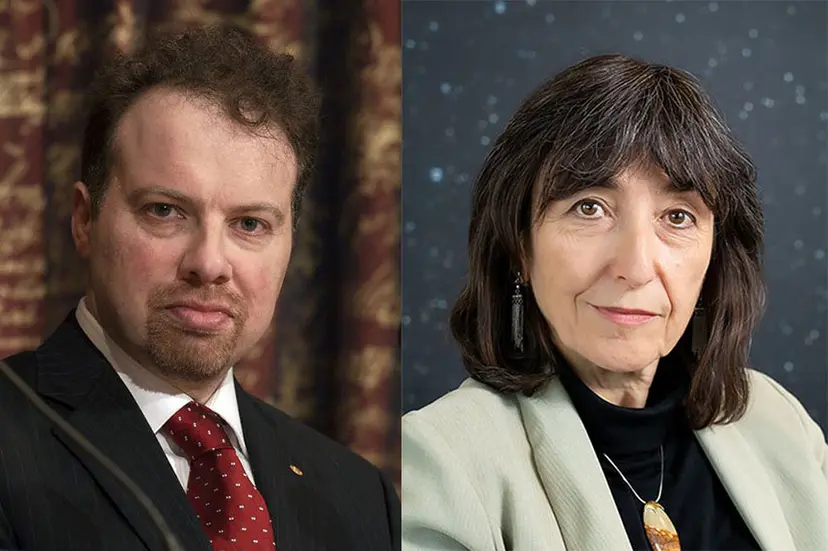
More than 100 years have passed since the Great Debate. Recently, a new battle has begun as two astronomers have been intensely exchanging papers. Unlike the anticlimactic end of the 1920s debate, this modern one is quite intense. The protagonists of the 21st-century astronomical debate are Adam Riess of Johns Hopkins University and Wendy Freedman of the University of Chicago. Adam Riess is a Nobel laureate in Physics (2011), honored for his work with Brian Schmidt and Saul Perlmutter in confirming the accelerated expansion of the universe through supernova observations and proposing the possibility of dark energy.
Recently, Riess and Freedman have been locked in a fierce dispute over the speed of the universe's expansion using data from galaxies observed by the James Webb Space Telescope. Riess, who previously established the paradigm of the universe's accelerated expansion through supernova observations, argues that there are no problems with the distance values to galaxies estimated thus far. On the other hand, Freedman raises an issue, claiming that research conducted secretly with her colleagues suggests there may be a serious and common error in the estimated distances to those galaxies. While the subject of the dispute may seem trivial at first glance, it is anything but. Depending on who is correct, the future and fate of the universe, as well as the fate of modern astronomy, could head in entirely different directions.
To understand why these two astronomers are in such sharp disagreement, we must first understand the most difficult and unresolved enigma in modern astronomy: the "Hubble Tension." Simply put, the Hubble Tension is the problem where the expansion rate of the universe is calculated differently depending on the observation method.
There are, in fact, various ways to determine the expansion rate of the universe. Among them, two are central to the Hubble Tension. The first is the method of observing the Cosmic Microwave Background (CMB), which is the remnant of the heat left behind as the hot, dense, early universe expanded uniformly. When the early universe cooled, random, tiny differences in density emerged throughout the cosmos. Those density differences left subtle variations in the temperature distribution of the CMB observed today, which are called temperature or density fluctuations. By statistically analyzing the distribution of these fluctuations, one can infer the ratio of dark matter and dark energy that make up the universe, and thus determine its expansion rate.
This method has the problem that estimates vary slightly depending on which cosmological model is applied. However, because it analyzes the remnants left throughout the universe as it cooled immediately after the Big Bang, it is considered a method that can directly determine the expansion rate of the entire universe.
The second method involves calculating the universe's expansion rate by directly comparing the distances to galaxies with the speed at which they are moving away from us (recession velocity). This is the most traditional method, used ever since the observations of Edwin Hubble long ago. It is also a method that many astronomers firmly believe can directly determine the expansion rate of the universe.
However, there is a problem here. While the recession velocity—how fast a galaxy is moving away from us—can be determined quite directly by measuring the redshift of the galaxy's light spectrum, the challenge lies in calculating the distance to the galaxy.
For very nearby stars within our own galaxy, we can measure the distance using parallax, which occurs due to Earth's orbit around the Sun. Parallax uses simple trigonometry; it is an excellent method for determining the distance to a star with mathematical precision. However, when the distance is too great, parallax is no longer useful. It ceases to be effective even before leaving our galaxy. Thus, astronomers had to devise other methods to calculate distances to other, much farther galaxies.
How can we know the distance to a far-off galaxy? The basic principle is actually quite simple. If we can determine the intrinsic brightness (luminosity) of a celestial body seen from afar, we can compare it to its apparent brightness as seen in the sky. This allows us to calculate how far away an inherently bright object must be to appear so dim in the sky. The key to measuring distance in today’s galactic astronomy lies in whether we can determine an object's intrinsic brightness using other methods, even without knowing the distance beforehand.
Celestial bodies that serve as indicators for determining distance in this way are known in astronomy as "standard candles." The concept is that because we know the intrinsic brightness of the candle itself, we can determine its distance based on how dim it appears in the sky.
The most representative standard candles are Cepheid variable stars, studied by astronomer Henrietta Leavitt, and Type Ia supernovae, which occur when a white dwarf accretes matter from a neighboring star or collides with another white dwarf, leading to an explosion. Leavitt studied variable stars in the Magellanic Clouds and discovered that the period of a Cepheid variable star's brightness change is exactly proportional to its intrinsic luminosity. By utilizing this relationship, one can determine the intrinsic brightness of a Cepheid variable simply by observing its pulsation period, and thus calculate its distance.
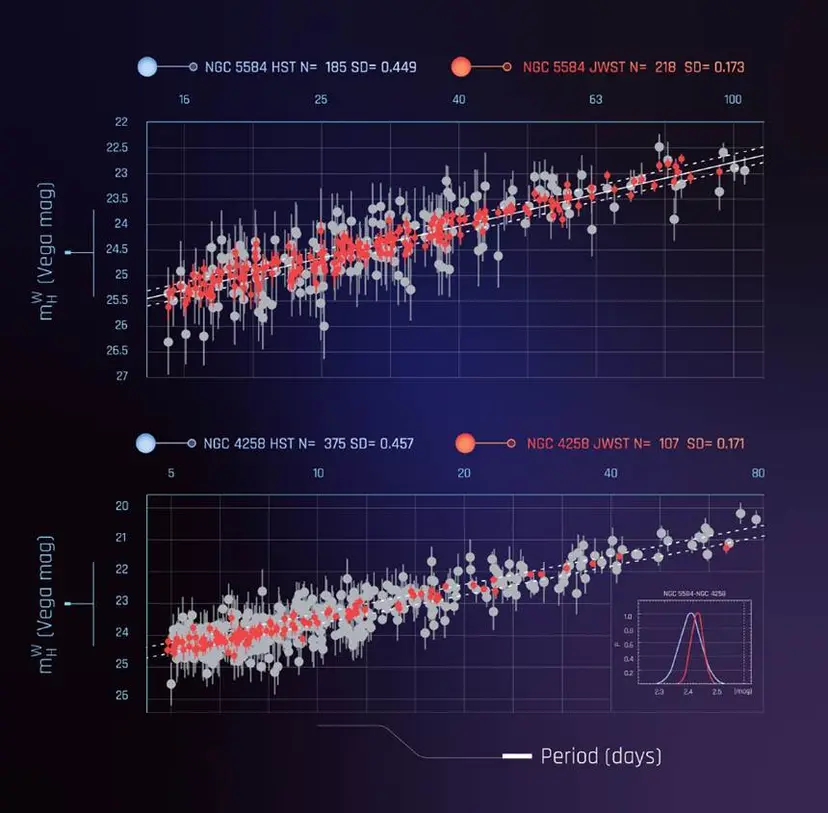
Type Ia supernovae rely on a slightly radical assumption. A white dwarf is known to explode instantaneously when it exceeds the limit of 1.4 times the mass of the Sun because it can no longer withstand its unstable state. The sheer amount of energy released by the star ultimately depends on its mass. If all Type Ia supernovae explode the moment they cross the same mass threshold, we can expect that the peak brightness of all Type Ia supernovae will be roughly similar. Based on this expectation, Type Ia supernovae are accepted as standard candles that reveal distances to the very far reaches of the universe.
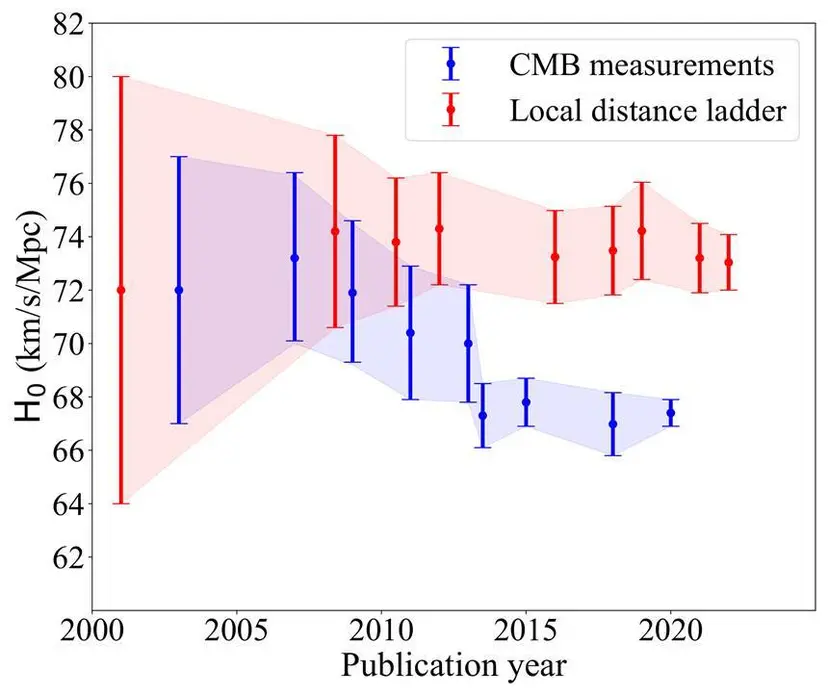
The problem is that the expansion rate of the universe calculated from the cosmic microwave background differs from the rate calculated by directly comparing the distances to galaxies (using Cepheids and Type Ia supernovae) with their recession velocities. The result from the cosmic microwave background is about 63 km/s/Mpc. In contrast, the result directly calculated from galactic recession is about 73 km/s/Mpc. Interestingly, the expansion rate sensed by the recession of galaxies is faster than the expansion rate perceived through the cooling of the entire universe. Furthermore, as each observation method becomes more sophisticated, the margin of error for each decreases, but the gap between the two methods is actually widening. It is a frustrating situation where two methods, observing the same universe, yield completely different expansion rates.
Ultimately, this situation raises the question: Are the two methods even looking at the same universe to begin with? This puzzle is what we call the "Hubble Tension."
To resolve the Hubble Tension, many astronomers until recently suspected that there might have been a slight misunderstanding regarding the expansion of the universe as inferred from galactic recession. Because this method calculates the expansion rate by observing the movement of galaxies, one cannot ignore not only the effect of the universe’s overall expansion but also the individual motions of nearby galaxies pulling on each other. If we happened to live in an empty space, like a "void," where the density of surrounding galaxies is sparse, nearby galaxies might appear to be scattering in all directions at a speed faster than the average expansion rate of the universe. However, evidence of a massive void around our galaxy has not been found in recent observations.
This led Freedman to think that it was necessary to look at the situation very objectively. In fact, if we take a step back and think rigorously, there is a common fundamental premise underlying the way we have measured distances on various scales, from nearby galaxies to distant ones. It is the premise that characteristics of the universe confirmed in the relatively nearby cosmos apply identically to the distant cosmos. It could be seen as a form of faith. For example, Leavitt discovered a consistent rule among Cepheid variable stars at a distance of several hundred thousand light-years, which is not particularly far. Astronomers then applied the law discovered by Leavitt as a standard to measure distances to galaxies millions, tens of millions, and hundreds of millions of light-years away.
Likewise, the characteristic that Type Ia supernovae always explode with a similar peak brightness is merely a result confirmed in the relatively nearby universe. Astronomers have assumed that this characteristic applies equally to the distant universe and have used it to measure distances.
Astronomers start with stars that are relatively close, whose distances can be accurately determined, and gradually calibrate the "scale" of their distance-measuring methods by moving to more distant stars. For example, among the stars whose distances can be determined accurately using trigonometric parallax, there are also Cepheid variable stars. For these stars, we can know the exact distance without needing Leavitt’s law. This allows us to know the precise intrinsic brightness of variable stars and more accurately calibrate the relationship Leavitt discovered.
This philosophy of measuring distances to the universe step by step is called the "distance ladder" in astronomy. It means measuring distances to the farther universe by stepping up one rung at a time. It can be seen as the fundamental philosophy underlying how we measure the scale of the universe in modern astronomy.
However, Freedman questioned this ladder. Were each of the rungs we climbed really perfect? If even one rung in the middle is slightly off, we arrive at the wrong destination. The research recently published by Freedman seems to hold that possibility. (The rest of the story will be in the next column.)
About the author, Ji Woong-bae: He loves cats and the universe. After watching "Galaxy Express 999" as a child, he dreamed of spreading the beauty of the universe. He currently researches the evolution of galaxies through their interactions at the Yonsei University Galaxy Evolution Research Center and the Near-field Cosmology Laboratory. He is involved in various science communication activities, including lectures and writing. He is the author of books such as "The Observatory Having a Flirt," "Thinking About the Universe All Day," and "Stars, the Science of Light."