

[비즈한국] President Yoon Suk Yeol recently emphasized large-scale investment attraction to propel the nation into one of the top three global artificial intelligence (AI) powerhouses, while promising government support for semiconductors, the cornerstone of AI and the backbone of Korea's exports. Having suffered a slump for some time, the semiconductor industry began to recover late last year, driving export growth for 12 consecutive months. With the government promising to expand investment, it seems as though the path ahead should be smooth sailing.
However, the problem is that the perspectives of foreign investment banks and the figures shown by economic indicators tell a different story. Foreign investment banks have been issuing a series of negative reports on Korea's semiconductor industry. While there are complaints within Korea that foreign firms are applying overly harsh standards to "K-Semiconductors," analysts point out that it is difficult to simply ignore these warnings when examining "Tobin's Q," an indicator that reflects the investment climate. This is because the growth rate of Tobin's Q in the semiconductor industry has recently been lagging behind other sectors.

Presiding over the "Inauguration Ceremony and First Meeting of the National Artificial Intelligence Committee" on September 26, President Yoon emphasized, "As we experience a civilizational transformation where AI changes human life, a national makeover through an AI transition will determine our future fate." He added, "The government will actively invest in building an overall AI ecosystem, including cloud, network, AI, and semiconductors."
President Yoon’s confidence in Korea becoming a top-three AI powerhouse is based on his belief that the nation possesses international competitiveness in the semiconductor industry. Indeed, the Korean semiconductor sector, which struggled amid the global economic downturn, has been leading national exports since November of last year, showing growth compared to the same month the previous year. According to the Ministry of Trade, Industry and Energy, exports in September continued their 12-month positive streak despite fewer working days due to the Chuseok holiday. A major driver of this was record-high semiconductor exports, which reached $13.6 billion in September.
While this might make the future of Korea's semiconductor industry look bright, foreign investment banks are sounding alarms daily. In a report titled "Winter looms" on September 15, Morgan Stanley lowered SK Hynix's target price from 260,000 won to 120,000 won and changed its investment rating from "Overweight" to "Underweight." It also cut the target price for Samsung Electronics005930 from 105,000 won to 76,000 won. The reasoning is that starting next year, there could be an oversupply of HBM (High Bandwidth Memory), an AI server memory chip, and a contraction in demand for general-purpose DRAM and NAND flash due to reduced demand for smartphones and PCs.
Macquarie also lowered its target price for Samsung Electronics from 125,000 won to 64,000 won at the end of September, downgrading its investment rating from "Buy" to "Neutral." Macquarie pointed out, "With the average selling price (ASP) turning downward due to a DRAM memory oversupply, a contraction in demand from downstream industries will lead to a slowdown in performance." Some in Korea criticize the Morgan Stanley and Macquarie reports as excessive, citing the recent recovery in semiconductor exports. However, looking at Tobin's Q, which indicates companies' investment opportunities, the situation for the semiconductor industry is not quite as simple.
Tobin's Q is a concept proposed by American economist James Tobin (1918–2002), calculated by dividing a firm's market value in the stock market by the value of its physical capital. Therefore, a company's Tobin's Q increases as expectations for future profits are reflected in its stock market value. Consequently, a higher Tobin's Q leads companies to increase investment in pursuit of expected future profits. For the South Korean manufacturing sector, the average Tobin's Q over the recent five-year period (2018–2022) increased overall compared to the previous five-year period (2013–2017).
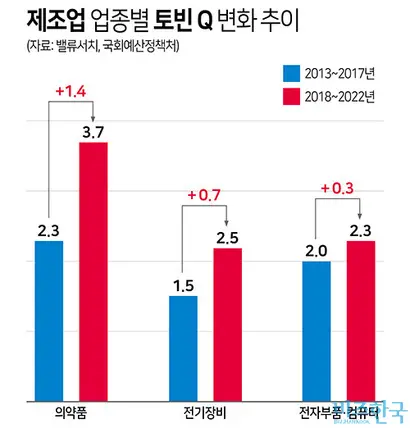
However, when looking at the industry level, the growth rate of Tobin's Q for the electronic components and computer manufacturing sector, which includes semiconductors, is lower than other manufacturing fields. In the pharmaceutical manufacturing industry, Tobin's Q increased by 1.4 points, from 2.3 in 2013–2017 to 3.7 in 2018–2022. The electrical equipment manufacturing industry also saw a 0.7-point increase in Tobin's Q, from 1.5 to 2.2 during the same period. In contrast, Tobin's Q for the electronic components and computer manufacturing sector, including semiconductors, only grew by 0.3 points, from 2.0 in 2013–2017 to 2.3 in 2018–2022. Expectations for the semiconductor industry are weakening compared to other sectors.