

[비즈한국] There is a saying, "The value of 'together'." This phrase appeared in a corporate image advertisement about ten years ago. It is a wonderful copy that carries the meaning that the power of being together can change the world. Being together signifies empathy or communication, and with this power, a new paradigm can be created. Art also holds value when it earns the empathy of people. Empathy comes from the spirit of the times and a universal artistic language. The 'Korean Art Support Project' also aims to showcase the thoughts of various people through an accessible artistic language. As we reach Season 10, we support artists who strive to put into practice Confucius's idea that 'good art must be easy.'
Entering the 20th century, artists completely transformed the fundamental basis of art. The art train, which had been running on the engine of 'appreciation' for over 2,000 years, has been pioneering new tracks since the last century, equipped with an engine that operates in an entirely different way called 'thought.' The art we see now is on the extension of those tracks.
The person who first proposed this new principle of art is Paul Cézanne (1839-1906), a painter representing Post-Impressionism. That is why he is called the father of modern art.
With the emergence of Cézanne's original paintings, Western art abandoned the principle of 'reproducing the real world' it had upheld until then and began to pursue a new world that only art could create. This is why modern art became difficult and distanced itself from the public. In other words, it shifted from 'art to be appreciated' to 'art to be thought about.' This means that the core focus of artistic expression moved from 'what was painted' to 'how it was made.'
To know what was painted, one simply needs to look at the picture and find the content. However, to know 'how it was made,' one must carefully examine the mode of expression. Through this approach, finding the materials and methods of the work, and analyzing whether this is logically sound, provides a new sensation, or holds value in art history is the path to approaching modern art.
As art moved away from being a means to package specific stories (content) and began to take an interest in the packaging itself, various packaging techniques emerged. This was always accompanied by a manual explaining the methods and materials used for the packaging. This manual is art theory. Therefore, modern art is difficult to understand without the manual.
Korean art has also accepted this trend, and many of the artists currently active in the Korean art scene are dedicated to creating new manuals. That is why many young artists no longer focus on drawing. They are not 'painting works' but 'making' them.
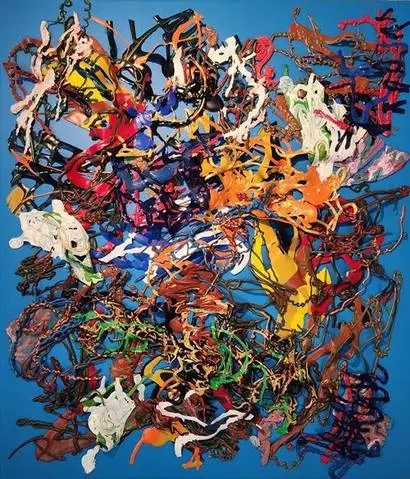
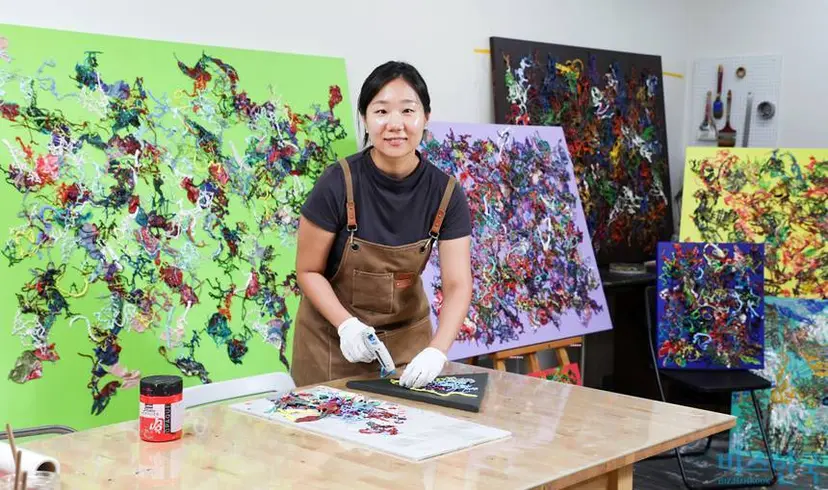
Ellie Jung's paintings should also be viewed from this angle. She works with acrylic paint, which was newly developed in the 20th century. She strives to create new visual pleasure by utilizing the characteristics of the material that acrylic paint possesses.
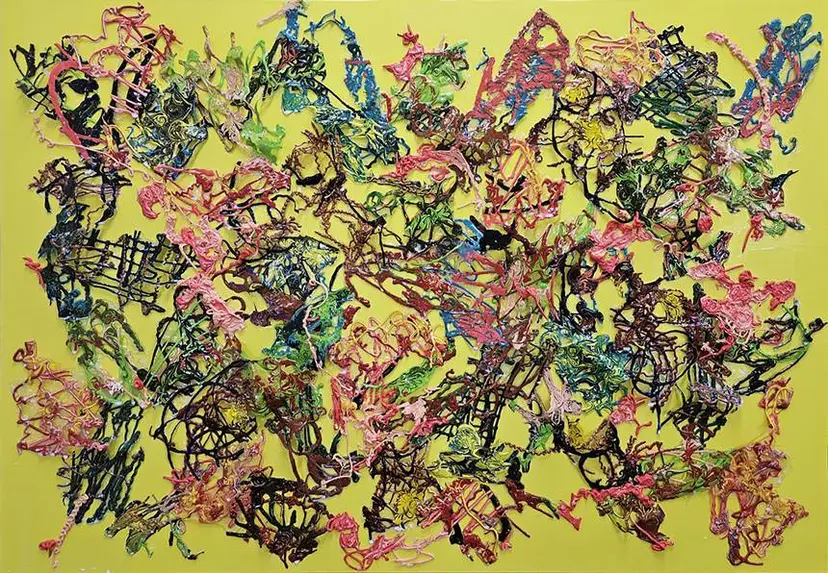
She creates abstract works by using a vinyl piping bag, which bakers use to make cakes, to create various lines and surfaces, and then arranges them on the canvas. Thus, Ellie Jung's paintings are characterized by vibrant colors and a material three-dimensionality that resembles relief forms.
Through these abstract paintings, she seeks to discover the energy of life hidden within a boring daily routine, by orchestrating a vibrant canvas through the materiality of acrylic paint and the accidental effects that arise from it.