

[비즈한국] Shinsegae Food031440 has decided to terminate its operation of Smoothie King Korea. Shinsegae Food states that it will decisively cut loss-making businesses and focus on high-growth potential areas, expressing a strong commitment to investing in its No Brand Burger franchise business. However, industry insiders are skeptical, noting that No Brand Burger has yet to fully establish itself in the market, raising questions about whether it can truly be the "key" to a performance turnaround for Shinsegae Food.
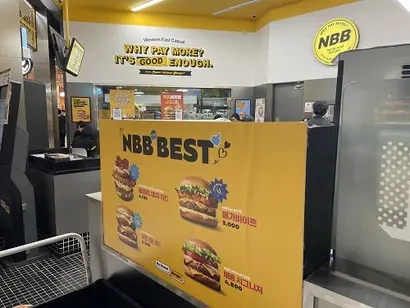
Only Smoothie King in the red? Shinsegae Food continues to struggle with poor subsidiary performance
Shinsegae Food will terminate its 'Smoothie King' franchise business in October next year. The company explained, "The contract is ending as negotiations regarding the Smoothie King business rights could not be reached with the U.S. headquarters." Smoothie King, an American fruit beverage franchise, was brought into the domestic market in 2003 by Kim Sung-wan, the eldest son of Kyung-In Electronics Chairman Kim Hyo-jo. Its menu, distinct from coffee drinks, was fresh enough to capture consumer interest, and during its initial launch, it enjoyed such high popularity that domestic locations recorded the highest sales in the world.
Seeing the growth potential, Shinsegae Food acquired the domestic sales rights for Smoothie King for 18 billion KRW in 2015. However, Smoothie King never turned a profit. Its operating loss, which was around 200 million KRW in 2015, grew to 800 million KRW the following year. It went on to record operating losses of 1.2 billion KRW in 2019, 2.2 billion KRW in 2020, and 1.8 billion KRW in 2021.
Plagued by chronic deficits, Shinsegae Food attempted to revitalize Smoothie King by restructuring inefficient stores and adopting a shop-in-shop model, succeeding in reducing the deficit to around 89 million KRW last year. However, it seems the decision was ultimately made to exit the business due to low profitability. A Shinsegae Food official said, "While it is true that we could not reach an agreement with the U.S. headquarters, it is also part of our procedure to clear out loss-making businesses. Shinsegae Food has been consistently liquidating deficit-ridden businesses recently."
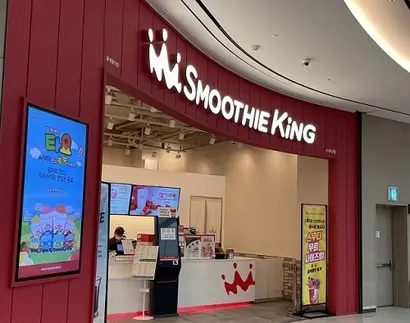
Smoothie King Korea is not the only thorn in Shinsegae Food's side. In addition to Smoothie King Korea, Shinsegae Food owns subsidiaries like Serin Foods and Better Foods Inc., both of which are also experiencing poor performance.
Serin Foods, which produces dumplings for Shinsegae Food's HMR (Home Meal Replacement) brand 'Olbaan,' has been in the red since 2022. It recorded an 806 million KRW loss in 2022 and a 100 million KRW loss last year. Better Foods, a subsidiary specializing in plant-based foods established in the U.S. in 2022, is also struggling to see results. Last year, Better Foods' operating loss was 1.18 billion KRW, and it posted a 1.128 billion KRW loss in the first half of this year. Shinsegae Food acquired the water company 'J-One' as a subsidiary in 2016, but decided to sell it in 2019 following persistent poor performance.
No Brand Burger openings slow down; is 'value for money' enough?
Shinsegae Food's policy is to decisively prune loss-making businesses and focus investment on areas with clear growth trends to improve its profit structure. In particular, the company is determined to improve the fundamental health of its restaurant business by expanding No Brand Burger, which is considered its flagship franchise. No Brand Burger launched in 2019 with a "value-for-money burger" concept, with its cheapest burger menu priced at 2,900 KRW.
Shinsegae Food previously entered the burger market in 2011 by bringing in the American handmade burger brand 'Johnny Rockets.' It attempted to target the high-end premium burger market through Johnny Rockets, but failed to gain consumer traction and exited the business in 2022. Having concluded that a premium strategy was difficult in the current burger market, Shinsegae Food launched its second attempt at the market with a low-price product strategy.
However, industry experts suggest that even in its fifth year, No Brand Burger's market presence remains minimal. An industry insider noted, "Because the number of franchisees is small compared to other brands, awareness in the market is relatively low. While Shinsegae may evaluate it as successful internally, it is difficult to say it has truly established a strong position in the market."
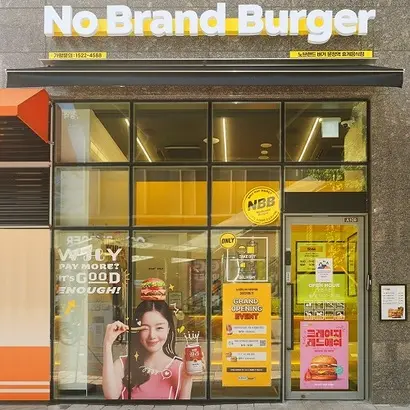
The domestic hamburger market is becoming increasingly competitive. While first-generation franchises like McDonald's and Lotteria maintain a firm grip on the market, new brands are aggressively entering the space. In particular, as consumer interest in premium burgers grows, brands like SPC's 'Shake Shack,' BHC's 'Super Duper,' and Hanwha Galleria's 'Five Guys' are gaining popularity and expanding their store counts. Recently, Hyundai Green Food also decided to introduce the American handmade burger brand 'Jaggers' to Korea.
No Brand Burger is avoiding competition with premium burgers by targeting the low-price segment, but this is also proving difficult. Frank Burger, which entered the market with a value-for-money burger concept following No Brand Burger, has already expanded to over 700 stores. In contrast, No Brand Burger has only 250 locations. Mom's Touch, the market leader in franchise store count, has exceeded 1,400 locations, while Lotteria operates around 1,300, and Burger King and McDonald's each operate around 400.
Recently, there has been a sense of slowing momentum in No Brand Burger's expansion. Last year, Shinsegae Food planned to open more than 30 new stores in the first half of the year. However, it reduced that target to 20 stores in the first half of this year. A Shinsegae Food official explained, "When we launched No Brand Burger, our strategy was to expand aggressively, but our direction has changed recently. We are now being more cautious about opening new stores to focus on efficient store operations and increased profitability rather than aggressive expansion."
Industry observers point to profitability issues behind the slower opening pace of No Brand Burger. Lee Jong-woo, a professor at Ajou University's School of Business, pointed out, "Because No Brand Burger has a low price point, it must sell in high volumes to turn a profit. The inability to increase the number of franchisees suggests that revenue per store isn't meeting expectations, making it a structure where opening more stores only increases losses." He added, "Other burger franchises are aggressively running 1+1 promotions, making it difficult for No Brand Burger to maintain competitiveness on price alone. They need to focus on developing signature menus to ensure repeat customers through differentiated recipes."