

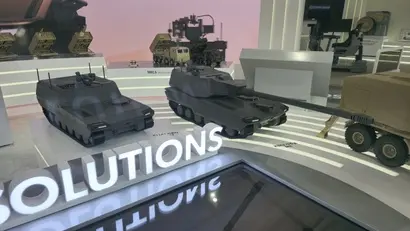
[비즈한국] At the KADEX exhibition held at the Gyeryongdae emergency runway starting on the 2nd, a model and detailed specifications of Hanwha's next-generation self-propelled howitzer, the K9A3, were unveiled for the first time. While bits of its operational concept had been known, this marks the first time a complete concept model and full performance specifications have been disclosed.
Currently, Hanwha Aerospace has produced over 1,700 K9 self-propelled howitzers for more than 10 countries, cementing its status as a "bestselling self-propelled howitzer." According to Hanwha's report, as of last year, K9s accounted for 1,787 out of 4,656 155mm-caliber self-propelled howitzers worldwide. This figure indicates that the K9 holds a 36% market share in the global self-propelled howitzer export market. However, with fierce competition from rivals, Hanwha needed to widen the gap through a "quantum leap" in artillery technology. Thus, in collaboration with the Agency for Defense Development and various domestic and international research institutes and companies, they have been pursuing the "next-next" generation howitzer project, following the K9A2.
The innovation Hanwha has chosen to fend off global competitors appears to be the "world's first Manned-Unmanned Teaming (MUM-T) self-propelled howitzer." According to Hanwha, the K9A3 is a MUM-T system that allows a single crew member to control one unit, or, depending on the situation, a few individuals to command an entire battalion of howitzers through automated operational functions.
Hanwha has selected three core technologies for this. First, it eliminates the need for a dedicated loader by utilizing the fully unmanned automated loading technology being implemented in the K9A2. Next, it applies MUM-T driving capabilities, enabling unmanned howitzers to autonomously move to firing positions or follow a lead vehicle manned by humans in a convoy mode.
Finally, there is the next-generation command vehicle: the K11A1 new command and control armored vehicle. While existing command vehicles were essentially mobile platforms for artillery commanders to issue orders and make tactical decisions, the K11A1 also accommodates crew members tasked with controlling the unmanned artillery units. In effect, it becomes a mobile, remotely operated command station.
Hanwha Systems272210 decided on these concepts for the K9A3 and the K11A1 command vehicle for two reasons. The first is to meet the South Korean military's requirements to cope with the shrinking pool of military recruits due to population decline. If the K9A3 replaces existing artillery, the number of personnel required for operations can be significantly reduced, making it possible for our military to maintain powerful artillery fire even in an era of demographic decline.
The second reason is that while the war in Ukraine has proven the importance of artillery, it has simultaneously demonstrated that artillery is highly vulnerable and easily exposed to enemy threats. The war in Ukraine is often called a "drone war," and because various suicide drones and FPV drones are active, it is easy to mistake it for a purely high-tech conflict. However, the battlefield situation is still shifting based on how much ammunition both sides expend and how effectively they conduct artillery strikes. To date, the Ukrainian military has lagged behind Russia in terms of daily artillery volume, attempting to close the gap with precision-guided munitions like the GPS-guided 'Excalibur' and HIMARS rockets, though they are currently at a disadvantage due to shell shortages. As a result, both sides are fully committed to "artillery hunting," with suicide drones prioritizing towed and self-propelled howitzers as targets, leading to massive losses for both sides.
Reflecting these lessons, Hanwha designed the K9A3 to be unmanned to minimize casualties and allow for remote withdrawal from the battlefield if hit. Meanwhile, the manned K11A1 command vehicle is equipped with various advanced defensive systems to fend off enemy attacks. Its Remote Controlled Weapon Station (RCWS) is an AI-powered remote machine gun that intercepts enemy drones with a K6 machine gun, and it is designed to mount specialized anti-drone and anti-aircraft interceptor missiles currently under development. To reflect the recent trend in Ukraine where drones are used to lay landmines, anti-mine armor has also been added to the underside of the hull.
Firepower is another key upgrade for the K9A3. Along with drone defense via the RCWS, it is equipped with a new 58-caliber gun barrel, increasing the firing range by over 20% compared to the existing K9A1 and K9A2. If the K9A3 is combined with the latest guided shells currently under research, it is expected to secure a range of 80km—nearing missile-level performance—allowing it to easily strike key targets such as enemy ammunition depots deep in the rear.
Additionally, both the K9A3 and K11A2 use integrated rubber tracks, similar to those adopted for the AS21 'Redback' infantry fighting vehicle exported to Australia, enhancing long-range operational capabilities while reducing noise and vibration to lower the risk of detection by the enemy. Hanwha is also conducting research on applying hybrid propulsion systems to the K9A3 and its next-generation armored vehicles, though specific details have not yet been finalized.