

[비즈한국] Following Israel's attack on Hezbollah, Iran—a key supporter of the group—launched 180 missiles at Israel on the 1st (local time). Immediately after, Israeli Prime Minister Benjamin Netanyahu declared his intention to retaliate, stating, "We will adhere to the rule we have established: whoever attacks us, we will attack them," signaling an escalation in the conflict between the two nations. This has caused volatility in both the New York and domestic stock markets.
The world is currently witnessing a full-scale competition over security and hegemony, fueled by geopolitical variables. From the Russia-Ukraine war to the Israel-Hamas war, there hasn't been a single day of calm. Furthermore, the far-right wave sweeping across Europe has even engulfed the Austrian general elections, and with the U.S. presidential election approaching in November, global political uncertainty is expected to persist.
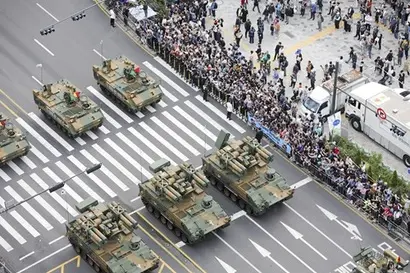
Lee Jung-hoon, a researcher at Eugene Investment & Securities, said, "The U.S., which was the world's sole hegemon, adopted a strategic shift around the time of the Obama administration to step down from its role as the 'world's police' and focus on countering China." He added, "This created a power vacuum, particularly in Europe and the Middle East, leading to the Russia-Ukraine war and the Israel-Hamas conflict." Consequently, defense stocks are being favored by investors as assets that provide both stability and growth, and which can be held comfortably after purchase.
Some investors are concerned about the future of defense stocks, as there are predictions that the Russia-Ukraine war could end this year or next. These concerns stem from the fear that demand for weapons might decrease.
Jang Nam-hyun, a researcher at Korea Investment & Securities, noted, "Defense spending will continue even after the war ends." He explained, "Considering the current defense budget plans of NATO European countries, a steady increase in defense spending is expected until at least 2028." Researcher Jang further diagnosed, "Because each country has experienced the necessity of weapon systems amid the threat of war, they will maintain their plans to increase defense budgets regardless of the end of the war." In fact, even after the end of the Vietnam War and the Iraq-Afghanistan wars, the elevated levels of defense spending were maintained for about 6 to 7 years. He stated, "The necessity of weapon systems, once ingrained through war, does not diminish in an instant."
Ultimately, individual nations must survive on their own, and the logic of power is bound to persist. This will be linked to global demand for weapons, and the outlook for the defense industry remains positive.
Because of this expectation, domestic defense stocks have remained robust despite the recent highly volatile market. While the KOSPI index fell 11.0% from 2891.35 on July 11 to 2572.09 on the 12th, and the KOSDAQ index dropped 14.2% from 852.42 to 731.03 during the same period, the combined market capitalization of five major domestic defense companies rose 9.5% from 30.3 trillion won to 33.1 trillion won.
Observations suggest that domestic defense stocks will continue to post strong earnings through next year. This is because major domestic defense firms such as Hanwha Aerospace012450, Hyundai Rotem064350, and LIG Nex1079550 are continuing to secure overseas orders. Kim Sung-ho, a researcher at Hana Securities, pointed out, "The overseas market is larger than the domestic market and offers relatively higher price points, so the expansion of domestic companies with technical prowess and price competitiveness is in full swing," adding, "This is also positive in terms of revenue and profitability."
Then, could the sentiment for defense stocks change depending on the winner of the U.S. presidential election? Experts believe it is unlikely that expectations for defense stocks will vanish, regardless of who wins. Researcher Lee Jung-hoon predicted, "It won't make a significant difference who is elected," adding, "The broader framework of the U.S. focusing on checking China will not change, and the resulting power vacuum will continue."
Recently, it is said that ESG (Environmental, Social, and Governance) funds are increasing their investments in defense companies, which they had previously avoided. In the past, they labeled defense firms as "merchants of death" and shunned them, but they have now begun to change their interpretation, viewing them as protectors of the collective against enemies and maintainers of society. The underlying reason is said to be the growing number of investors who feel disillusioned with ESG due to declining returns caused by strict ESG investment principles. It is a difficult investment reality to simply stand by and watch while the returns of defense stocks soar.