

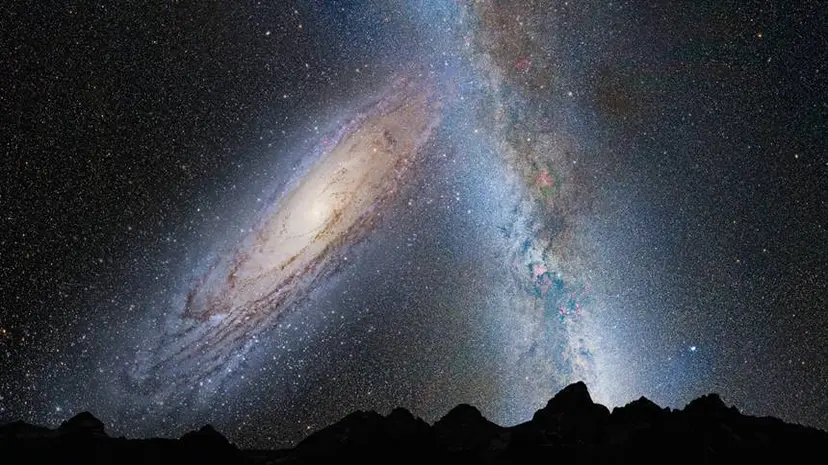
[비즈한국] What will happen in the universe in the future? Of course, astronomers are not fortune-tellers. However, we can talk about what might occur in the universe based on the belief that the physical laws we currently understand will continue to operate in the same way in the past, present, and distant future. For example, in about 4 to 5 billion years, the Sun will eventually swell up, cease its evolution, and disappear, leaving behind a planetary nebula. Whenever we talk about future cosmic events, there is one prediction that is always mentioned: the Milky Way will collide with the neighboring Andromeda Galaxy and merge into a single, massive galaxy.
In 2008, astronomers simulated the gravitational interaction between the Milky Way and the Andromeda Galaxy using a model consisting of 1.3 million particles. The results suggested that in about 5 billion years, the two would merge into a giant elliptical galaxy. This finding was quickly accepted by the astronomical community, and the idea that our galaxy is destined to collide with Andromeda has been treated as a near-certainty.
However, recent observational data has raised a surprising possibility that the future of the Milky Way might unfold in a completely different way. To put it bluntly: the Milky Way might not collide with the Andromeda Galaxy at all!
The fact that the Andromeda Galaxy is rapidly approaching the Milky Way was first discovered long ago through the spectral observations of astronomer Vesto Slipher. At the time, Slipher noticed that the spectrum of the Andromeda Galaxy was shifted toward the shorter-wavelength (blue) end. This meant the two galaxies were approaching each other at a high speed of nearly 110 km/s. It indicated that the two galaxies were slowly being drawn together by their mutual gravity.
Since then, many subsequent simulations have supported the prediction that the Milky Way and Andromeda would merge into one. Impatient astronomers even gave this future combined galaxy a catchy name: "Milkomeda" (a portmanteau of Milky Way and Andromeda), predicting it would form in 5 to 7 billion years.
Because this scenario is taken for granted in so many places, such a prediction feels entirely natural. But in truth, predicting the ultimate fate of the Milky Way and the Andromeda Galaxy is quite tricky.
First, surprisingly, astronomers still do not know the exact masses of the Milky Way and the Andromeda Galaxy. To accurately measure a galaxy's mass, one must include not only the bright, luminous stars but also the dark matter that fills the space between them. Naturally, dark matter cannot be seen directly. Instead, we must determine the galaxy's mass—the strength of the gravity holding its stars—by observing the orbital motions of stars captured by the galaxy's overall gravity.
Since we live inside the Milky Way, it might seem easy to weigh it, but that is far from the truth. In fact, it is even more difficult. It is incredibly challenging to distinguish individual stars within the densely packed Milky Way, crowded with stars and gas clouds. Astronomers' estimates for the mass of the Milky Way still vary by as much as a factor of two.
Measuring the mass of the Andromeda Galaxy is no easy task either. The distance to Andromeda is about 2.5 million light-years—a distance that is neither near nor far. While we can distinguish its satellite galaxies or globular clusters fairly well, observing individual stars remains difficult. Embarrassingly, astronomers are still not certain which of the two galaxies is more massive.
The second reason it is difficult to answer whether the "Milkomeda" galaxy will form is the existence of numerous satellite galaxies orbiting each primary galaxy. While individual satellite galaxies have only 1/100 to 1/1000 the mass of the central main galaxy, their collective number cannot be ignored. Furthermore, these satellites are separated by only tens to hundreds of thousands of light-years. Gravity weakens rapidly with distance. Therefore, the effect of these relatively nearby satellite galaxies is just as significant as the more distant Andromeda Galaxy located 2.5 million light-years away.
To date, about 60 satellite galaxies have been observed and confirmed around the Milky Way. However, astronomers estimate that there are many more, perhaps between 100 and 500, still hiding undiscovered. These satellites naturally influence the orbits of both the Milky Way and the Andromeda Galaxy. Therefore, without accounting for all of them, any prediction about the Milky Way's future cannot be perfect.
Currently, the Gaia satellite tracks not only the stars within the Milky Way but also the motions of stars within relatively nearby satellite galaxies, including the Magellanic Clouds. Thanks to Gaia’s vital work in mapping the precise 3D spatial distribution and detailed motions of hundreds of millions of stars in our vicinity, we can now foresee the future of our neighboring stars more accurately than ever before. Recently, astronomers re-simulated the galactic collision with finer detail using updated information from Gaia observations. The results are quite interesting.
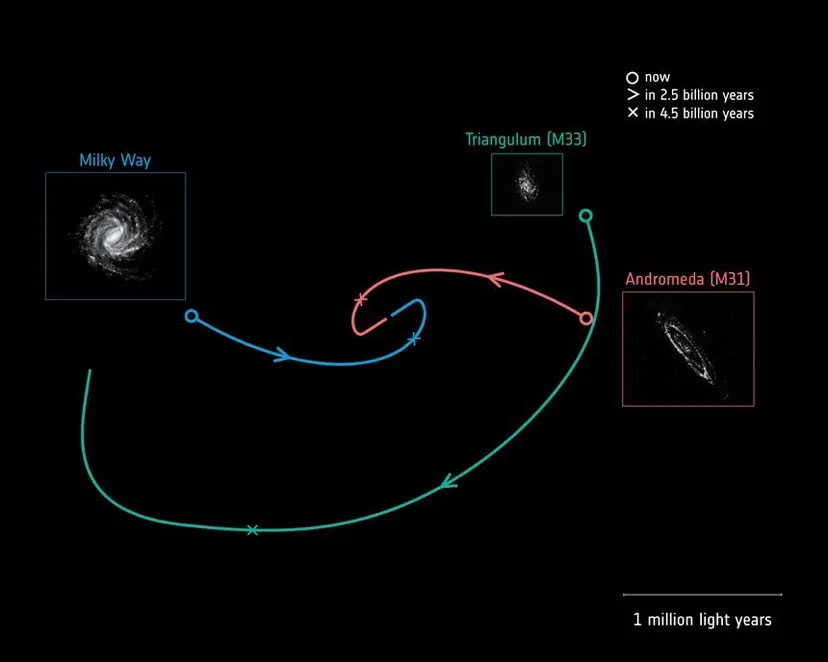
When the simulation was run setting only the Milky Way and the Andromeda Galaxy, the probability of an actual collision was found to be only 50%! While it might sound like an irresponsible prediction—a 50/50 toss-up—it is not. We had previously assumed there was a 100% chance of a collision. This means the predicted probability has suddenly dropped by half!
That is not all. Astronomers applied one more relatively large satellite galaxy to this simulation: the Triangulum Galaxy, which orbits the Andromeda Galaxy. This satellite is the third-largest in the Local Group, which centers around the Milky Way and Andromeda. Therefore, its gravity also affects the collision probability of the two giants. When the Triangulum Galaxy was factored in, the probability of a collision between the Milky Way and Andromeda rose again to about two-thirds.
However, when the Large Magellanic Cloud, which orbits the Milky Way, was also included, the probability of a collision dropped back to the 50% level. Moreover, even in that 50% scenario, the actual collision is now predicted to occur 8 billion years from now. Compared to the previous predictions that the Milky Way would inevitably collide and merge with Andromeda within 4 to 5 billion years, both the probability and the expected timing are vastly different!
Even if the two galaxies do eventually collide to form the Milkomeda galaxy, it appears this will happen much later than originally expected. By that time, it is highly likely that our solar system will have already vanished. The Sun would be in the final stages of its evolution, and the Earth would have already been absorbed into the Sun's surface. If the updated predictions are true, we do not even need to worry about whether Earth will be safe when the Milky Way collides with the Andromeda Galaxy. By then, the Earth will no longer exist.
The fact that it is this difficult to accurately predict if—or when—two massive galaxies containing trillions of stars will collide, let alone predicting when a small rock might fall onto Earth, proves how sensitive our universe is and how its fate can be changed by even the smallest variables. Will the Milky Way collide with the Andromeda Galaxy someday? I used to answer that with great confidence and as a matter of course, but now I think I need to be more cautious.
I have introduced myself as an astronomer who studies the collision and evolution of galaxies. Naturally, I thought that included the Milky Way and Andromeda pair. But, surprisingly, we might live in a galaxy whose destiny is far from a collision. Perhaps the worry about what would happen to our solar system if we collided with Andromeda in the distant future was unnecessary concern all along.
Reference
https://academic.oup.com/mnras/article/386/1/461/978865?login=false#16953981
Who is the author, Ji Ung-bae? He loves cats and the universe. After watching "Galaxy Express 999" as a child, he dreamed of sharing the beauty of the universe with others. He currently researches galaxy evolution through interactions at the Center for Galaxy Evolution Research and the Near-Universe Cosmology Laboratory at Yonsei University. He engages in various science communication activities, including lectures and writing, and has authored books such as "The Observatory of 'Sseom' (Dating)," "Thinking About the Universe All Day," and "Stars, the Science of Light."