

[비즈한국] The focus of the Yoon Suk Yeol administration's economic policy is shifting from a "war on inflation" to a "war on economic recession." President Yoon, who had been emphasizing price stability earlier this year, has recently shifted his tone toward economic recovery. Furthermore, in the "Current Economic Trends (Green Book)" published monthly by the Ministry of Economy and Finance, mentions of inflation have decreased, while concerns over the economic recovery are gradually increasing.
As the government shows signs of shifting its economic strategy from addressing high inflation to combating economic stagnation, it is expected that the Bank of Korea, which will hold its Monetary Policy Board meeting next month, will cut the base interest rate without fear of conflict with the government. However, with household debt rising due to the recent surge in real estate prices, concerns are deepening within both the government and the financial sector regarding measures to stabilize the housing market.
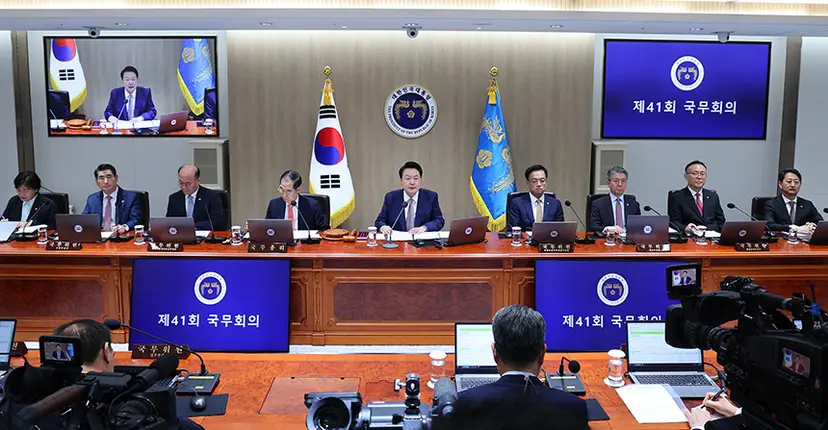
In his opening remarks at the cabinet meeting held at the presidential office in Yongsan on the 24th, President Yoon stated, "On September 19, the U.S. Federal Open Market Committee (FOMC) decided to lower the base interest rate by 0.5 percentage points for the first time in 4 years and 6 months," adding, "It is evaluated as a turning point for monetary policies that had maintained high interest rates to respond to global inflation." President Yoon continued, "There are signs that the era of high inflation and high interest rates that lasted for several years is coming to an end," and stated, "If global security and supply chain anxieties do not escalate further, inflation is expected to maintain a stable trend in the 2% range."
This is the first time President Yoon has made such confident remarks about price stability in public. Instead, he expressed concerns about the economy. President Yoon emphasized to the ministers and vice-ministers, "Due to the accumulated high inflation and high interest rates, the public's perceived economic situation is not recovering easily," urging them to "work even harder so that the government's efforts can lead to tangible changes in the public's livelihood."
In the cabinet meeting on January 16 of this year, President Yoon expressed concerns about high inflation, stating, "Small businesses are finding it hard to endure due to high interest rates and high prices," and has since continuously emphasized the need for price stability policies. Just a month ago, at the cabinet meeting on August 27, he said, "We will strengthen customized support for small business owners who are struggling with high interest rates, high prices, and declining sales," signaling that inflation remained in an unstable state. Thus, President Yoon's focus has clearly shifted from inflation to the economy.
This change is also evident in the government's assessment of the economic situation. In the "September 2024 Current Economic Trends (Green Book)" released on the 19th, the Ministry of Economy and Finance assessed the recent state of our economy by stating that "the trend of price stability is expanding." This is the first time the ministry has used the expression that the trend of stability is expanding regarding inflation. In the January Green Book, the ministry assessed that "inflationary pressure is slowing down," a sentiment it maintained until June.
This meant that although the consumer price inflation rate, which once hit the 5% range, had consistently fallen to the low 3% range this year, it was still too early to let one's guard down. This assessment of inflation changed to "the trend of price stability is continuing" in July and August, showing that the anxiety over high inflation was disappearing, and then shifted to "expansion of the stabilization trend" in September. This means that, as President Yoon stated, a stable trend in the 2% range has taken root.
On the other hand, concerns about the economy, particularly the domestic demand felt by ordinary citizens, have grown. In the September Green Book, the Ministry of Economy and Finance assessed the economy by stating that "there is a difference in speed by sector amidst signs of a moderate recovery in domestic demand." This is different from the assessment in the May Green Book, which stated, "With signs of domestic demand recovery adding to the momentum, the economic recovery trend is gradually expanding," a view it maintained until August. This reveals that the domestic demand sector is showing signs of stagnation.
In fact, consumer sentiment regarding the economy has worsened. According to the "September 2024 Consumer Survey Results" released by the Bank of Korea on the 25th, the Current Economic Judgment Consumer Sentiment Index (CSI) was 71, down 2 points from the previous month. Additionally, the Future Economic Outlook CSI also recorded 79, down 2 points from the previous month. If the CSI is lower than the baseline value of 100, it means that more consumers evaluate the economy as bad. In other words, more people perceive that the current economy is worsening and will continue to do so in the future.