

[비즈한국] As global warming increases the melting of sea ice in the Arctic Ocean, expanding the accessibility of shipping routes, the competition for hegemony over these paths is intensifying. With the U.S. Department of Defense recently strengthening countermeasures against deepening Arctic cooperation between China and Russia, a "New Cold War" is expected to unfold in the Arctic as well.
In particular, regions adjacent to the Arctic, such as Europe and Canada, have begun actively responding by increasing defense budgets due to security concerns. More opportunities are also expected to open up for domestic defense companies that have been working hard to export to the U.S. and NATO.
Due to advancements in science and technology and the effects of climate change, the Arctic has become a region that can be traversed more freely than in the past. According to the academic journal Nature Communications, it is predicted that by the 2030s, there will be virtually no ice left in the Arctic during September, the month with the least amount of sea ice.
This is very welcome news for Russia, as it makes it easier to project its influence externally through the Arctic Ocean. Russia can place the shortest route connecting Europe and East Asia under its own control. Currently, cargo ships in East Asia use a route of about 20,000 km that passes through the Indian Ocean and the Suez Canal to reach the Netherlands' Rotterdam, the largest port in Europe. However, when using the Arctic route, the distance is only about 9,650 km, cutting the journey by more than half. With the shipping distance reduced by about 32%, billions of won in Suez Canal transit fees and various costs, as well as time, can be saved.
China is also expressing its intention to actively enter the Arctic Ocean. In 2018, China published a white paper defining itself as a "Near-Arctic State." Along with the goal of transporting Russian crude oil and liquefied natural gas (LNG), it is actively pursuing entry into the Arctic Ocean for military purposes to counter Western powers such as the U.S.
Russia currently appears diplomatically isolated in the Arctic. Following the war with Ukraine, Western countries belonging to the Arctic Council, an association of eight Arctic nations including the U.S., Canada, Finland, and Norway, have suspended all cooperation. Consequently, Russia is strengthening its influence by drawing China in as an ally. Since 2022, Russia and China have conducted joint military drills in the Arctic, creating an atmosphere of military tension. Last July, four strategic bombers from the two countries (H-6 and Tu-95) conducted a joint aerial strategic patrol that reached the airspace around Alaska in the U.S.
Western countries, including the U.S. and those in Europe, are expressing vigilance regarding the military advancement of Russia and China into the Arctic. The U.S. established an "Arctic Ambassador" position last year and is increasing its investment in military power. NATO member countries have pledged to spend at least 2% of their GDP on their national defense budgets.
Canada, also a NATO member, announced a defense policy titled "Our North, Strong and Free" earlier this year to strengthen defense in the Arctic circle. The country plans to spend 73 billion Canadian dollars (approximately 71.6341 trillion won) on various defense projects, including the addition of early warning aircraft, a new helicopter fleet, the construction of Arctic infrastructure and maritime sensors, and the expansion of large-scale munitions stockpiles. It has also entered into the official process of acquiring 12 new submarines.
This international situation is expected to become a new opportunity for South Korean defense companies that have been focusing on entering European and American markets. In particular, South Korean companies are expected to actively enter Canada, which is recently discussing security cooperation. Canadian Minister of National Defence Bill Blair, who visited South Korea to attend the Seoul Defense Dialogue (SDD) and the Korea-UN Command Member States Defense Ministerial Meeting, met with Minister of National Defense Kim Yong-hyun on the 11th to discuss ways to strengthen defense cooperation. The ministers of both countries agreed to actively explore mutual cooperation opportunities in Canada's power reinforcement projects.
However, intense competition is expected as shipbuilding companies from Japan, Germany, France, Spain, and Sweden are also preparing to bid for the submarine projects. South Korean defense companies are expected to highlight their marketing strategies based on their experience in exporting submarines.
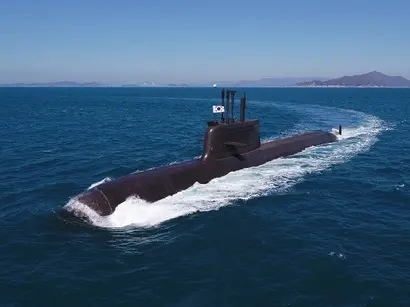
Hanwha Ocean plans to propose the 3,000-ton Jangbogo-III submarine currently operated by the South Korean Navy. It is equipped with combat and sonar systems with improved detection and target processing capabilities, and the latest noise-reduction technology has also been applied. It is the second in the world to be equipped with a lithium battery system, which enhances underwater operational endurance compared to the lead-acid batteries used previously. Automation technology has been introduced to reflect the nature of submarines that must operate underwater for long periods. An industry official explained, "Canada wants a submarine capable of operating even under ice," adding, "Companies will only be able to win the contract if their attack capabilities and maneuverability function normally even when deployed in the Arctic."