

[비즈한국] Until the 1990s, when humanity spoke of "planets," the word referred exclusively to the planets in our solar system orbiting the Sun. While people imagined that there might be exoplanets orbiting other stars beyond our solar system, they remained purely theoretical—their existence had never been proven. However, as the 1990s passed, we finally began to capture tangible data on exoplanets. Today, thanks to the immense success of various space telescopes like the Kepler Space Telescope and TESS, we have confirmed over ten thousand exoplanets and candidate celestial bodies. The term "planet" no longer refers only to those in our solar system. Instead, it encompasses the countless planets orbiting other stars across the universe.
In fact, the primary goal behind humanity's search for exoplanets is clear: to find places capable of supporting life, like Earth. Research on exoplanets naturally leads to the search for extraterrestrial life. To meet the conditions for sustaining life, a planet must be at an appropriate distance from its host star and possess a solid, rocky surface, much like Earth. A cloud-covered gas planet like Jupiter would lack a solid surface for life to exist on.
So, how many exoplanets discovered by humanity to date meet conditions similar to Earth? In reality, that proportion is quite small. Instead, as we turned our gaze beyond our solar system, we discovered many strange types of exoplanets that we never expected to find. These are gas giants as large as Jupiter, yet they orbit so closely to their host stars that they are intensely hot. These peculiar planets are classified as "Hot Jupiters."
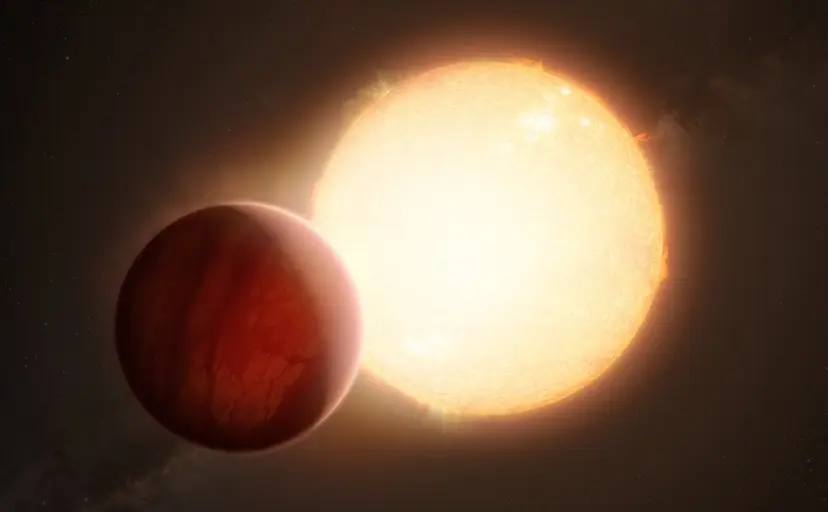
Hot Jupiters do not exist in our solar system. The massive gas giants we see, such as Jupiter, are all located in the cold, outer regions far from the Sun. This is easily understood: in areas far from the Sun, gas does not dissipate and remains available to form gas planets composed of relatively light elements. Conversely, inside the solar system, small, solid, rocky planets like Earth, made of heat-resistant materials and metals, would have formed. The principle that solid, rocky bodies form near a star while light, cloudy gas giants form in the outer regions seemed perfectly logical based on our own solar system.
However, once astronomers learned of the existence of exoplanets and began to grasp their detailed characteristics, they became confused. Our understanding of how planetary systems form did not seem to apply to most exoplanets outside our solar system. How should we understand Hot Jupiters? How could fragile gas planets end up scorched and huddled so close to their host stars? Perhaps our solar system is actually a rare case, with its planets arranged in a unique order compared to the rest of the universe?
For a long time, astronomers believed that Hot Jupiters could not have existed in their current state from the very beginning. They reasoned that it is difficult for a planet made only of light gas to form stably in an orbit so close to a star, completing a revolution in less than 100 days. Instead, they hypothesized that these gas planets were originally born in the outer reaches of their system and migrated toward the center due to some disruptive event. In other words, it was a planetary version of migration. Recently, astronomers discovered stunning observational evidence that validates this scenario for the origin of Hot Jupiters!
In 2020, using the TESS space telescope, astronomers discovered an exoplanet orbiting a star called TIC 241249530, located approximately 1,100 light-years away. They used the "transit method," observing the slight dimming of the host star's light as the planet periodically passed in front of it. Later, astronomers used another method to determine the exoplanet's mass. As a planet orbits its star, they exert mutual gravitational forces, causing the host star to wobble slightly. By measuring this movement, they can determine the gravitational influence of the planet—and thus, its mass. According to the astronomers' observations, the planet TIC 241249530b is a massive gas giant with about 4.98 times the mass of Jupiter—essentially equivalent to five Jupiters combined.
This exoplanet orbits its host star with a short period of only about 165 days; its "year" is half as long as an Earth year. More surprisingly, the orbit of this planet is an extremely elongated ellipse. After consistent observation of the planet's movement, astronomers confirmed that its eccentricity is 0.94. An eccentricity close to 1 means it is so highly elongated that it is almost a straight line.
If this planet were orbiting our Sun, it would approach 10 times closer than Mercury at its closest point (periastron) and reach as far out as Earth's distance at its farthest point (apastron). Among all planets discovered to date, this exoplanet follows the most severely elongated elliptical orbit. It is almost more like a comet than a planet. Furthermore, it is in a retrograde orbit, moving in the direction opposite to the rotation of its host star.
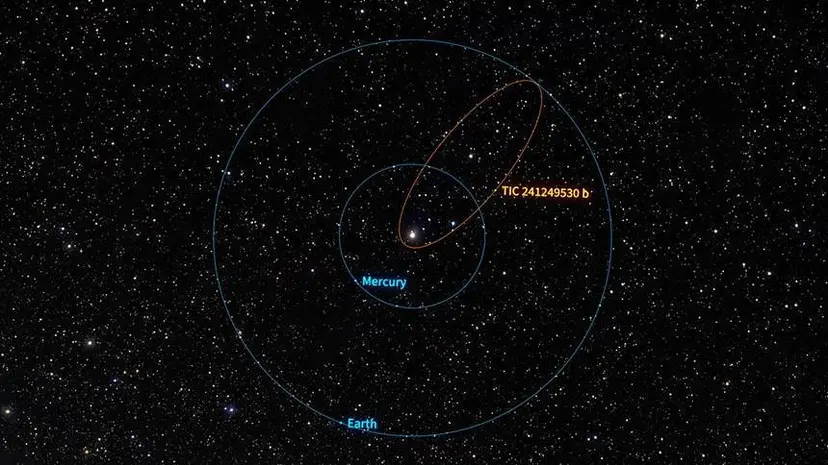
This unique movement is caused by the fact that the host star is part of a binary system. In this study, astronomers used simulations to reconstruct the dynamical evolution of this planet and its unusual orbit. They also predicted how the planet’s orbit will change over the next billion years.
Originally, this planet was likely a gas giant that formed at a significant distance from its host star. However, the gravitational interaction with the other star in the binary system caused its orbit to become severely distorted, leading to its current extreme eccentricity. According to the simulation, the planet's orbit will eventually shrink as it drifts closer to the host star it currently orbits. It will eventually settle into a small, circular orbit huddled close to the star—the type of orbit we refer to today as a Hot Jupiter.
With such an extremely elongated orbit, the atmosphere of this exoplanet would be highly erratic. The amount of stellar energy reaching the planet's surface would fluctuate drastically between its closest approach to the star and its farthest point. Simply put, temperatures could fluctuate from 1,200 degrees at their hottest to 200 degrees at their coldest. Previously, the planet with the most extreme elliptical orbit discovered by humanity was HD 80606 b, which also has an eccentricity of 0.93, close to 1. Now, that record has been broken. For both planets, the extreme orbits suggest that their atmospheric circulation systems and seasonal changes are equally extreme.
As we continue to find exoplanets with extreme eccentricities, we gain clues into the origins of the Hot Jupiters that have long puzzled us. Hot Jupiters likely did not start out in their strange state. Instead, they were likely subjected to persistent perturbations by the gravity of a nearby star or a massive planet, causing their orbits to distort and gradually draw them toward their host star, resulting in the "terrible" orbits we see today. Planets with highly elongated elliptical orbits demonstrate the process by which "Cold Jupiters" transform into Hot Jupiters.
Since we have not searched every star beyond our solar system, we cannot yet say for certain whether our solar system is a rare case or if "peers" like us are common. However, it is certain that the environments and appearances of planets in the universe are far more diverse than we ever imagined. There are undoubtedly exoplanets hidden somewhere in the universe with characteristics beyond our wildest imagination.
References
https://www.nature.com/articles/s41586-024-07688-3
About the author, Woong-bae Ji: Loves cats and the universe. After watching "Galaxy Express 999" as a child, he dreamed of sharing the beauty of the cosmos. He currently researches galaxy evolution through interactions at the Yonsei University Galaxy Evolution Center and the Near-Field Cosmology Laboratory, and engages in various science communication activities including lectures and writing. He is the author of books such as "Thumb-taping Observatory," "Thinking About the Universe All Day," and "Star, The Science of Light."