

[비즈한국] As the U.S. Federal Reserve (Fed) implemented an interest rate cut for the first time in four and a half years, what stance should investors maintain? The Fed announced on the 18th (local time) at the conclusion of its two-day Federal Open Market Committee (FOMC) meeting that it would lower the benchmark interest rate by 0.5 percentage points, from the previous 5.25–5.50% to 4.75–5.00%. The Fed also lowered its year-end interest rate projection in its "dot plot" from 5.1% to 4.4%, signaling an additional 0.5 percentage point cut within the year.
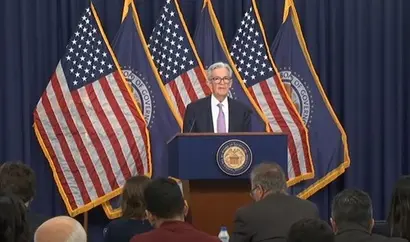
In a statement that day, the Fed assessed that "recent indicators suggest that economic activity has continued to expand at a solid pace," adding that "job gains have slowed, and the unemployment rate has moved up but remains low." It further noted that "inflation has made further progress toward the FOMC’s 2 percent objective but remains somewhat elevated," but added, "The Committee has gained greater confidence that inflation is moving sustainably toward 2 percent, and judges that the risks to achieving its employment and inflation goals are roughly in balance."
The U.S. stock market, which showed little movement despite the Fed's "Big Cut" on the day of the announcement, rallied on the 19th as the perception that it was an "insurance cut" spread. Since most experts initially expected a "0.25% cut," the market interpreted the Fed's Big Cut (0.5 percentage point reduction) as a preemptive measure to prepare for a slowdown in employment.
Heo Gyeong-hwan, an analyst at Eugene Investment & Securities, analyzed, "While the Fed's action to pivot its monetary policy for the first time in 30 months was bold, their rhetoric showed an effort to dispel economic anxiety and soothe the market." Lee Kyung-min, an analyst at Daishin Securities, also assessed, "With inflation nearing the Fed's target, starting a rate-cutting cycle reveals the Fed's commitment to controlling economic and employment instability."
Ultimately, since the U.S. economy has not severely deteriorated and the Fed remains optimistic about a soft landing, experts suggest that the risk of a stock market decline due to growing economic concerns from this Big Cut is limited. Lee Kyung-min of Daishin Securities explained, "There are historical cases where a rate-cutting cycle in a non-recessionary environment became a powerful driver for global stock markets and risky assets. 1995, 1998, and 2019 are prime examples. Even though stock markets fluctuated around the time of the rate cuts back then due to economic and financial sector instability, they rose by 20–30% from their lows when considering a 6-month to 1-year investment horizon."
Lee Jung-hoon, an analyst at Eugene Investment & Securities, also stated, "Historically, the Fed's Big Cut was not a sufficient condition for stock market declines; rather, it was often the case that a stock market plunge itself triggered the Big Cut." The analyst added, "Currently, the 0.5 percentage point cut was implemented near all-time highs, and the Fed does not view the economy as being in a critical state. Although earnings indicators are slowing, there is no reason for a rate cut to be accepted as negative news when the economy is not in severe decline."
However, the KOSPI index remains sluggish even after the U.S. Big Cut. Why is that? While the U.S. and Japanese stock markets rose 2–3% in the two days following the Big Cut, the KOSPI index showed almost no change. The sluggishness of the domestic market is due to massive foreign selling driven by concerns over the semiconductor industry. The semiconductor sector has been in a 30% slump since July 11.
Analyst Lee Kyung-min said, "Since July 12, there has been 12.04 trillion won in foreign selling in the semiconductor sector, with 6.7 trillion won in September alone. Foreigners are not selling the entire KOSPI, but primarily the semiconductor sector." He projected, "The valuations of Samsung Electronics005930 and SK Hynix000660 are nearing historical lows, and the Micron Technology earnings release on September 26 and the disclosure of Samsung Electronics' earnings guidance in early October will be turning points."