

[비즈한국] From a decision-maker for base interest rates to a think tank. The ‘Bank of Korea’ (BOK) under Governor Rhee Chang-yong is drawing the financial sector's attention day after day. To put it positively, it is groundbreaking; to put it negatively, it is at the center of controversy. This is because the BOK, which was once quiet, conservative, and closed-off, is now voicing opinions on various social issues. The prevailing mood in the financial sector is to give a 'positive assessment' of the BOK’s transformation. However, some also criticize it, asking, 'Is this not a move for a future political run?'
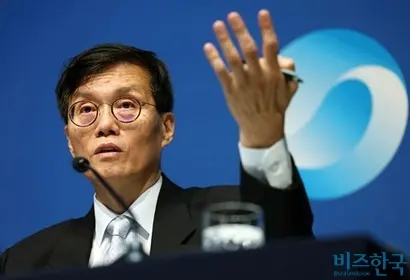
From interest rate decision-maker to think tank
The Bank of Korea is our country's central bank and the issuing bank for currency. However, one of its most important roles is to establish and implement monetary and credit policies, determining the money supply or interest rates to keep them at appropriate levels through various policy tools.
However, the BOK’s changed appearance has become a subject of controversy this year. It started with a report on care costs released in March this year. Addressing chronic problems in our society like aging and low birth rates, the report suggested lowering nursing and childcare costs. It even proposed methods to bypass minimum wage laws, such as directly hiring foreign workers. In the report, the BOK suggested, "Considering the low productivity in the care service sector, applying a slightly lower minimum wage to this sector could improve efficiency for the economy as a whole." This sparked backlash from the labor sector.
Three months later, the BOK pointed out 'agricultural product prices' in a price report. It suggested expanding imports, noting that agricultural prices in Korea are exceptionally high compared to other OECD countries. At the time, BOK Governor Rhee Chang-yong also remarked, "While it might be an excellent policy from the perspective of protecting farmers if we do not import everything, like apples, the volatility could become very high," adding, "Wouldn't it be better to promote the diversification of imports?"
In response, Minister of Agriculture, Food and Rural Affairs Song Mi-ryung stepped forward personally to rebut the claim, stating, "(The BOK) is not an expert in the agricultural field. There is no major correlation between importing more and prices falling."
Nevertheless, the BOK did not stop. Last month, it even touched upon the most sensitive issue: the university entrance exam system. It argued that parents' economic power or residential area determines admission to top universities more than a child’s potential, and suggested selecting top university enrollment quotas based on the ratio of the school-age population by region. It proposed that selecting students based on the regional school-age population ratio is a way to resolve structural social problems such as the concentration of population in the metropolitan area, rising house prices in Seoul, and low birth rates caused by entrance exam inequality. This time, Governor Rhee Chang-yong also spoke up directly, mentioning, "It would be very realistic if we just controlled it so that the number of students from specific regions (like Seoul or Gangnam) does not exceed a certain percentage of the enrollment quota."
Topic-worthiness grows along with the number of reports
The reason the Bank of Korea, which used to be conservative and only made refined statements to the media, has begun throwing out such controversial topics stems from the 'think tank role' proposed by Governor Rhee Chang-yong. Governor Rhee determined that the BOK's role could not be confined only to the framework of monetary policy, and judged that it should also propose sensitive policies in the face of structural problems such as low birth rates, aging, income inequality, and education gaps.
There is an assessment that he is continuing groundbreaking steps by reborn as a 'noisy BOK' for the sake of such structural reform.
The BOK Issue Note is one of the Bank of Korea's research reports. In fact, a total of 94 BOK Issue Notes have been released since April 2022, when Governor Rhee took office; this is a two-fold increase from the average of 17 reports per year in the three years prior to his inauguration to 36 reports per year after.
The topics have also expanded to society as a whole. Moving beyond the central bank's traditional concerns such as inflation, employment, interest rates, and exchange rates, it has started to boldly voice opinions on areas where structural reform is needed, including the economy, society, labor, and education.
At a symposium where the BOK presented a report on education, Governor Rhee Chang-yong addressed this change, saying, "The reason the BOK is interested in long-term structural reform is that these issues are not irrelevant to deciding monetary policy in the short term." He diagnosed, "As structural problems have accumulated over decades, they have reached a level where they restrict choices even for short-term macroeconomic policies like monetary policy."
In the financial sector, positive evaluations of BOK Governor Rhee Chang-yong have increased. An official from a state-run bank explained, "The general mood is to evaluate the Bank of Korea's changed appearance as 'positive'," adding, "Even if the proposals are not necessarily accepted, I believe that thinking about real estate, stocks, and inflation centered on interest rates from a macroscopic perspective is a role the Bank of Korea can play."
However, some criticize it as exceeding the duties of a central bank. In particular, there is no small amount of speculation in the financial industry that Governor Rhee might be thinking about a 'political run.' A financial authority official analyzed, "Because he is even making proposals regarding education in relation to real estate issues, there is talk about whether Governor Rhee is keeping the possibility of a future political run in mind," adding, "As he is attempting various things, it is inevitable that various interpretations will arise."