

[비즈한국] Hanwha has proposed integrating an 'Anti-Ship Ballistic Missile' (ASBM)—capable of striking not only ground targets but also ships—into the 'HOMAR-K', the Polish export version of its multiple rocket launcher system. This marks the first public disclosure of such a domestic ASBM, a weapon system currently possessed by only a few nations including China, Iran, and the United States, and is expected to significantly boost the export competitiveness of Hanwha’s multiple rocket launchers.
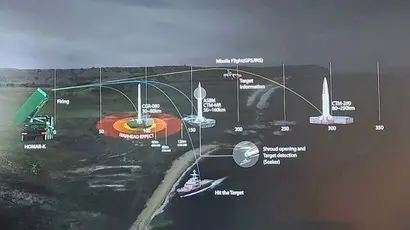
At the MSPO 2024 defense exhibition held in Poland last September 4th, Hanwha finalized a local production contract for the CGR-80 guided rockets for the HOMAR-K, an improved version of the Chunmoo multiple rocket launcher already exported to Poland. Hanwha has agreed to export a total of 290 HOMAR-K systems, along with CGR-80 guided rockets and CTM-290 ballistic missiles. In addition, it appears they have proposed the ASBM as part of a sales effort to export further munitions.
Hanwha's proposal involves integrating new CTM-MR and CTM-MR ASBM missiles into the HOMAR-K. The CTM-MR is a guided missile with a diameter of approximately 280mm. It is a 160km-class missile, filling the range gap between the 80km-range CGR-80 and the 290km-range CTM-290. A single Chunmoo or HOMAR-K vehicle can carry eight CTM-MR rounds.
Hanwha’s concept involves modifying the CTM-MR missile—which is originally guided only by GPS/INS and cannot attack moving targets—to include the capability to track and sink ships, effectively converting it into an ASBM. To achieve this, an infrared (IR) seeker is added to the nose of the existing CTM-MR missile. This seeker is protected by a shroud similar to a cap during launch, which is jettisoned in the terminal phase to allow the seeker to track enemy vessels. This structure is similar to the ABM (anti-ballistic missile) seeker used in Hanwha’s L-SAM, also known as the ‘Korean THAAD’.
Because the infrared sensor detects exhaust heat from the ship's engines and thermal radiation from the hull, it is immune to electronic jamming, and since the missile does not emit its own radar signals, it is highly suitable for an ASBM seeker. Some countries that have already developed ASBMs use radar or anti-radiation seekers, which are easily detected in advance or susceptible to electronic deception.
If Hanwha’s ASBM enters development, it would be the fourth in the world to be operationalized, following Russia, China, Iran, and the United States. Countries like Russia and China have developed or deployed ballistic missiles nicknamed 'aircraft carrier killers,' such as the R-27K or the DF-21D. China’s DF-21D, in particular, has a range exceeding 3,500km and poses a significant threat to U.S. aircraft carriers, serving as a core weapon system for China's Anti-Access/Area Denial (A2/AD) strategy.
Iran has modified smaller missiles into ASBMs, and while their range is shorter than those of Russia or China, they are currently deployed in active service. Recently, they supplied ASBMs to Houthi rebels, who have used them to launch indiscriminate attacks on merchant vessels passing through the Gulf, significantly threatening regional security.
The U.S. is also considering equipping its M142 HIMARS, a competitor to the Chunmoo, with an ASBM. The 'PrSM' (Precision Strike Missile), the next-generation missile for HIMARS, is limited to land-attack capabilities in its initial production, but upcoming improved versions are planned to feature ship-attack capabilities, similar to the Chunmoo’s CTM-MR ASBM. Beyond these, India and North Korea are also estimated to possess or have tested ASBM technology.
It is highly encouraging that Hanwha’s multiple rocket launcher is expanding its role to include ASBM missions, which is expected to contribute greatly to future export competitiveness. Although a 160km range is relatively short for an ASBM, Iran has already demonstrated the effectiveness of short-range ASBMs in confined maritime environments.
In particular, for Poland—the recipient of this ASBM proposal—integrating the Hanwha CTM-MR ASBM into its coastal defense system would allow it to blockade the Russian enclave of Kaliningrad without the need for warships. By employing a 'mixed-strike' tactic with the already-purchased Norwegian Naval Strike Missiles (NSM), it would be impossible for Russian warships to intercept the incoming threats.
Furthermore, Saudi Arabia and the United Arab Emirates, which have also purchased the Chunmoo, may show high interest in the CTM-MR ASBM to counter the Iranian Navy in the narrow Persian Gulf. There is also potential for selling Chunmoo rockets as a coastal defense system to countries that may be hesitant to purchase U.S.-made ASBMs.
However, as the CTM-MR missile was developed independently by the company and has not yet been adopted by the South Korean military, it seems necessary for our military to also consider 'Multi-Domain Coastal Defense' using the CTM-MR ASBM. Developed nations, including the U.S., are already researching concepts where the army conducts maritime blockades and denial operations using missiles as part of multi-domain operations. By using the Chunmoo ASBM, which can strike both land and sea targets, rather than expensive dedicated anti-ship missiles, it is projected that a 'three-tier coastal defense missile force' composed of Bigung, Biryong, and Chunmoo ASBMs could be completed.
Another task is the operationalization of an extended-range ASBM. Hanwha Aerospace012450, the manufacturer of the Chunmoo, and the Agency for Defense Development (ADD) have been researching a Korean-style ASBM for several years, mimicking the concepts of ASBMs deployed by China. If an infrared seeker and terminal maneuvering wings, like those on the CTM-MR, are added to the warhead section of Hyunmoo 2/4/5 ballistic missiles, they could strike enemy aircraft carriers at distances of around 500km, which would be a significant help in suppressing enemy naval power.