

[비즈한국] As the social fallout from large-scale "deepfake" sex crimes grows, the National Assembly is rushing to churn out various bills. Under current law, deepfake synthetic media—unlike illicitly filmed material—carries lighter sentences and cannot be punished if there is no intent to distribute, leaving a dangerous loophole in the legal system. With growing public pressure to strengthen punitive measures, the National Assembly has begun to respond, but critics point out that it remains to be seen whether this will actually lead to effective legislation that fills the institutional void.
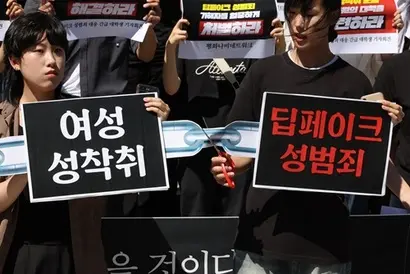
Over 50 bills poured out after massive Telegram ‘deepfake’ sex crime outbreak
As damage from deepfake-based illicit synthetic media sex crimes spreads widely across university campuses, elementary, middle, and high schools, and even the military, bills related to the issue are flooding into the National Assembly. An analysis of the National Assembly's legislative information system shows that a total of 54 related bills have been proposed from late last month, when the massive deepfake sex crime crisis emerged, to the present. Among these, 35 bills explicitly mention "deepfake" in their reasons for proposal and main content.
Over the past four weeks, the National Assembly has been eager to develop countermeasures against illicit synthetic media. Of the 54 related bills uploaded to the legislative information system between the 27th of last month and September 20, about half (25) were "amendments to the Act on Special Cases Concerning the Punishment, etc. of Sexual Crimes." The main focus was on expanding the scope of punishment to include the production, possession, purchase, or viewing of sexually explicit false videos, even without the intent to distribute, and increasing statutory penalties for perpetrators. Individual bills proposed measures such as: △aggravated punishment for habitual acts (proposed by Representative Hwang Myeong-seon); △establishing a basis for "undercover and anonymous investigations" for digital sex crimes against adults (proposed by Representative Cho Eun-hee); and △the creation of a "preservation order system" that allows investigative agencies to directly delete or preserve victimized media (proposed by Representative Park Eun-jeong).
Three "amendments to the Act on the Prevention of Sexual Violence" were also proposed to strengthen state-level support for victims. Under current law, the "Digital Sex Crime Victim Support Center" handles victim support, but these measures were prepared in recognition that there is no legal basis to support the deletion of illicitly filmed or synthetic media.
Bills have also been successively proposed to improve distribution structures, including "amendments to the Information and Communications Network Act" (11 cases) and "amendments to the Act on the Protection of Children and Juveniles against Sexual Abuse," which strengthens punishment for blackmail and coercion using child/juvenile sexual exploitation material (8 cases). Additionally, legislation is being pushed for other bills, such as the "Teacher Support Act" (1 case) which outlines methods to protect teachers including video deletion, the "Act on Special Cases Concerning Expedited Legal Proceedings" (2 cases) regarding compensation for medical expenses and consolation money, the "School Violence Prevention Act" (1 case), the "Probation Act" (1 case), and the "Korea Communications Commission Establishment Act" (1 case).
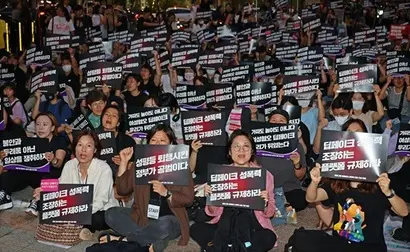
“Must punish even without intent to distribute”: How to ensure the effectiveness of anti-deepfake laws
Looking at the timing of the proposals, the first week after the crisis broke out focused on strengthening punishment for individuals involved in the crime, while subsequent efforts have shifted toward detailed alternatives applicable to platform environments and educational settings.
Unlike directly filmed illegal videos, falsely synthesized videos are not currently subject to punishment under existing sexual violence laws. This legal gap arose due to the difference in regulations between filmed videos and synthetic videos. Considering the severity of the situation—where over 200,000 people participated in channels sharing sexual exploitation material that mocks acquaintances, and financial transactions took place involving illicit synthetic media—legislation to overcome the limitations of current laws is essential. Experts explain that simply increasing sentences will not lead to a fundamental solution. Heo Min-sook, a legislative researcher at the National Assembly Research Service, emphasized, "There were 240,000 requests for deletion support related to deepfake incidents last year, but only about 100 cases were prosecuted. Considering that more than half of those resulted in suspended sentences, it is more appropriate to set minimum sentencing standards rather than just increasing the maximum. If the condition of 'intent to distribute,' which is difficult to prove, remains in the punitive regulations, effective sanctions are impossible. We must first establish the principle that 'producing material against the subject's will is a punishable offense.'"
Critics also point out the need to break the cycle where politicians focus on issues only immediately after a major incident occurs, only to let the passing of bills fizzle out. Lee Yoon-ho, a chair professor in the Department of Police Administration at Korea Cyber University, pointed out, "There is no supply of illicit synthetic media without demand. It is a problem that can only be solved by strongly punishing not only the producers and distributors but also the consumers. The National Assembly is churning out bills now because it cannot ignore public sentiment, but when attention to the issue wanes, these bills often fail to pass. The ruling and opposition parties must agree on a proper proposal and cooperate to ensure it is passed."
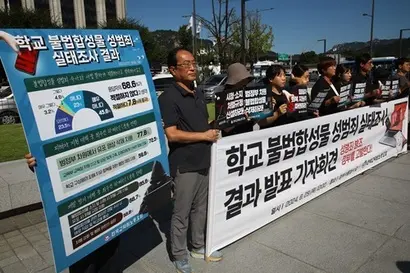
It is also painful to note that most of the bills proposed this time were ones that had been discarded due to the expiration of the term of the 21st National Assembly. The necessity of punitive regulations for the possession, purchase, viewing, or storage of false videos was mentioned during the discussions on the "Nth Room Prevention Act" in 2020, but it was not included in the final amendments. This was highlighted during an emergency debate held by the National Assembly's Science, ICT, Broadcasting, and Communications Committee, which oversees deepfake sex crime issues. The consensus is that there is a need to check the effectiveness of these bills, rather than resorting to "pan-in-the-fire" legislation.
Kim Myung-joo, a professor in the School of Information Security at Seoul Women's University, pointed out the importance of related education, noting that AI education for children and adolescents has been almost non-existent. Professor Kim noted, "Through digital and AI ethics education, we must make children and adolescents aware that AI is a current technology and extinguish any criminal intent. To eradicate deepfake sex crimes, we must hold the platforms used as distribution channels accountable, in addition to the producers and distributors of sexual exploitation material."
Legislative researcher Heo Min-sook said, "The police have thus far cited limitations such as cooperation issues with overseas platforms and a lack of authority. The police should actively demand legislation for the areas that have hindered digital sex crime investigations, and the Korea Communications Standards Commission and the National Assembly must work together to establish principles to create powerful eradication measures."