

[비즈한국] With forecasts emerging that another large-scale tax revenue shortfall is expected this year, following last year's 56 trillion won deficit, concerns are mounting over the government's tax revenue projections during budget planning. Budgets are designed to balance government expenditures and revenue, but the figures fail to align every year. As tax revenue errors have been widening recently—and specifically showing a significant negative gap (tax shortfall) under the Yoon Suk Yeol administration—critics point out that the fiscal soundness the government has emphasized may now be out of reach.
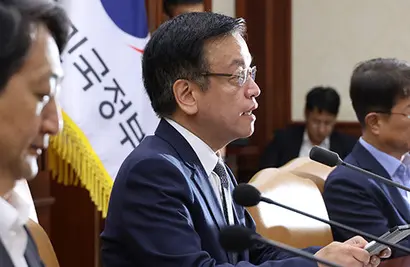
On the 2nd, during a general policy inquiry at the National Assembly's Special Committee on Budget and Accounts, Deputy Prime Minister and Minister of Economy and Finance Choi Sang-mok responded to a question from Democratic Party lawmaker Kim Young-hwan regarding whether a "tax revenue shortfall of 32 trillion won could occur this year," by saying, "If things continue this way, that is the case." The head of the nation's fiscal affairs has effectively admitted that a tax revenue shortfall could occur for two consecutive years. Although the government projected that it could collect 367.3 trillion won in taxes this year, only 208.8 trillion won had been collected by July, which is 8.8 trillion won less than the same period last year. If this trend continues, the possibility of a 32 trillion won shortfall is being raised, and Deputy Prime Minister Choi has essentially acknowledged it. The problem is that the gap between the government's projected tax revenue and the actual amount collected is not only occurring every year but is even widening.
According to the Ministry of Economy and Finance and other sources, the average error rate between the government’s projected tax revenue and actual tax revenue during the five-year period from 2006 to 2010 was 3.46%. During these five years, the largest error rate occurred in 2007, when the projected tax revenue was 147.3 trillion won, but the actual revenue was 161.5 trillion won—14.2 trillion won higher—resulting in an error rate of 9.6%. The year with the smallest error rate was 2009, with a projection of 164 trillion won and an actual revenue of 164.5 trillion won, an increase of 500 billion won, resulting in an error rate of 0.3%.
A fortunate aspect was that from 2006 to 2010, tax revenue exceeded projections in all cases. During the five-year period from 2011 to 2015, the average error rate was 2.78%, showing a smaller range of error compared to the previous five years. However, excluding 2011 and 2015, the years 2012–2014 saw three consecutive years of tax shortfalls compared to projections. In particular, in 2014, the actual revenue was 205.5 trillion won, which was 11 trillion won less than the 216.5 trillion won projection, resulting in an error rate of 5.1%.
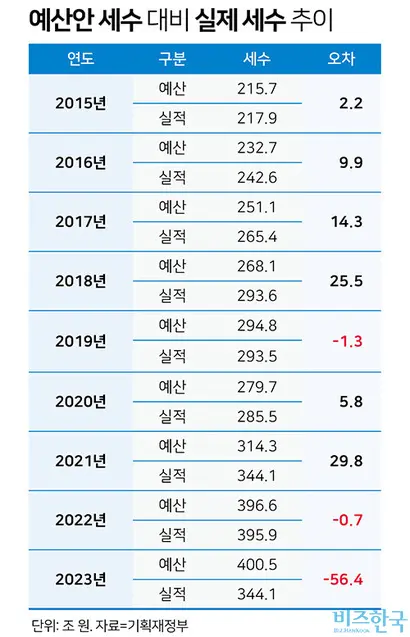
The error rate began to widen thereafter. The average tax revenue error rate from 2016 to 2020 increased to 4.40%. While it was fortunate that the error was positive in four out of five years, concerns began to grow that there might be a problem with the government's forecasting system, given the expanding tax revenue gap. In 2018, the tax revenue reached 293.6 trillion won, which was 25.5 trillion won higher than the 268.1 trillion won projection, resulting in an error rate of 9.5%. In 2019, a shortfall was recorded as 293.5 trillion won was collected, 1.3 trillion won less than the 294.8 trillion won projection.
The error rate grew rapidly after 2021. The average tax revenue error rate for the three years from 2021 to 2023 reached 7.93%. If this year’s tax revenue falls 32 trillion won short of the initial budget, as admitted by Deputy Prime Minister Choi, the average tax revenue error rate from 2021 to 2024 will reach 8.38%, double that of the previous five-year period. A bigger problem lies in the fact that tax revenue shortfalls have become continuous under the Yoon Suk Yeol administration. In 2021, the final year of the Moon Jae-in administration, tax revenue was 344.1 trillion won, which was 29.8 trillion won higher than the 314.3 trillion won projection, resulting in an error rate of 9.5%.
On the other hand, in 2022, the first year of the Yoon Suk Yeol administration, tax revenue was 395.9 trillion won, 700 billion won less than the 396.6 trillion won projection (a 0.2% error rate), followed by 2023, when tax revenue was only 344.1 trillion won, which was 56.4 trillion won less than the 400.5 trillion won projection (a 14.1% error rate).
In particular, last year's tax revenue error rate was the largest since related statistics began being recorded in 2004. This year, the government set its tax revenue projection at 362.3 trillion won, significantly lower than last year, but it is expected that even this will not be achieved. If a 32 trillion won shortfall occurs as the Deputy Prime Minister stated, the error rate will reach 9.7%. This would be the second-highest error rate, following last year.