

[비즈한국] Ten years ago, scientists discovered another work hidden within the early Pablo Picasso masterpiece, "The Blue Room." An infrared analysis revealed a portrait of a man beneath the layers of paint covering the canvas. This left researchers with new, unanswered questions: Who is the person in this unknown portrait, and why did Picasso paint it only to cover it with a new work?
In this same way, infrared light reveals another unknown hidden beyond the world we know. The same is true for the universe. The James Webb Space Telescope (JWST), which observes the cosmos in infrared, is uncovering new cosmic secrets that were unimaginable during the era of the Hubble Space Telescope.
Recently, however, there has been a discovery that has left astronomers bewildered: the "Little Red Dots" (LRD) that keep appearing at the edge of the universe. Looking at the various observation images captured by the James Webb, amidst the brightly shining nearby stars and galaxies, these small red dots are consistently and clearly visible against the dark cosmic background. There are far too many of them. Even more puzzling is that these little red dots are nowhere to be found in our nearby local universe. They only appear when we look into the much more distant universe, which is only visible with the help of the James Webb. Astronomers still do not know what these dots really are. Infrared light is once again raising new questions for us by exposing a new unknown hidden within the universe.
Astronomers never expected these red dots to be lurking at the edge of the universe. Nor were they specifically looking for them. They were observing the universe to prove the "Epoch of Reionization," a period when it is assumed that the first stars and galaxies formed just after the Big Bang, ionizing the entire universe and making it shine. But in doing so, they discovered an overwhelming number of red dots in their photos.
There are two primary possibilities as to why these celestial objects appear uniquely red in infrared wavelengths. First, it is possible they are so far away that they have undergone extreme redshift due to the expansion of the universe. If so, they would indeed be primordial galaxies existing in the very early universe, a mere 600 to 700 million years after the Big Bang.
However, cosmic expansion is not the only thing that can paint a galaxy's light red. If a galaxy contains a significant amount of dust, it can appear much redder. The dust absorbs most of the light emitted from the galaxy and re-emits it at longer infrared wavelengths, shifting the light toward the red end of the spectrum. Dust is particularly troublesome for astronomers when they try to determine the precise specifications of a galaxy. Depending on how much dust a galaxy contains, its brightness and the total mass estimated from its light can change drastically.
Astronomers are currently conducting two major projects to observe the universe during the Epoch of Reionization using the James Webb: EIGER (Emission-line galaxies and Intergalactic Gas in the Epoch of Reionization) and FRESCO (First Reionization Epoch Spectroscopically Complete Observations). So far, they have observed only a very small area of the sky. To put its size into perspective, it is about 1/20th of the area covered by a fingernail held at arm's length. To borrow the words of an astronomer involved in these projects, they have so far only "barely scratched the edge of the universe with a fingernail."
Another reason these red spots are so surprising is that their estimated size is incredibly small. Based on the size of the red dots in the James Webb images, they are estimated to be no more than 500 light-years across. Some are even smaller, at around 100 light-years. These are far too small to be considered typical galaxies. Our own Milky Way, for instance, spans 100,000 light-years in diameter. These red dots must be at least 100 to 1,000 times smaller than ordinary galaxies. Can they really be galaxies formed by the gathering of tens of millions to hundreds of millions of stars?
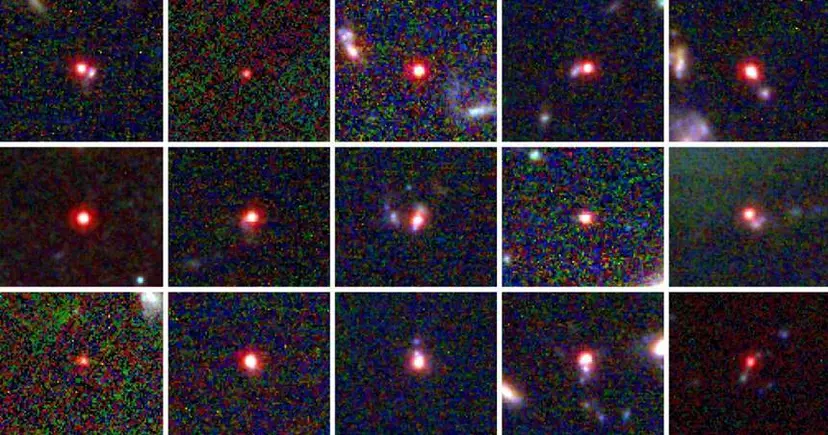
Recently, some astronomers have suggested that at the center of these little red dots might be baby supermassive black holes that have just begun to grow. One piece of evidence is the detection of hydrogen emission lines in the spectrum of these red dots, which indicate very rapid motion. The presence of a black hole at the center of a galaxy can be indirectly confirmed by observing gas clouds moving at high speeds while being captured by the intense gravity surrounding the center.
Gas clouds containing hydrogen atoms emit light at specific wavelengths. That trace remains in the spectrum of the entire galaxy as thin, sharp emission lines. However, if these gas clouds are moving at extremely high speeds while trapped by the gravity of a central black hole, they undergo a Doppler effect, causing the wavelength of the emission lines to shift toward shorter or longer wavelengths. The faster they move, the greater the shift in both directions, and the emission lines broaden into a wider shape. This is a characteristic feature observed in most active galaxies that harbor large, violent black holes at their centers.
If the speed of the gas clouds moving at the center of a galaxy can be measured, the mass of the supermassive black hole growing at the center can also be determined. If the red dots identified by the James Webb are truly galaxies harboring black holes, the mass of those black holes would need to be diverse and heavy, ranging from millions to hundreds of millions of times the mass of the Sun!
But this is quite baffling. These red dots are very young, primordial galaxies that existed when the universe was only 600 to 700 million years old. We are looking at a very early stage of cosmic history, where only 5% of its current age has passed. In such an early universe, it would be logical to assume that both the galaxies and the black holes at their centers were in their infancy, having just begun their growth, and should therefore be in a "lightweight" stage. However, the James Webb shows evidence that even in the early universe, there were black holes that had already grown to be hundreds of millions of times the mass of the Sun. It is like entering a kindergarten and finding it packed with 2-meter-tall giants.
Even more mysterious is what we find when comparing the mass of the central black hole to the total mass of the galaxy. Usually, in galaxies of standard size like our own, the proportion of the central black hole's mass relative to the total mass of the stars is very small—only 1/1000th of the galaxy's total mass. Almost all galaxies follow this proportional relationship consistently. If a galaxy’s total mass doubles, the mass of its central black hole also doubles.
Naturally, it was assumed that the red dots discovered by the James Webb in the early universe would follow this proportional relationship. However, that is not the case at all. The central black holes of these "red dot" galaxies are excessively heavy for their size. Assuming they are indeed galaxies, the black holes account for 30 to 40% of their estimated total mass!
This is an incredible mass ratio that is hard to comprehend. If you think of a galaxy as a steamed bun (hoppang) with red bean paste inside, typically, the galaxies around us have a very small proportion of red bean paste inside the bun; they are mostly just bread. But the "red dot" buns identified by the James Webb are filled with red bean paste for nearly half their volume. It is a level of "generosity" with red bean paste that one would never expect to see in the universe. It is enough to give indigestion to astronomers who have never before tasted such a sweet, red-bean-heavy treat.
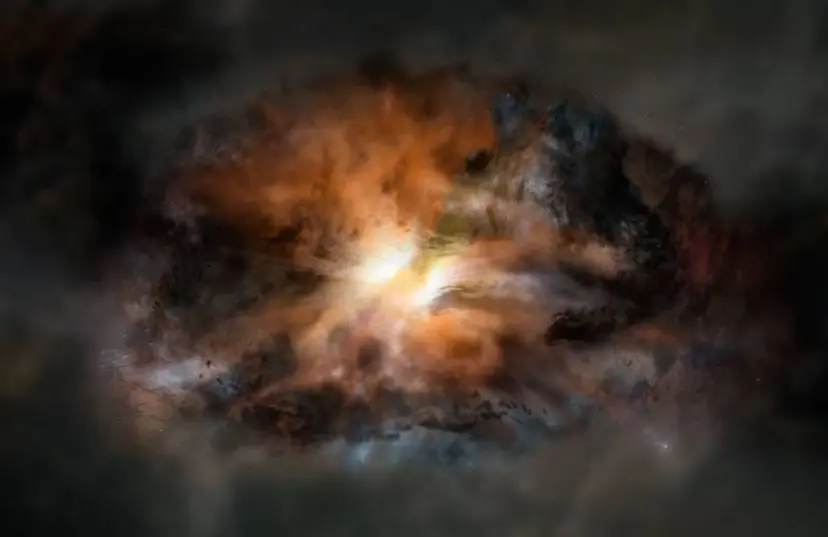
If this is true, we could assume that black holes in the early universe grew much faster than anything we can compare to today. But this hypothesis also has a problem. A rapidly growing black hole at the center of a galaxy emits powerful high-energy light, such as X-rays and gamma rays, far out into the galaxy's surroundings. Astronomers discovered these suspected "fast-growing" red dot galaxies with the James Webb and cross-referenced them with previous Chandra X-ray Observatory observation data to see if they were indeed emitting strong, high-energy X-rays. However, no X-rays were detected. They are too quiet to harbor black holes growing at such an excessive rate.
Then, another possibility can be considered: the possibility that these red dots are not harboring massive black holes at their centers, but are simply a form of primordial galaxy where stars are packed at high density. However, there is a problem. A black hole growing rapidly at the center of a galaxy spews out enormous amounts of energy, incomparable to even a single average star. Thus, such a black hole could sufficiently explain the total energy of the red spots confirmed by the James Webb observations. But if we assume there is no black hole at the center, the problem becomes complicated.
To fill the entire energy of the red spots with stars that have much less energy than a black hole, an excessively large number of stars would be needed. As mentioned earlier, these red dots are estimated to be very small in size, on the scale of only 100 to 500 light-years. The conclusion would be that in a cramped space 1,000 times smaller than our Milky Way, a number of stars as large as those in our galaxy must be packed tightly together. If stars were to gather at such a high density, it might be more reasonable to conclude that they would simply knead together and create a massive black hole.
Astronomers are also considering the possibility that these red dots might be baby versions of quasars currently growing in the early universe. If so, these dots could provide important clues to the birth and growth of supermassive black holes at the centers of galaxies—a puzzle that has yet to be clearly solved in the field of galactic astronomy. They could be the very site where we can watch the process of a massive black hole forming at the center of a galaxy in real-time. Furthermore, we might be able to uncover the secret of the symbiotic relationship between a galaxy's total mass and the mass of its central black hole, and how they manage to grow together while maintaining the exact same proportional relationship. Interestingly, the red dots being discovered by the James Webb are proving to be a green light, not a red one, for astronomers and the Big Bang cosmology.
References
https://ui.adsabs.harvard.edu/abs/2024arXiv240500504M/abstract
https://iopscience.iop.org/article/10.3847/1538-4357/ad4265
https://iopscience.iop.org/article/10.3847/1538-4357/ad2345
https://iopscience.iop.org/article/10.3847/2041-8213/ad55f7
About the author, Woong-bae Ji: He loves cats and the universe. After watching "Galaxy Express 999" as a child, he dreamed of sharing the beauty of the cosmos. He is currently researching galaxy evolution through galactic interactions at the Yonsei University Center for Galaxy Evolution and the Near-field Cosmology Laboratory, while engaging in various science communication activities, including lectures and writing. He is the author of books such as "The Flirting Observatory," "Thinking About the Universe All Day Long," and "Stars, the Science of Light."