

[비즈한국] President Yoon Suk Yeol stated during a national policy briefing on August 29 that the burden of interest for the public has significantly decreased through loan refinancing. To alleviate the pressure of high interest rates, the government has been offering an online, one-stop loan refinancing service since last year. It has been shown that many individuals have effectively moved to loans with lower interest rates through this service.

However, as the number of people who can switch to lower interest rates at financial institutions is limited, the number of victims suffering from illegal private lending is increasing. Even with the government's online loan refinancing service, those with low credit scores—who struggle to borrow money from financial institutions in the first place—find it difficult to survive in an era of economic downturn and high interest rates. Furthermore, corporate bankruptcies have surged this year, and the number of individual rehabilitation applications—where people get debt relief after paying a portion over a certain period—is also rising, indicating that the damage caused by high interest rates continues.
President Yoon highlighted his administration's achievements during the briefing, mentioning the online loan refinancing service implemented to reduce high-interest damage. President Yoon emphasized, "As a result of promoting competition in the banking sector, loans totaling 14 trillion won in principal have moved to lower interest rates, significantly reducing the public's interest burden." The Financial Services Commission stated that since the launch of the online loan refinancing service last year, the average interest rate for individuals dropped by 1.54 percentage points, saving them 1.53 million won in annual interest. However, critics point out that such online refinancing is limited to a select few. Low-credit individuals, who are most affected by high interest rates, are excluded from online refinancing, and among small business owners, there has been a surge in bankruptcies as they cannot even pay interest due to the economic slump and high rates.
Vulnerable groups with low income and credit scores who find it difficult to borrow from banks turn to private lenders, and the delinquency rates of these lenders have recently surged. According to the Financial Supervisory Service, the delinquency rate of the 25 largest private lenders jumped from 7.3% at the end of 2022 to 12.6% at the end of 2023. Vulnerable groups, hit by the dual impact of high interest rates and economic decline, are unable to properly repay their principal and interest.
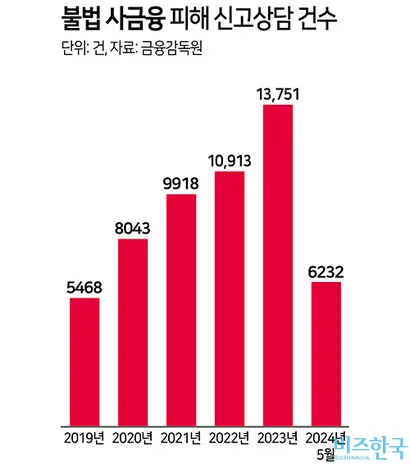
Those who cannot even use these private lenders are falling victim to illegal private lending. The number of reports and consultations regarding illegal private lending rose from 5,468 in 2019 to 8,043 in 2020 and 9,918 in 2021, surpassed 10,000 in 2022 at 10,913, and reached 13,751 last year. As of May this year, there have been 6,322 cases, showing signs of exceeding last year's level.
Among reports and consultations regarding illegal private lending, those concerning high interest rates surged 6.1 times, from 569 cases in 2019 to 3,472 last year. Considering that the total number of reports increased by 2.5 times, this demonstrates the severity of damage caused by high interest rates. Illegal private lenders are exploiting the circumstances of vulnerable groups who cannot access banks or financial institutions by lending money at exorbitant interest rates.
As damage to vulnerable groups increases, the government and the ruling party are scrambling to significantly raise sanctions, including penalties for illegal lending, and are pushing for a plan to invalidate the principal and interest for anti-social loan contracts involving illegal collection. On the 11th, the government and the People Power Party held a consultative meeting and decided to strengthen penalties to the maximum level under financial laws for unregistered lending and violations of legal interest rate caps. They also decided to establish grounds for invalidating the principal and interest for anti-social loan contracts concluded through sexual exploitation, human trafficking, physical injury, assault, or threats.
Although the government and the ruling party decided to strengthen regulations on illegal lending, the situation where those unable to access loan refinancing are suffering from high interest rates continues to worsen. According to court data, 1,153 corporations filed for bankruptcy in the first seven months of this year, a 32.5% (283 cases) surge compared to the same period last year (870 cases). Additionally, the number of individuals filing for rehabilitation by July of this year reached 77,625, an increase of 10.0% (7,050 people) compared to the same period last year (70,525), showing a trend where more people are unable to repay their debts due to high interest rates.