

[비즈한국] Since the war in Ukraine, it has become an undeniable fact that the 'drone' is the core weapon of future warfare. Nevertheless, the future of the drone industry—which develops and produces military drones—has not been very bright until now.
First, the lack of technological prowess is a problem. While it is easy to enter the field of small, lightweight drones, it is not easy to internalize the technology. Before the drone industry grew, there were several domestic manufacturers of R/C (radio-controlled) airplanes, and while some of them still produce parts for drones, it is difficult to compete with Chinese drones that have dominated the industry.
An even bigger problem is the so-called 'controversy over Chinese parts in military drones.' Centered around small reconnaissance drones, the Ministry of National Defense, the military, and the Defense Acquisition Program Administration (DAPA) are gradually increasing projects that domestic drone companies can challenge, but reports and accusations continue that specific companies are using Chinese parts during the competitive bidding process.
In reality, even DAPA under the Ministry of National Defense and other agencies have failed to establish any principles or rules regarding the use of Chinese drone parts. Even if they specify that only certain parts can be used, or regulate that others cannot be used, it could lead to trade disputes. This is because there is a strong sense of crisis that if a security incident occurs even after following government-made rules, someone will have to take responsibility.
If all drones containing even a small amount of Chinese parts are banned, domestic drone companies, especially drone startups, will have no place to stand. To put it slightly exaggeratingly, there is a concern that all drones used by our military could be filled only with foreign, not domestic, products.
For domestic drones, one can investigate the companies and find out whether they use imported Chinese parts, but for imported drones, there is almost no way to determine which parts inside are Chinese. Even in a situation where it is difficult to completely exclude Chinese parts from the military drones of our allies who are hostile to China, the introduction of drones by our military is being pushed forward in many ways but is facing difficulties.
Despite these difficult circumstances, the technological development and competition among domestic drone startups are remarkable. In particular, challenges and achievements by domestic startups are notable in 'Air-to-Air drones,' or drone-killing drone technology, which belongs to the most difficult category of military small drones.
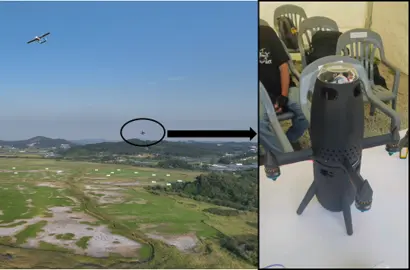
Last March, I gathered information and reported on the drone-killing drone of domestic drone company Nears Lab at the '2024 Drone Show Korea' held in Busan. At that time, the drone-killing drone unveiled by Nears Lab had just produced a prototype. The drone interception video released by the company showed a scene of intercepting a drone, but it was intercepting a quadcopter drone that was hovering in the air, and it failed to intercept a fixed-wing drone in the form of an airplane like the North Korean UAV that violated our airspace in December 2022.
However, less than 6 months later, Nears Lab's drone-killing drone 'Kaiden-X' succeeded in intercepting a fixed-wing drone flying at a speed of 60km/h. This was the result of improved performance through multiple design modifications and upgrades within a short period, and a major difference was that it succeeded in automatic target tracking (ATR) mode, rather than manually controlling the drone-killing drone. Optimization of the flight vehicle's internal equipment and performance improvements were also achieved in a short time, leading to significant performance enhancements.
This speed and performance improvement is rarely seen in the development of existing weapon systems, and if such technological development continues, it seems that it will be possible to sufficiently intercept drones at the level of the North Korean UAV that violated our airspace in 2022. The long-range fixed-wing drones used by North Korea fly along a predetermined flight path rather than by remote control, so their flight path is simple.
The 'Shahed-136' drone, which Russia imported from Iran and is still using for airstrikes in Ukraine, also uses the same pre-positioning method, so the day is not far off when domestic drone startups such as Nears Lab and UAM Tech can equip themselves with the ability to respond to North Korean drones.
The problem is that even though the development of military drone technology by domestic drone companies is fast, the support and operational concepts of the Ministry of National Defense and its affiliated agencies are unable to keep up. Rather than considering utilization plans in line with the current level of drones and gradually improving performance, they often follow the development methods of past weapon systems or the Required Operational Capability (ROC) method as is, setting unreasonable goals.
For example, in the drone-killing drone category of the Drone-Bot Challenge held at the Seungjin Training Center in Pocheon on September 7, the Ministry of National Defense set a task to shoot down a target drone maneuvering for avoidance at a speed of 150km/h launched from an arbitrary location. Since North Korean drones or Shahed drones that invaded our airspace fly at speeds of around 100km/h along predetermined paths, much harsher conditions than in reality were presented.
Of course, it is a source of pride and increases export competitiveness if Korean drone companies make the world's best drone-killing drones. The problem is that before aiming for such drones, operational concepts that can maximize utilization after realistically considering the company's development capabilities and level must be developed. Only then can domestic companies secure the research personnel to perform performance upgrades and grow as they are deployed and purchased for actual combat.
This is especially important in the field of drone interception operations using drone-killing drones, so-called 'hard-kill' drones. Military drones are used for various purposes such as surveillance, reconnaissance, suicide strikes, deception, and communication relay. Since drone-killing drones must track and collide with unmanned aerial vehicles in flight to destroy them, they require faster speed, more accurate precision, and rapid maneuverability than other drones. It is the same principle as how the F-15 Eagle fighter or F-16 Falcon fighter, built for air combat, are active in ground attacks because of their good flight performance.
As the development and performance improvement of drone-killing drones by domestic companies such as Nears Lab and UAM Tech are accelerating, the Ministry of National Defense, DAPA, and the Army must quickly come up with ways to enhance the military drone development capabilities of private startups and effectively put them into force.
Recently, Anduril Industries, a U.S. defense startup with fancy nicknames like 'SpaceX of the defense industry' and 'Stark Industries in the real world,' unveiled a new long-range cruise missile called 'Barracuda-M.' The company claimed that it had created a product that could contribute to U.S. national defense by using large-scale commercial parts to double production when needed. If the Ministry of National Defense and the military create conditions for Korean drone startups challenging military drone development to unleash their potential to the fullest, the day will surely come when we have our own Korean Anduril Industries.