

[비즈한국] Signals of crisis continue to surround Samsung Electronics005930. Its stock price recently fell to the 60,000 won range, marking a 52-week low. The brokerage industry has signaled a decline in third-quarter earnings, and reports from foreign media have emerged regarding significant layoffs of overseas personnel. Amid internal friction, including the first general strike since the company's founding, attention is turning to the leadership of Samsung Electronics Chairman Lee Jae-yong to see how he will navigate these challenges.
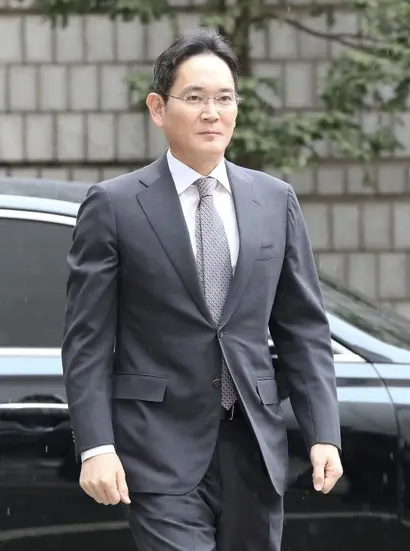
Character
Samsung Electronics Chairman Lee Jae-yong was born in Seoul on June 23, 1968. He is the eldest son and one of four children of the late former Samsung Electronics Chairman Lee Kun-hee and Hong Ra-hee, former director of the Leeum, Samsung Museum of Art. His sisters are Lee Boo-jin, President and CEO of Hotel Shilla008770, and Lee Seo-hyun, President of Strategic Planning at Samsung C&T028260. He married Lim Se-ryeong, Vice Chair of Daesang, in 1998, with whom he has one daughter and one son, but they divorced in 2009.
Chairman Lee graduated from Kyungbock High School in 1987 and earned a degree in Asian History from Seoul National University in 1992. While working at Samsung Electronics, he received an MBA from Keio University in Japan in 1995 and completed a doctoral program at Harvard Business School in the United States.
Although he is the owner of a major conglomerate, he is known for his modest and gentle personality. Despite not engaging in outward public communication, he has built a friendly image among the public. He had a special love for baseball and used to visit stadiums to watch games, but stopped doing so after becoming involved in the national scandal. Chairman Lee was arrested twice, in 2017 and 2021, on charges of bribing former President Park Geun-hye.
Career
Chairman Lee Jae-yong is the third leader of the Samsung Group and a third-generation business owner. He began his career in 1991 when he joined the general affairs group of Samsung Electronics. He served as a managing director in the management planning team from 2003 to 2007 and as a senior vice president from 2007 to 2009. He became Chief Operating Officer (COO) of Samsung Electronics in 2010 and climbed the ranks to executive vice president and president, eventually becoming Vice Chairman of Samsung Electronics in December 2012.
In October 2022, he was promoted to Chairman, ten years after serving as Vice Chairman. However, he had already been designated as the "de facto leader" (head) of Samsung Group in May 2018 during his time as Vice Chairman, as the Korea Fair Trade Commission viewed him as the effective controller while the late Chairman Lee Kun-hee was hospitalized for an extended period.
Capability
Chairman Lee Jae-yong has led Samsung since the late Chairman Lee Kun-hee became bedridden in May 2014. He actively pursued mergers and acquisitions (M&A), such as selling off less profitable subsidiaries, and undertook large-scale investments. At the end of 2014, he sold Samsung Techwin and Samsung General Chemicals to the Hanwha Group, and in 2015, he divested chemical and defense units including Samsung Fine Chemicals, the chemical division of Samsung SDI, and Samsung BP Chemicals to the Lotte Group.
In November 2016, Samsung Electronics announced the 9 trillion won acquisition of "Harman," an automotive electronics and audio specialist. Although Harman's automotive division saw sluggish performance immediately after the acquisition, it has since become a core business for Samsung Electronics, surpassing 1 trillion won in operating profit in 2023. As the semiconductor sector maintained its growth trend, it accounted for nearly 20% of the company's total operating profit.
In April 2019, Chairman Lee announced a blueprint to invest 133 trillion won in the system semiconductor sector by 2030 to become the world's leader. This was aimed at securing competitiveness in foundry (semiconductor contract manufacturing), fabless (semiconductor design), and system LSI (non-memory semiconductor) businesses, in addition to its mainstay memory semiconductors. During his 2023 business trip to the U.S., Chairman Lee personally engaged in securing foundry clients by meeting with figures such as Tesla CEO Elon Musk and NVIDIA CEO Jensen Huang.
Critical
Five years have passed since the goal of becoming the world leader in system semiconductors was declared, but the timeline for achieving this remains unclear. Samsung Electronics recorded its lowest operating profit in 15 years (6.54 trillion won in 2023). Factors for this poor performance include not only the semiconductor downturn but also losses in the non-memory business.
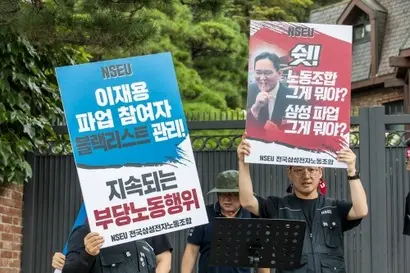
The poor performance led to internal conflict. In July of this year, Samsung Electronics experienced its first general strike since the company's founding. The union and management failed to reach an agreement regarding base salary increases and the restructuring of the performance-based bonus system, which favored management. The National Samsung Electronics Union (NSEU) held a strike for 25 days starting July 8 before switching to guerrilla-style strikes on August 1.
The conflict between the two sides appears to be reigniting. On September 12, it was revealed that Samsung Electronics had filed criminal complaints against three union leaders—the committee chair, vice-chair, and secretariat director—on charges including obstruction of business.
Controversy also remains over the illegal succession of management rights within the owner family. In February of this year, Chairman Lee Jae-yong was acquitted in the first trial regarding allegations of illegal succession of management rights through the merger of Samsung C&T and Cheil Industries. The verdict came three years and five months after he was indicted in 2020. The court of the first instance stated that "it is difficult to conclude that the main purpose of the merger was the succession of management rights," citing that the prosecution failed to prove any illegal acts during the merger process. While the acquittal relieved some judicial risk, the appellate trial is still ongoing.
Challenges
While the company has emerged from the tunnel of the semiconductor recession, it now faces the task of boosting its stock price. Samsung Electronics' stock price hit a 52-week low of 64,200 won on September 11. As it is the "bellwether" of the domestic stock market, recovery is urgent as individual investors face significant losses; however, with brokerage firms anticipating that third-quarter earnings will fall short of expectations, target prices have been lowered by approximately 20%.
Added to this is the signal of crisis following reports of overseas restructuring. On September 11 (local time), the British news agency Reuters reported that Samsung Electronics is cutting up to 30% of its overseas staff. According to Reuters, the reasons for the restructuring include a global economic slowdown, competition in the smartphone market, and cost-cutting measures. However, Samsung Electronics described it as "routine personnel adjustment."
Countermeasures against semiconductor technology leaks must also be prepared. Two former Samsung Electronics executives were handed over to the prosecution on September 10 on charges of leaking key semiconductor manufacturing technologies to a Chinese firm. According to the police, the value of the technology development costs impacted by these leaks exceeds 4 trillion won.