

[비즈한국] As the trial of Kim Beom-su, the Kakao035720 Management Reform Committee Chairman who was arrested over alleged stock price manipulation for SM Entertainment, begins, internal conflict over the direction of Kakao's reform is deepening. Faced with opposition from the labor union regarding the sale of affiliates and demands to purge former executives involved in breach of trust and embezzlement allegations, the company appears to be in the midst of internal strife and external pressure.
Still in office despite allegations of pursuing private interests
Recently, criticism has been mounting from within regarding Kakao's reform efforts. The Kakao branch of the Korean Federation of Chemical, Fiber & Food Workers' Unions is openly opposing the company's reform direction, protesting the termination of consultancy contracts for executives and the sale of Kakao VX. Collective bargaining has also hit a roadblock. The union declared the breakdown of negotiations with the company late last month and has filed for mediation with the Gyeonggi Regional Labor Relations Commission.
The individuals pointed out by the union for the company's lack of improved internal control are former Kakao Entertainment co-CEOs Kim Sung-soo and former Investment Strategy Division head Lee Joon-ho. The two are at the center of allegations regarding the overpriced acquisition of a drama production company. The union is demanding the termination of former CEO Kim's consultancy contract and the dismissal of former Investment Strategy head Lee, who is still employed by the company. Seo Seung-wook, head of the Kakao union branch, pointed out, "Even before the court reaches a final verdict, the company has easy access to internal transaction records, allowing it to determine more quickly whether company rules were violated." He added, "If there are specific allegations, measures to exclude them from system access and positions should have been taken first to prevent further crimes or destruction of evidence, but this has not been improved."
Former CEO Kim and former division head Lee are accused of causing financial damage to the company by inflating the acquisition price during the process of buying the drama production company 'Baram Pictures.' According to the prosecution, they invested 33.7 billion won in Kakao Entertainment funds between April and September 2019 to recruit writers and PDs to acquire Baram Pictures, and the following year, Kakao Entertainment acquired Baram Pictures—which had been transferred to a private equity fund—for 40 billion won. Baram Pictures was known to have the spouse of former division head Lee, actress Yoon Jung-hee, as an investor, and it was not operating normally, having generated no revenue since its establishment in February 2017. The prosecution believes that former division head Lee, the actual owner of Baram Pictures, embezzled 31.9 billion won during the acquisition process, and that former CEO Kim, who helped with the acquisition through illicit solicitation, received 1.2 billion won in the form of check cards and bank accounts in return.

Last month, the prosecution indicted former CEO Kim and former division head Lee without detention on charges including violation of the Act on the Aggravated Punishment, etc. of Specific Economic Crimes (breach of trust), offering and accepting bribes, and violation of the Act on Regulation and Punishment of Criminal Proceeds Concealment. Separately from this case, former CEO Kim stood trial on the 11th along with Chairman Kim Beom-su, former Kakao CEO Hong Eun-taek, and Kakao Investment Strategy Office head Kang Ho-joong on charges of conspiring to manipulate the stock price of SM Entertainment. Regarding the fact that only former division head Lee among the key executives facing the same charges was not indicted, it is interpreted that his crucial testimony stating, "Chairman Kim approved the decision-making," played a role.
However, domestic group companies like Kakao often use the method of tying CEOs to consultancy contracts for a certain period after their retirement to maintain trade secrets, and it is possible this case is part of such a measure. Aside from internal audits, the union plans to report suspected unfair trade and investment execution cases through the Compliance and Trust Committee.
Kakao VX voluntary retirement ahead of sale, ‘coercion’ alleged
At the end of last year, Chairman Kim of the Management Reform Committee stated himself that he would "engage in high-intensity reform management with the resolve that we could even change the company name, Kakao." Since then, the company has focused on strengthening control by establishing external oversight bodies for compliance and ethical management, setting up a control tower, and improving organizational efficiency by reducing the number of affiliates.
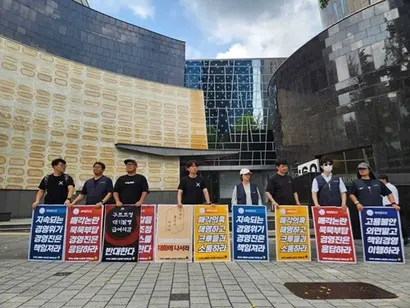
However, it appears the company could not avoid internal backlash regarding rumors of sale and restructuring. On the 9th, the union held a picket protest in front of the Murex Partners headquarters in Gangnam-gu, Seoul, demanding a halt to the sale of Kakao VX. The protest was triggered by Kakao's move to sell the management rights of Kakao VX, a subsidiary of Kakao Games293490, to the private equity fund Murex Partners and its rapid implementation of a voluntary retirement program. The concern is that if sold to a private equity fund that pursues profit maximization, restructuring will be inevitable, leading to a deterioration of working conditions—a sign the union believes is already appearing through the ongoing voluntary retirement and administrative leave measures.
The voluntary retirement program for Kakao VX employees announced by the company concludes this week. Branch head Seo Seung-wook stated, "Although it is a voluntary retirement program, the problem is that it is effectively being coerced through conditions like administrative leave and pay cuts." He added, "It is suspected that the private equity firm set workforce reduction as a precondition, and the company is executing it." According to the union, Kakao VX is carrying out voluntary retirements for about 100 employees in departments slated for business closure. Employees who refused the offer were presented with administrative leave (not reporting to work) and a 30% salary cut.
Hwang Yong-sik, a professor at the School of Business at Sejong University, pointed out, "The fundamental cause of the Kakao situation lies with the management, and it is difficult to evaluate the current reform strategy as high-intensity." He added, "Members may feel skeptical when the management attempts to cut the workforce through restructuring or voluntary retirement while maintaining their own positions."