

[비즈한국] There is a saying, "The value of being together." It appeared in a corporate image advertisement about ten years ago. It is a brilliant slogan, implying that the power of togetherness can change the world. "Being together" signifies empathy or communication, and this power can create a new paradigm. Art, too, holds value when it resonates with people. Empathy arises from the spirit of the times and a universal artistic language. The 'Korean Art Promotion Project' also aims to showcase the thoughts of various people through an accessible artistic language. Entering its 10th season, we support artists who strive to practice Confucius's idea that "good art must be simple."
In contemporary painting, the weight of the "act of making" is increasingly outweighing the "act of drawing." This is because there is a greater interest in work created by combining various materials rather than drawings based on sketching. Therefore, artists are pouring their efforts into discovering new materials and developing techniques that suit them.
This trend emerged because of a shift in the perception of painting in the early 20th century. Until then, painting was valued for reproducing reality or expressing stories. However, after the advent of photography, depicting reality began to move away from the primary goal of painting.
Painting began to find a domain distinct from photography by capturing human thoughts or the artist's own unique world. Consequently, creating a new world rather than replicating reality emerged as the goal of painting, and a new aesthetic suited to this took hold.
The emergence of abstract art is a representative result of this. Abstraction created a new territory for painting in a world beyond reality, marked by the discovery of various materials and the invention of new techniques.
These changes led to the diverse development of 20th-century painting, which continues to this day. Thus, modern painting absorbs the materials and techniques of surrounding arts like a melting pot, demonstrating the possibilities of a new visual world.
This is also why painting, a visual art, has been able to survive in a reality overflowing with things to see. Even after the advent of video, which delivers much stronger visual impact, painting continues to capture people's attention through new visual effects.
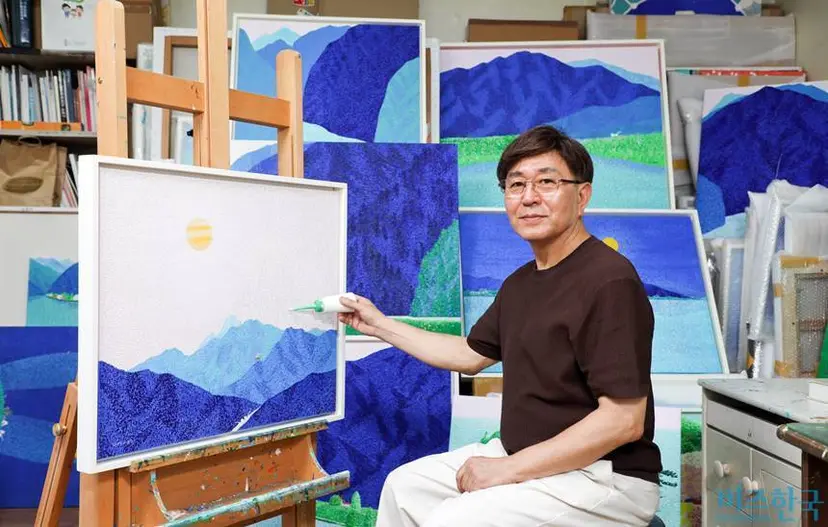
Jung Young-mo's painting also draws attention in this context. His paintings consist of somewhat clichéd subjects and materials that are not particularly new. He paints landscape compositions, simplified from nature, using acrylic paint. Yet, why does it continue to garner attention from people for so long?
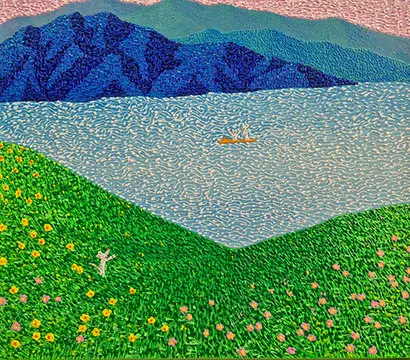
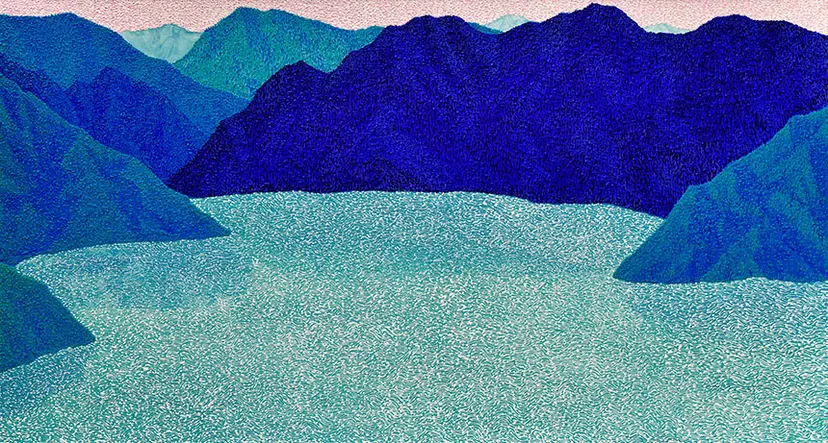
His paintings look as if they were created using traditional methods. Blue mountains fill the canvas, with rivers flowing between them or waterfalls as thin as threads. Small animals crossing a valley can be seen, as well as a ferry boat with a boatman rowing. They are images that evoke scenes from traditional landscape paintings.
However, when you get close to the painting, there are no traces of brushwork. It is a work where the labor of crafting, rather than painting, is visible. Tiny, textured dots of various shapes cover the entire screen.
Jung Young-mo's work exhibits the same characteristics as the materials and techniques sought by abstract painters. He applied the properties of acrylic paint—a common material—to create his own technique and transformed the landscape, a subject very familiar to us, into an abstract composition, turning it into a painting with a new sensibility. Because it was born through such processes and efforts, his work continues to be loved by people today.