

[비즈한국] Karrot (Danggeun Market) plans to introduce a "Safe Payment" service for secondhand transactions in the second half of this year. While Karrot explains that the new payment service is intended to provide users with a wider range of options for transferring funds, some are questioning whether the move is aimed at generating revenue through fees, as the company plans to charge for the service.
New Safe Payment Service Expected in Second Half
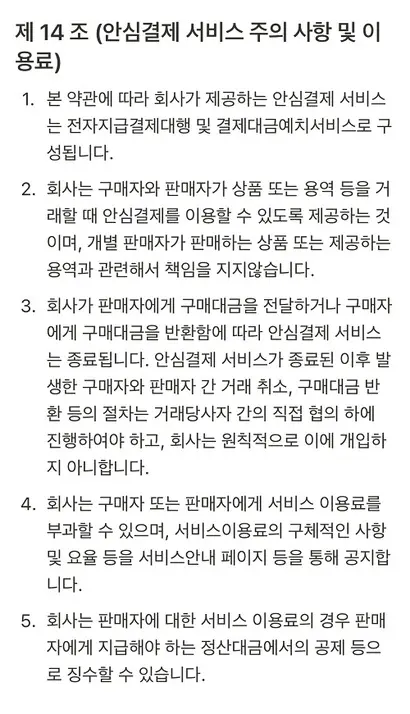
Karrot recently announced revisions to its Karrot Pay and e-commerce terms of service. The core of these revisions is the introduction of Safe Payment. Safe Payment is a service where the company holds the buyer's payment in escrow for a certain period, releasing the funds to the seller only after the buyer confirms the purchase. By updating its Karrot Pay terms, Karrot has specified the new service, its usage guidelines, fees, and procedures for cancellations and refunds.
Karrot has been working toward introducing an escrow system since last year. Following approval for electronic financial business registration from the Financial Services Commission in June, the company is now set to implement the Safe Payment service. While the updated terms for Karrot Pay are set to take effect on the 29th of this month, a specific launch date for the Safe Payment service has not yet been determined. A Karrot official stated, "The launch date for the Safe Payment service is not yet set. Currently, Karrot Pay is going through the necessary preparations to introduce the feature within the second half of the year."
Karrot explains that the service was introduced to expand users' options for fund transfers. The official added, "Most Karrot users engage in face-to-face transactions. However, to provide more options in various trading situations, including non-face-to-face transactions, and to enhance user protection and convenience, we have prepared to introduce the Safe Payment feature."
Although platforms like Bungaejangteo (2018) and Joonggonara (2021) introduced escrow-based safe payment services early on, Karrot has refrained from doing so. While secondhand platforms that rely heavily on non-face-to-face shipping transactions needed such protections due to the higher risk of fraud, Karrot's high proportion of face-to-face local transactions meant it was relatively less exposed to such risks.
From the early days of its app, Karrot has promoted "local face-to-face transactions." It has emphasized its identity as a neighborhood-specific platform and even displays messages in user chat rooms encouraging face-to-face transactions over shipping.
Because of this, some users have reacted with confusion to the introduction of a safe payment service, which is typically used for shipping transactions. In online communities, users are asking, "Is Karrot now encouraging shipping transactions?" and "Expanding shipping transactions seems to go against the purpose of Karrot."
Will Safe Payment Fees Help Reduce Karrot Pay's Deficit?
In revising its terms, Karrot stated that it could charge fees for the Safe Payment service. The terms note that the service fee "may be collected through deductions from the settlement amount to be paid to the seller," increasing the likelihood that sellers will be charged a percentage of their sales as a fee.
Regarding this, a Karrot representative stated, "It is true that a service fee will be charged when using Safe Payment. Detailed conditions regarding the service will be available when it is officially launched."
Improving Karrot Pay's profitability is a major challenge for the company. While Karrot recorded its first profit on a standalone basis last year, it remained in the red on a consolidated basis due to the poor performance of its subsidiaries. In particular, Karrot Pay has the largest deficit among all of Karrot's subsidiaries, with 2.3 billion won in revenue and an operating loss of 7.9 billion won last year.
Industry observers predict that by introducing Safe Payment and charging fees, Karrot aims to improve Karrot Pay's profitability. Kim Dae-jong, a professor of business administration at Sejong University, analyzed, "As secondhand platforms continue to face deficits, they seem to be considering revenue models based on fees. While Karrot has previously focused on advertising as its primary revenue model, they are being forced to consider transaction fees as another viable path."
Concerns have also surfaced among users that this move might lead to fees on all secondhand transactions. This suspicion stems from the fact that Bungaejangteo, which has struggled with losses for years, recently made its previously optional safe payment mandatory, effectively imposing fees on all transactions.
In response, Karrot stated, "There is no change in our policy of not charging fees for using the secondhand marketplace or for transactions. Even without using Safe Payment, users can continue to trade as they always have. Since the Safe Payment feature is an optional tool, those who do not wish to use it can continue using our services for free."
The company further explained, "Currently, Karrot Pay is focusing on increasing utility by supporting organic connections between services rather than focusing solely on monetization. We plan to provide a 'hyper-local financial' experience and benefits through cooperation with the financial sector, while also increasing the usage of Karrot Money. We expect that as we establish ourselves as an essential financial service for local neighborhoods, a business model based on this will naturally follow."