

[비즈한국] Unlike in the past, when the pandemic caused an explosion in demand for non-face-to-face services, market interest in the metaverse has rapidly faded, leading an increasing number of companies to withdraw from related businesses. This is because most platforms that emerged during the metaverse craze struggled to secure users and corporate clients, failing to produce any significant results. Public metaverse projects led by central and local governments are also being criticized for wasting budgets with little to show for it.
Even high-profile platforms face serial restructuring
As the "Virtual Convergence Industry Promotion Act"—which provides the legal basis for promoting the metaverse industry—is set to take effect for the first time in the world on the 28th of this month, major domestic metaverse services are shutting down one after another this year, following a "metaverse graveyard" of a year last year. Companies that once looked at the metaverse as a next-generation growth engine, including gaming companies and telecommunications firms, are showing a distinct shift in attitude. Many seem unable to escape the post-pandemic slump, and cases of meaningful success have been identified as extremely rare.
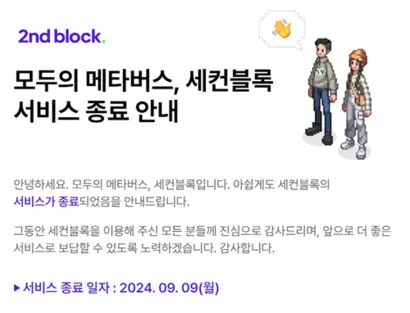
‘2ndblock,’ a metaverse platform launched in November 2021 by Dunamu, operator of the virtual asset exchange Upbit, ended its service on the 9th. In the public sector, ‘Metaverse Seoul,’ introduced by the Seoul Metropolitan Government with the goal of providing futuristic, new-concept public services, will shut down on October 16, just one year and nine months after its launch.

The telecommunications industry, which had faced ups and downs in securing users and expanding the market, has begun full-scale restructuring this year. An industry official said, "It is the result of companies that had explored possibilities in various fields deeply considering market trends and changes in their core businesses from multiple angles."
KT030200 shut down its corporate platform ‘Meta Lounge’ this past April, and ended the open beta service of its general user platform ‘Genieverse’ early last month. LG Uplus032640, which had planned three types of metaverse services targeting office workers, university students, and children, is currently taking a breather as the market stagnates. The original intention was to provide customized platforms needed by those whose lifestyle patterns had changed during the COVID-19 pandemic; currently, the services in operation include ‘KidsTopia,’ linked with kids' phones; ‘Pickkids,’ which transferred daycare center events to the metaverse; and ‘Uverse,’ a platform exclusively for university students that applied campus life to virtual reality. News of the launch of ‘Meta Slab,’ an exclusive service for office workers that was under development with a target release last year, has been indefinitely postponed.
SK Telecom017670’s ‘ifland,’ which managed to maintain millions of users, has begun a strategic realignment by incorporating generative AI technology and linking it with K-pop business. While ifland, which achieved differentiation through the introduction of an economic system and consistent content updates, is credited with driving global traffic from regions like Southeast Asia, it is also experiencing difficulties due to the market downturn.

Failures at Kakao and KT; local government metaverses are ‘closed for business’
The series of service closures since last year reflects a market atmosphere where investment sentiment and the driving force behind metaverse projects have collapsed. According to Galaxy Research, a virtual asset market analysis firm, investments in blockchain startups, including the metaverse, reached $2.3 billion (3 trillion won) in the second quarter of last year, a 71% decrease compared to the same period the previous year ($8 billion).
Colorverse, a great-grandchild company of Kakao, liquidated its mobile 3D metaverse service ‘Puppy Red’ at the end of last year, and ‘CyTown,’ a joint venture between Hancom and Cyworld Z, also shut down after repeated delays and errors. Com2uS078340 also folded its ‘Com2Verse’ business. In the case of Puppy Red, expectations were high as it was a nostalgic service reborn after seven years, backed by the "Kakao community" including an equity investment from Neptune, a subsidiary of Kakao Games293490; however, it faced financial issues after posting an operating loss of over 11.5 billion won in 2022 alone. While Naver’s ‘Zepeto,’ Korea’s representative metaverse, has survived, attempts by retailers like GS25, Tonymoly, and Baskin Robbins, and financial institutions like IBK, KB Kookmin Card, and Acuon Savings Bank—which operated their own channels within Zepeto—ended as short-term experiments.
The limitations of public-sector metaverse projects created without mid-to-long-term operation plans or concrete use cases are also clear. Gyeonggi Ansan City’s ‘Meta Ansan,’ Gyeongnam Jinju City’s ‘Jinjuseong Metaverse,’ Chungbuk Cheongju City’s ‘Suamgol Metaverse,’ and Jeonbuk Namwon City’s ‘Gwanghalluwon Metaverse’ are platforms built independently by local governments.

Although project costs ranged from tens of millions to 400–500 million won, and even up to 1 billion won in some cases, the number of users is negligible, leaving them effectively closed. ‘Virtual Gangwon,’ opened by Gangwon Province ahead of the 2024 Gangwon Winter Youth Olympics, had a total project cost of 6.5 billion won. As the reporter observed firsthand, most of these platforms did not exceed the level of simple tourist maps that recreate local areas in virtual reality to provide basic location information. The ‘25th World Scout Jamboree,’ held in Saemangeum, Buan-gun, Jeonbuk, in August last year, also created a ‘World Jamboree Metaverse’ before the event, with 1 billion won in tax money poured into it.
Wi Jong-hyun, a professor of business administration at Chung-Ang University (and president of the Korea Game Society), pointed out, "The very fact that public institutions with low understanding of platforms like the metaverse want to run platform businesses themselves is the problem. The most important part of a platform after its construction is maintaining and managing users. Even when companies invest tens of billions and deploy many personnel, they fail; this is a business that public institutions could never succeed at in the first place."
While the cooling atmosphere in Korea has influenced the metaverse slump, the causes are complex. User disappointment was high because expectations for the metaverse were high while the technology was not yet mature, and there are views that the imagery of avatars and the like is juvenile. Lee Im-bok, CEO of Second Brain Institute, said, "There are parts that cannot be blamed on anyone. It had value during COVID-19 as a way to go to places one could not reach, and environmental factors like the decrease in non-face-to-face demand are significant." He added, "However, the limitation is that they failed to provide incentives or a sense of belonging that would organically connect offline and online spaces and keep users returning to the metaverse."
Professor Wi noted, "They should have realized value that cannot be obtained offline, but some were merely transferring the offline world to the online space. This experience led to user disappointment with the metaverse, creating a vicious cycle."