

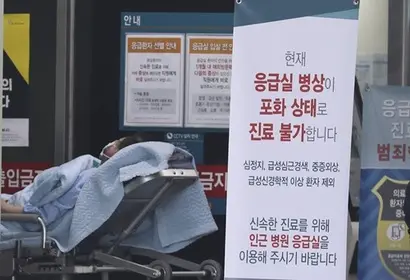
[비즈한국] As the medical vacuum persists following the mass resignation of resident doctors, a series of allegations have emerged regarding members of the National Assembly and high-ranking public officials receiving special treatment, such as medical referrals and preferential hospital admissions. This stands in stark contrast to the experience of ordinary patients, who face "ER shopping" and delays in treatment and surgery due to severe staffing shortages. Previously, in 2021, at the peak of the COVID-19 pandemic, the hospitalization of the son of former Deputy Prime Minister and Minister of Economy and Finance Hong Nam-ki in a special room at Seoul National University Hospital sparked controversy. The medical community points out that "such solicitations are not limited to politicians" and that prioritizing the repair of the broken medical delivery system is essential.

Allegations of 'Medical Solicitation' Following Helicopter Transfers and Hospital Referrals
On the 5th, In Yo-han, a supreme council member of the People Power Party, was caught on camera during the National Assembly plenary session exchanging text messages that appeared to involve requesting surgery for a patient, stirring controversy. The message received from a person presumed to be a doctor read, "The patient you asked for is in surgery now. They would have died if it had been a little later. It was so dangerous that I'm worried if they'll recover well even after the surgery," to which Rep. In replied, "Thank you, thank you." Rep. In clarified, "I contacted them to ask for good care for a surgery that was already scheduled, not an emergency," but the Democratic Party of Korea alleged a violation of the Improper Solicitation and Graft Act and stated they would consider filing a complaint with the National Assembly Ethics Committee.
In late April, it was revealed that a high-ranking official at the Ministry of Culture, Sports and Tourism had been transferred to a large hospital in Seoul, sparking public outrage. The official, identified as 'A', a Grade 1 public servant, received initial treatment for cerebral hemorrhage at the Chungnam National University Sejong Hospital near the Government Complex Sejong before being transferred to Asan Medical Center in Seoul for surgery. Although surgery was possible at the Chungnam National University Hospital at the time, official 'A' opted for the transfer to Asan Medical Center citing existing medical records. Amidst this, a post on the online community 'Blind' alleged that the Ministry of Health and Welfare exerted pressure on the hospital to facilitate the transfer and surgery, though the post was later deleted. The Korean Medical Association filed a complaint with the Corruption Investigation Office for High-ranking Officials against 'A' and a Ministry of Health and Welfare official 'B' for abuse of power.
In January, after Democratic Party leader Lee Jae-myung was attacked, his emergency treatment at Pusan National University Hospital followed by a helicopter transfer and surgery at Seoul National University Hospital drew criticism regarding preferential treatment and the neglect of regional healthcare. Lee Kyung-won, a professor of emergency medicine at Yongin Severance Hospital (PR Director of the Korean Society of Emergency Medicine), stated in an official position, "If it was an emergency, treatment should have been provided in Busan. If things are done this way, which citizen will trust regional hospitals or the national trauma and emergency medical system?" Recently, the Anti-Corruption and Civil Rights Commission announced that while they would notify the supervisory agency regarding medical staff at Pusan National University and Seoul National University Hospitals and paramedics at the Busan Fire and Disaster Headquarters for "clearly violating regulations and providing preferential treatment," they closed the case regarding Representative Lee and Rep. Cheon Joon-ho, who requested the transfer, stating that "there is no code of conduct applicable to National Assembly members."
In 2021, when the COVID-19 pandemic was at its peak, the son of former Deputy Prime Minister and Minister of Economy and Finance Hong Nam-ki was admitted to a special room at Seoul National University Hospital, raising suspicions of favoritism. The son visited the SNU Hospital emergency room in November 2021 with fever and leg pain but was advised to seek treatment elsewhere as it was not deemed an emergency. However, about two hours later, he was admitted to a special room, and it was revealed that former Deputy Prime Minister Hong had contacted the then-president of the hospital, Kim Yeon-soo. At the time, the Korean Public Service and Transport Workers' Union stated, "They claim there was no solicitation, but since when does SNU Hospital call back a patient they sent away to offer a special room? After the phone call between the Deputy Prime Minister and the hospital president, the situation changed from being transferred to another hospital to admission in a special room. The call itself is solicitation."
The union added, "The clear fact is that at a time when COVID-19 patients and general patients alike are suffering from a lack of beds, the privileged class with money, power, and connections easily occupied a bed at a national tertiary general hospital," and expressed, "It is appalling that the government's response was home-based treatment, which is equivalent to giving up on care, while the Deputy Prime Minister's son was embroiled in allegations of preferential admission." Meanwhile, in March of last year, the police decided not to send the case against former Deputy Prime Minister Hong—regarding allegations of abuse of power, obstruction of business, and violation of the Improper Solicitation and Graft Act—to the prosecution, citing lack of evidence or insufficient grounds for charges. The former president of SNU Hospital was also cleared of charges. The police concluded that there was no basis to include the 'supervision and direction of doctors at SNU Hospital' within the general scope of duties for the Deputy Prime Minister and Minister of Finance, thus not recognizing the charge of abuse of power. Regarding the Improper Solicitation and Graft Act, they judged there was no evidence of illicit solicitation as the statements of both parties matched.
Experts: "Primary Care Doctors' Role is Negligible in Referrals... Medical Delivery System Must Change"
Preferential treatment in transfers or admissions can be a violation of the Improper Solicitation and Graft Act. The Act stipulates that no one shall make an improper request, directly or through a third party, to a public official performing their duties. According to the legal interpretation manual published by the Anti-Corruption and Civil Rights Commission, changing the order of admission through a head of administration is an "improper solicitation that deviates from normal business practices." Since hospitalization-related duties are services produced and managed by public national university hospitals, they fall under the scope of the Act, and normal business practice dictates that admissions should follow the order of registration unless there are exceptional circumstances. Whether an action deviates from normal practice is determined by comprehensively considering the intent, purpose, and damage caused to others.
Medical staff in the field point out that such solicitation cases occur not only among politicians but also among the general public, and emphasize that changing the medical delivery system is of utmost importance. The medical community explains that the collapse of regional healthcare is also accelerating due to the flawed medical delivery system. Jo Seok-ju, a professor of emergency medicine at Pusan National University Hospital (former director of the Korean Society of Emergency Medicine), pointed out, "In our country, primary care doctors have almost no role when a patient needs to go to a tertiary hospital. They write a referral letter, and the patient must choose the hospital themselves. As a result, patients blindly flock to well-known hospitals like the 'Big 5.' Politicians make solicitations for the same reason. In countries like the UK or the US, this is not an issue because primary care physicians and insurance companies intervene actively by designating specific tertiary hospitals and doctors."
Professor Jo said, "In our country, in the past, the number 1339 provided such designations for emergencies. When transferring between hospitals, even at 2 AM, one would call the specialist who would perform the surgery directly to arrange it. With that gone, people now call the emergency room, but since ER doctors' priority is patient care rather than managing information about other doctors, it doesn't work well." He continued, "Ultimately, as patients bypass regional hospitals and head directly to tertiary centers, more local hospitals are closing down. The argument sometimes made that 'patients go to tertiary hospitals because small hospitals aren't trusted' is nonsense. We must reintroduce a system like 1339 and establish a protocol where medical staff can communicate between hospitals during patient transfers."