

[비즈한국] An amendment to the Electronic Financial Transactions Act (EFTA), designed to prevent a "second Merge Point" crisis, will take effect on September 15. The amendment includes measures to expand the scope of prepaid business oversight and make the protection of users' prepaid balances mandatory, effectively closing regulatory loopholes. However, victims of the original Merge Point incident remain locked in a long battle. Even after securing favorable court rulings, many victims have yet to receive any compensation.
On September 3, the enforcement decree amendment for the EFTA passed the Cabinet meeting. The decree mandates that prepaid service providers separately manage 100% or more of users' prepaid balances. Here, a "prepaid balance" refers to the amount paid to a prepaid service provider in exchange for prepaid electronic payment means, such as points.
Under the new enforcement decree, prepaid service providers must manage these balances separately through methods such as trusts, deposits, or payment guarantee insurance. They must also prevent potential losses that could occur during asset management, such as investing in government bonds or depositing funds in banks or post offices. The requirement for separate management also covers amounts issued at a discount to users or loyalty points. If a prepaid provider goes bankrupt, the managing institution must obtain relevant information from the provider to facilitate refunds to users.
The amendment also tightened qualification requirements for prepaid service providers. To curb excessive discounting of prepaid balances, only companies with a debt-to-equity ratio of 200% or less are permitted to issue discounts or provide loyalty points. Furthermore, to broaden the scope of oversight, the condition that "goods or services must be purchasable at two or more business sectors" has been removed. This means mobile vouchers, such as coffee coupons, are now classified as prepaid electronic payment means, ensuring their full value is protected. Entities that issue such payment means without registering as required by the EFTA face up to three years in prison or fines of up to 20 million won.
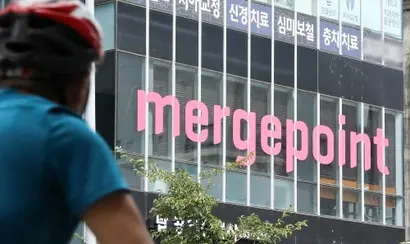
The expansion of qualification and oversight stems directly from the Merge Point crisis. Merge Point attracted over 1 million users by selling "Merge Money" vouchers under the unconventional promise of "20% discounts everywhere." These vouchers could be used to purchase goods at discounted prices across more than 200 brands, including grocery stores, restaurants, and convenience stores.
However, in August 2021, it was revealed that Merge Plus, the operator of Merge Point, was struggling to maintain operations due to accumulated losses and had not even registered as an electronic financial business. By registering simply as a "voucher issuer," the company operated effectively without a license, avoiding the scrutiny of financial authorities. Later, when Merge Point limited its usage to restaurants—complying with a regulation that voucher issuers could only provide payment services for one industry—it triggered a massive refund crisis known as a "Merge Run" (a play on bank run).
The problem is that even though the law has been belatedly amended in the wake of the Merge Point crisis, the plight of the victims is far from over. Three years later, lawsuits for damages surrounding Merge Point are still ongoing. Victims who won after long legal battles remain uncompensated.
At the end of July, 300 Merge Point victims won a partial victory in their first-instance damages suit against Merge Plus. While the court granted the victims' individual claims in full, it ruled that companies like TMON and WeMakePrice, which sold the vouchers, were not liable for damages. This lawsuit was supported by the Korea Consumer Agency (KCA) after collective dispute mediation failed. In June 2022, the KCA issued a recommendation stating that Merge Plus and the brokerage/sales platforms were liable, but the companies refused, leading to the collapse of the mediation.
Despite the first-instance victory, the road ahead is difficult. The lawsuit supported by the KCA involved about 1,500 victims out of the 7,200 who originally applied for collective dispute mediation. The litigation is split into five separate groups, and only one group has received a first-instance ruling so far. The other four groups are still waiting for their verdicts, and even for the winning group, it remains uncertain whether they will actually receive compensation.
Even the KCA, which provided legal support, is skeptical about the prospects of compensation. According to the minutes of the Litigation Support Deliberation Committee meeting on July 29, the KCA decided not to support further appeals. The decision was based on considerations of efficacy and costs. The committee stated in the minutes, "As Merge Point operators did not respond to the first-instance lawsuit, it is expected that the victims will retain their win in the second instance. However, since the likelihood of actual enforcement against them is low, the need for continued litigation support is minimal." They also predicted that the ruling absolving sales and brokerage platforms like TMON and WeMakePrice would be difficult to overturn in an appeal.
In fact, it has been confirmed that most of the 143 victims who filed a collective damages suit in September 2021, immediately after the crisis, have also failed to receive compensation. Although they achieved a partial victory in the first instance in September 2023—two years later—they were pushed back in the priority list of creditors.
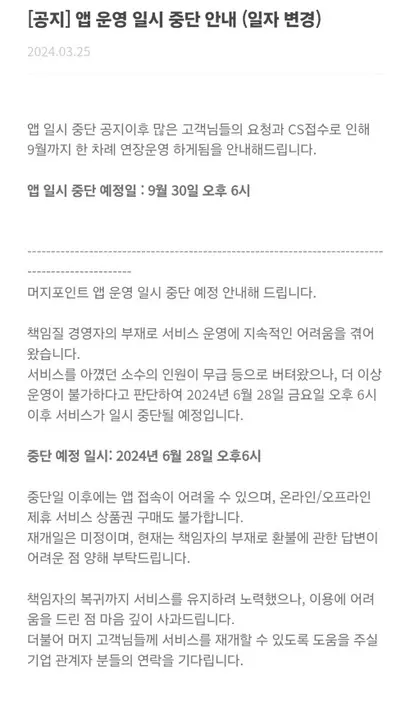
Amidst this, the app that Merge Point had converted into a shopping mall also ceased operations on September 30, leaving users with no way to use their remaining prepaid balances. Although Merge Point labeled the suspension as "temporary," the chances of resuming operations are slim now that the management is imprisoned. The company announced through a notice, "A small number of staff held on without pay, but we have determined that further operation is impossible. The date of resumption is undecided, and due to the absence of those in charge, it is difficult to provide answers regarding refunds."