

[비즈한국] Black holes are the universe's largest and darkest secrets. What would happen if you were to enter a black hole? How big is the largest black hole in the universe? Furthermore, there is a keyword that never fails to appear in stories about black holes: the white hole.
A black hole, literally, is a "black hole." A white hole is its exact conceptual opposite—a "white hole." We often imagine black holes as drain holes bored into the bottom of a swimming pool. We think of them as drains in space-time that indiscriminately suck everything nearby into them. Naturally, this question follows: If a black hole is an entity that swallows everything, where do the things it consumes disappear to? Just as there is a place for food to come back out after being eaten, shouldn't the matter swallowed by a black hole eventually have to come out somewhere? Thus, many people imagine white holes to be the exact opposite of black holes—entities that don't suck everything in, but rather spew it all out.
The existence of black holes was predicted long ago, and their actual images have even been confirmed using radio telescopes from all over the Earth. However, white holes are different. To date, there has been no recorded observation of a white hole. In fact, quite a few astronomers and physicists are skeptical about the very existence of white holes.
If white holes truly exist in the universe, and it is merely that we have not yet discovered them, what should we be looking for? Where should we be looking? At first glance, one might easily think that since they are entities that spit out all matter and energy, we should look for very bright celestial bodies emitting massive amounts of energy in all directions. However, that is the biggest mistake we make. If you want to find a white hole, you should not be looking for bright, shining places.
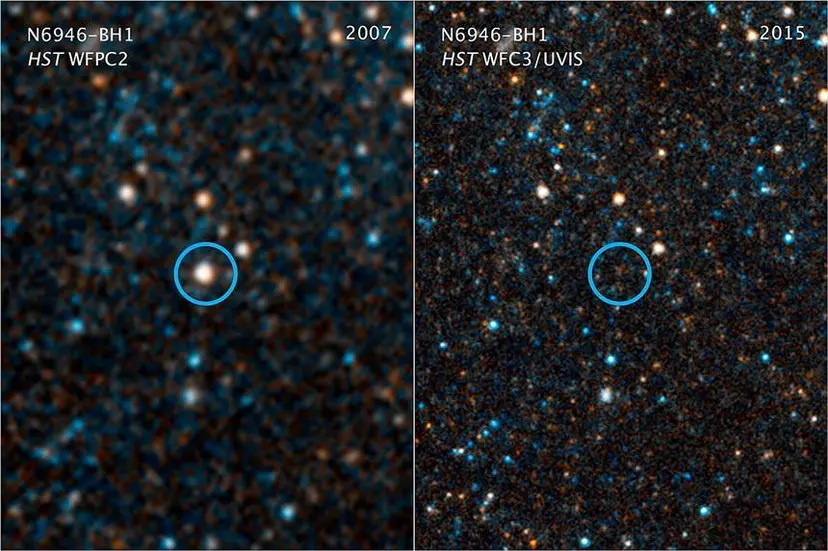
First, let’s consider the singularity of a black hole. The common black holes most easily observed in the universe are formed when stars dozens of times more massive than the Sun finish their evolution and collapse rapidly all at once. Many people think that the debris left behind after a heavy star undergoes a supernova explosion at its final moment becomes a black hole, but that is not the case. As the core of a star that has finished nuclear fusion collapses, high-energy particles, including neutrinos, are ejected rapidly in all directions. However, as such a massive amount of energy scatters, it collides with the outer shell layers of the star that were collapsing along with it, and ultimately, the outer material of the star recoils and is blown away rapidly. This is the supernova explosion we see.
Therefore, after a supernova explosion, a neutron star remains at the center. If the mass of the collapsing stellar core was too heavy to begin with, it can suppress even the force of the high-energy particles leaking from within. In that case, the entire star collapses into a single point without any explosion. This is the black hole left behind as a star dies.
In short, it is more accurate to view that the debris left from a supernova is not a black hole, but rather that a dying star follows one of two paths: either a supernova explosion or a collapse directly into a black hole without one.
A black hole formed in this way has virtually the entire mass of the collapsed star concentrated at a single point. According to Einstein's theory of relativity, space-time is bent and distorted by mass. The greater the mass, the greater the distortion of space-time. And in places where gravity is strong—that is, where space is more greatly distorted—time flows more slowly.
Because the gravity of a black hole is so strong, we can imagine a very extreme situation. In areas sufficiently far from the black hole, the degree of space-time distortion is not yet great, so if you can achieve high enough speed, you can escape safely without being continuously sucked into the black hole. However, it is dangerous to approach too closely to a black hole. Space-time bends too deeply and steeply. To escape from that steep curvature of space-time, one would need to travel faster than light. In other words, even the fastest thing in the universe—light—cannot escape the gravity of a black hole.
The boundary where one must get close to a black hole before light can no longer escape is called the event horizon. Einstein's theory of relativity predicted these extreme situations early on. However, Einstein himself did not initially accept the concept of a black hole from which not even light could escape. In a sense, even Einstein could not purely accept the truths of the universe revealed by mathematics.
Now, let's imagine a journey toward the center, beyond the event horizon of a black hole. If our spaceship were extremely sturdy and did not break apart, what changes would we, as passengers, feel? Surprisingly, we would feel no change at all. Whether we are wandering in the ordinary universe far from the black hole, narrowly skirting the event horizon, or even crossing the event horizon to enter the inside, time continues to flow for us in the same way.
However, if someone were watching us approach the event horizon from afar, it would look completely different to them. To them, our spaceship would appear to slow down and eventually freeze the moment it reached the event horizon, as if time had stopped forever. This is the strange part of the theory of relativity. No matter what I do or where I am, the time I observe for myself always flows without issue. It is only my time as viewed by another observer that appears different.
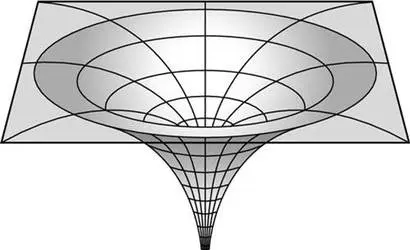
To help understand, let's lower our 3D space-time to a 2D plane. A black hole can be thought of as a pit that digs endlessly deep into 2D space-time. As time passes, the black hole continues to dig this space-time pit narrower and deeper. It seems to be dug endlessly deep, but the depth of this pit does not truly continue to infinity. It just continues to move deeper rapidly as time passes.
At the very bottom of the pit, the star that collapsed and created the black hole still exists! But surely, a star that has finished its evolution disappears in seconds as it collapses. So, how on earth can a black hole exist for such a much longer time?
This is where the magic of time in the theory of relativity unfolds. Only a short amount of time has passed in the world we live in, outside the event horizon. Much more time passes for the black hole living deep beyond the event horizon. In other words, the singularity of a black hole is not at the center of the black hole, but at a point in time further ahead than now—in the future!
Then, does the collapsed star truly collapse endlessly, forever? Italian physicist Carlo Rovelli proposes a model that says no. A collapsed star continues to shrink, and once it reaches the smallest scale allowed by quantum mechanics—the so-called Planck scale—the collapse can stop. If a collapsing star suddenly stops collapsing, what happens next? Just as a ball dropped on the floor bounces back up, a collapsed star can bounce back rapidly once it reaches its limit. It is simply the process of black hole formation in Einstein's general theory of relativity, with the direction of time reversed. In other words, if the process of a black hole forming is identical, but the flow of time is exactly reversed, one can very easily create a white hole.
Then, how can the debris of a star deep in a space-time pit that has collapsed to the Planck scale suddenly reverse the flow of time and transform into a white hole? Here, Rovelli utilizes a phenomenon that is very well-understood in the microscopic world governed by quantum mechanics: quantum tunneling. At very small quantum mechanical scales, everything takes on wave-like properties more strongly. It can even penetrate walls and pass to the other side. This is called the quantum tunneling effect.
Even inside a normal star like the Sun, the quantum tunneling effect allows protons that only repel each other to overcome their repulsion and combine into larger masses. By a similar logic, if a collapsed star in a black hole's pit undergoes the quantum tunneling effect, it could suddenly enter the formation process of a white hole, where the direction of time flows in reverse.
Once you cross beyond the event horizon of a black hole, you fall endlessly toward the bottom of the pit. It is impossible to get back out. Conversely, you cannot enter beyond the event horizon of a white hole. If so, is it possible to use these differences to prove the existence of white holes, which differ from black holes, through observation? In other words, when viewed from outside our universe, how do black holes and white holes differ in appearance?
Confusingly, there is no difference! This might sound strange at first. Think of someone watching from afar as you approach the event horizons of a black hole and a white hole. In the case of the black hole, you would cross the event horizon and go straight in. And you would continue to fall endlessly toward the black hole within. Conversely, in the case of a white hole, you cannot enter beyond the event horizon. Ultimately, you would remain frozen at the boundary of the white hole's event horizon.
Then wouldn't this difference eventually be noticeable from the outside? It is not. Did we not say that time slows down near a black hole and eventually freezes forever at the event horizon? Ultimately, whether it is a black hole or a white hole, if someone watches you reach the boundary of the event horizon from afar, you appear to be frozen in place at that boundary, stopped forever. There is no difference!
This is the subtle point of white holes. Inside the event horizon, the phenomena occurring in black holes and white holes are clearly opposite. However, the difference between the two exists only within the event horizon. There is no difference in the outside world.
Then, does a black hole that has collapsed once, experienced the Planck scale, and then rebounded through the quantum tunneling effect to transform into a white hole exist forever until the end of the universe without ever disappearing?
That is unlikely. Physicist Stephen Hawking already neatly predicted the end of black holes. At the boundary of a black hole's event horizon, negative energy flows into the black hole, causing an evaporation process where the black hole appears to emit particles in all directions—Hawking radiation. This is similar to thermal radiation where an object with temperature spreads heat. And the flow of heat is the only clue that lets us know that time in the universe ultimately flows in one direction. Inside the event horizon, the birth of a white hole, where time in Einstein's equations flows in reverse, is possible, but ultimately, when viewed from outside the universe, black holes are also slaves to time, slowly evaporating and losing mass.
To us outside the event horizon, this entire process would seem to take an extremely long time. However, inside the event horizon, it all happens in an instant. A very brief moment passes from the time the entire star collapses, passes through the Planck scale, and becomes a white hole again. But in the meantime, billions of years may have passed in the outside universe. Rovelli says this:
“The bounce of a Planck star is a shortcut to the future. It is a path where you can hide safely for a while, while eons of time pass slowly outside.”
If we accept this hypothesis, we can think of one more surprising possibility. Let's think about what a white hole might look like after a very long time. Eventually, a Planck star that has lost most of its energy and mass through Hawking radiation would be nothing more than a small lump emitting only tiny amounts of energy when viewed from the outside. Surprisingly, there might be a vast world inside it that seems to extend endlessly toward the future. A white hole at its final stage would remain at about the Planck mass, the smallest mass that can physically exist. Because the size of the event horizon cannot be shorter than the Planck scale, the white hole can only become as light as this mass. This is a mass almost equivalent to a single strand of hair.
What if many dark matter clumps contracted in the early universe right after the Big Bang, creating numerous primordial black holes? And what if most of them have been slowly losing mass until now, remaining as small white holes no larger than a strand of hair? Just like white cat hair floating around my room, there might be small white hole fragments of less than 0.1g floating around every corner of the universe. Even if the mass of one strand of a white hole is too insignificant and too small to be seen, if their numbers are countless, they might account for a significant portion of the total mass of the universe. Could the true identity of dark matter, whose existence we have yet to accurately pinpoint, actually be these countless white hole fragments wandering through space?
Who is the author, Ji Ung-bae? He loves cats and the universe. After watching 'Galaxy Express 999' as a child, he dreamed of sharing the beauty of the universe. Currently, he researches galaxy evolution through galactic interactions at the Yonsei University Galaxy Evolution Center and the Near-Field Cosmology Lab, and is engaged in various science communication activities, including lectures and writing. He has authored books such as 'The Observatory for Lovers', 'Thinking About the Universe All Day', and 'Stars, The Science of Light'.