

[비즈한국] IKEA, which previously insisted on large stores in the outskirts of cities, is moving into department stores and shopping malls. Industry experts interpret this as a strategy by IKEA to increase customer touchpoints through pop-up stores, thereby drawing customers to its main retail locations and online platforms. Having already played the price discount card to attract customers, IKEA now appears to be making a new bold move with these pop-up stores.
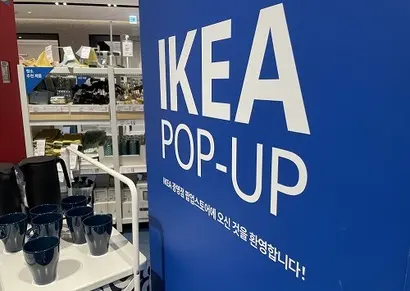
Pop-up stores in every department store, attracting customers with affordable accessories
On the 6th, the IKEA pop-up store at The Hyundai Seoul in Yeouido, Seoul, was bustling with visitors. Unlike the suburban stores, which see many families, most customers at this pop-up store were in their 20s and 30s, and foreign visitors were also noticeable. An office worker named A, who visited during lunch, said, "I bought a vegetable spinner. I hadn't bought IKEA products before because there wasn't a store near my house, but since the pop-up store opened, I drop by often during lunch or after work."
IKEA has been operating the pop-up store at The Hyundai Seoul since March. Originally scheduled for three months, the period was extended, and it is now set to remain open until mid-October. The pop-up store features a selection of IKEA's popular items, focusing mainly on home storage, office supplies, small appliances for single-person households, and interior decor products.
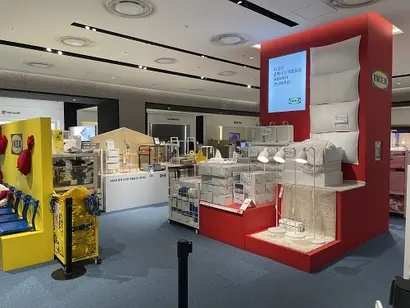
Lee Jong-woo, a professor of business administration at Ajou University, explained, "Since the products that can be displayed at a pop-up store are limited, it isn't a significant driver of total revenue. Rather than expanding sales, the intent seems to be promoting the idea that 'IKEA is affordable designer furniture' by curating products that are well-designed and low-priced."
Recently, IKEA has been expanding its pop-up store marketing. On August 30, it opened a pop-up store at Hyundai Department Store069960 Sinchon U-PLEX, and on the 4th of this month, it opened another at Connect Hyundai Busan in Busan's Dong-gu. It has also been operating a pop-up store at Shinsegae004170 Art & Science in Daejeon since May. From last October to this August, it ran a pop-up store at The Hyundai Daegu in Jung-gu, Daegu, and also operated one for two months at I'Park Mall in Yongsan, Seoul. In total, IKEA has operated 6 pop-up stores this year.
An IKEA Korea representative stated, "We are striving to expand customer touchpoints, and opening pop-up stores is part of that effort. We want to allow more people to experience IKEA's home furnishing solutions closer to the city center." The representative added, "In some cases, we extended the operating period due to positive customer feedback."

Continuous delays in new openings… Can pop-up stores increase offline and online customers?
IKEA had previously stuck to a strategy of large, experiential suburban stores. However, since opening its Dongbusan branch in 2020, it has been unable to open additional locations for four years. While several plans, such as the Gyeryong and Daegu branches, were announced, they fell through. The opening of the Gangdong branch, initially scheduled for the second half of this year, has also been delayed. An IKEA Korea representative explained, "The IKEA Gangdong branch is being developed as the company's first store in the form of a large mixed-use shopping mall. It is scheduled to open in the first half of 2025," adding, "No further opening plans have been decided yet."
Industry insiders analyze that IKEA has stepped up its pop-up store marketing as a response to difficulties in opening new stores. Professor Lee Jong-woo remarked, "IKEA hasn't opened a new store in four years, likely due to difficulties in finding suitable sites. They are expanding pop-up stores to increase touchpoints with younger customers and drive those customers to their main stores to generate revenue."
Seo Yong-gu, a professor of business administration at Sookmyung Women's University, also explained, "Nitori, Japan's No. 1 home furnishing company, had operated mainly through large stores, but it has continued to grow for 30 years by introducing urban-style stores in places like Tokyo. With its growth having stalled, IKEA also seems to be exploring new types of stores through these pop-ups."
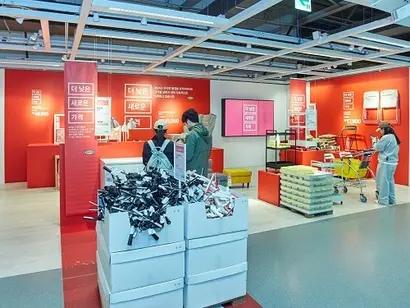
With new store openings at a standstill and the furniture industry facing a downturn, IKEA's performance has been declining. IKEA Korea's revenue, which was 687.2 billion won in the 2021 fiscal year (September 2020–August 2021), fell to 600.7 billion won in the 2023 fiscal year (September 2022–August 2023). Operating profit also dropped from 29.4 billion won to 2.6 billion won during the same period.
IKEA began efforts to boost sales last year by implementing discount strategies. IKEA Korea announced it would invest 7 million euros (10.4 billion won) from September last year through August this year to lower prices on around 800 products. An IKEA Korea representative stated, "Over the past year, approximately 1,200 products have been introduced under the 'New Lower Price' campaign. We will continue our efforts to provide competitive and reasonable prices."
Moving forward, IKEA plans to seek a turnaround through an omnichannel strategy that links online and offline channels. The representative noted, "We will continue to strengthen our omnichannel presence by introducing digital solutions while simultaneously offering lower-priced products. We aim to provide customized customer services and a seamless, convenient shopping experience."
Some in the industry point out that IKEA's omnichannel strategy needs improvement. Although IKEA started its e-commerce business in 2018, its online sales accounted for a mere 21% as of 2023. Professor Seo Yong-gu explained, "IKEA was one of the first companies to embrace digital transformation, such as using augmented reality. However, it seems they haven't been actively pursuing digital transformation recently, and given the rapid development of domestic e-commerce, they have failed to keep up with the convenience Korean consumers expect." He added, "To continue growing in Korea, IKEA needs to respond more quickly to digital transformation."
Some suggest that as IKEA has yet to make a significant mark in its online business, it should focus more on opening new offline stores. Professor Lee Jong-woo advised, "The furniture industry is struggling due to the poor real estate market. In times like these, consumers look for products with high price-to-performance ratios. There is a need to increase accessibility by opening new stores. They also need to be more aggressive in their marketing to boost brand awareness."