

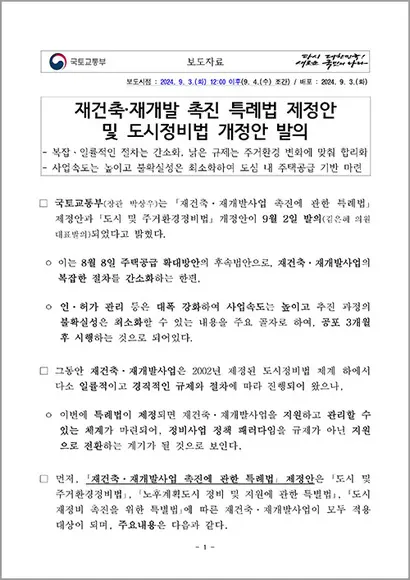
[비즈한국] On September 3, the Ministry of Land, Infrastructure and Transport announced that the bill for the "Special Act on the Promotion of Reconstruction and Redevelopment Projects" and the amendment to the "Urban and Residential Environment Maintenance Act," proposed by Representative Kim Eun-hye on September 2, 2023, had been officially introduced. These bills are follow-up measures to the housing supply expansion plan announced on August 8, aiming primarily to simplify the complex procedures of reconstruction and redevelopment projects, strengthen the licensing and management system, accelerate project progress, and reduce uncertainty in the implementation process.
The Special Act aims to serve as a catalyst for shifting the policy paradigm toward strengthening support and improving the somewhat rigid procedures under the existing Urban Maintenance Act and related regulations. Key contents include the simplification of procedures, resolution of project uncertainties, and deregulation.
The bills are scheduled to take effect three months after promulgation, and if passed, they are expected to simplify the procedures for reconstruction and redevelopment projects and shorten project timelines—provided, of course, that there is no opposition from the opposition party.
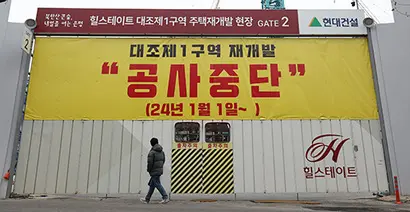
As of September 2024, reconstruction and redevelopment projects in South Korea play a core role in expanding housing supply and improving the urban environment, yet they still face numerous problems. In particular, complex procedures and regulations, conflicts between stakeholders, and economic burdens act as stumbling blocks to project implementation. If these issues are not resolved, the shortage of housing in large cities like Seoul is highly likely to worsen. Accordingly, it is necessary to analyze current problems and seek specific measures to improve them.
First, there are complex and prolonged procedures.
The biggest problem with reconstruction and redevelopment projects is the complex administrative procedures and the resulting long project duration. In most cases, it takes more than 10 years from the start of a project to its completion. During the implementation process, projects must pass through various stages of deliberation and licensing, and delays frequently occur because consultations between relevant agencies at each stage are not seamless. For instance, procedures such as establishing maintenance plans, forming associations, approving project implementation plans, and authorizing management and disposal plans are handled independently and often involve redundant review processes.
The administrative delays occurring during this process place a heavy economic burden on residents and associations participating in reconstruction and redevelopment, reducing the economic viability of the projects. As projects are delayed, construction costs rise and financing costs increase, leading to higher contributions required from residents.
To improve this, project periods can be shortened by simplifying procedures and processing them in parallel. The newly proposed "Special Act on the Promotion of Reconstruction and Redevelopment" enables the simultaneous establishment of basic plans and maintenance plans, and introduces measures to process management and disposal plans alongside project implementation plans. Expanding such measures to integrate redundant review procedures throughout the entire project process and establishing a coordination body at the central government level to quickly resolve disagreements between relevant agencies is also necessary.
Second, conflicts between stakeholders arise frequently.
Reconstruction and redevelopment projects have a complex structure involving various stakeholders. Beyond the association members, construction companies, and local governments directly participating in the project, the demands and interests of non-members, tenants, and nearby residents often clash. In particular, it is easy for conflicts to arise within the association over issues such as construction costs, sales price calculations, relocation, and compensation.
Conflicts between stakeholders delay project implementation and sometimes cause projects to be canceled. For example, when disputes occur between the association and the construction company over increased construction costs, they frequently lead to legal battles that bring the project to a halt. Furthermore, if trust between association executives and members collapses, extreme situations like the dissolution or reorganization of the association can occur.
To resolve these conflicts, a conflict mediation body appears necessary. The government should strengthen the dispute mediation team dispatch system it is currently promoting and establish a fair mediation system capable of quickly arbitrating not only internal association issues but also construction cost disputes with contractors and conflicts between residents. Additionally, to enhance transparency, accounting audits and construction cost verification procedures should be made mandatory, and information should be provided in a way that is easily understood by members.
Third, there is the increasing economic burden. Recently, this is perceived as the biggest problem.
The rise in economic burden for reconstruction and redevelopment projects is a major issue. As projects are prolonged, construction costs rise along with member contributions, which becomes a heavy burden particularly for elderly residents living in dilapidated housing. If contributions become excessively high, some residents find it difficult to participate, and there have been many recent cases where this has led to project delays or cancellations.
Moreover, as the costs of construction materials and labor increase, instances of construction companies demanding higher fees are rising. Association members often resist this, leading to disputes.
To alleviate the economic burden, the government needs active financial and fiscal support measures. The government could provide low-interest reconstruction loans for dilapidated housing meeting certain criteria or expand financial support on the condition of providing a certain ratio of public rental housing. Additionally, it is necessary to seek ways to increase project feasibility and reduce the burden of contributions through incentives such as relaxing floor area ratios.
As of September 2024, reconstruction and redevelopment projects in South Korea are facing various challenges. To resolve these, comprehensive improvements—including procedural simplification, conflict resolution, economic burden relief, and the strengthening of public interests—are required. Only when the government, local municipalities, and all stakeholders cooperate to prepare realistic and effective measures can we solve urban regeneration and housing supply issues while promoting residential stability for the public. There is no ruling or opposition party when it comes to solving the housing problem. I sincerely hope they will cooperate.
Kim Hak-ryeol, Director of the Smart Tube Real Estate Research Institute, well-known by his pen name "Pasyong," previously served as a team leader at the Real Estate Research Division of Gallup Korea. He operates and hosts the Naver blog "Pasyong’s World Exploration" and the YouTube channel "Stue TV." He is the author of books including "Absolute Principles of Seoul Real Estate (2023)," "The Future of Incheon Real Estate (2022)," "Kim Hak-ryeol's Absolute Principles of Real Estate Investment (2022)," "South Korea Real Estate Future Map (2021)," "From Now On, Only Places That Will Rise, Rise (2020)," and "South Korea Real Estate User Manual (2020)."