

[비즈한국] A single-person operation system, where one driver is responsible for both train operation and safety management, is expected to be introduced on Seoul Subway Line 2. Recently, Seoul Metro has been pushing a plan to transition from the current two-person system—involving a driver and a conductor—to a single-driver operation. The corporation formed a related task force (TF) early this year and is currently conducting research through an external agency.
Critics argue that social consensus is necessary for expanding the system, as safety issues consistently arise whenever accidents occur on lines where single-person operations are already in place. The labor union has also expressed strong opposition, stating that operating a large 10-car urban rail train with only a single driver threatens passenger safety and worsens working conditions for crew members.
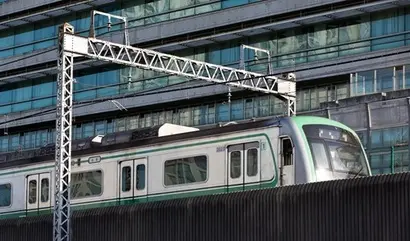
'First of its Kind for 10-Car Trains': Moving Toward Single-Driver Operation on Line 2
According to Seoul Metro and its labor union, the corporation, which operates lines 1–8 and the 2nd and 3rd phases of Line 9, has recently entered the final stages of preparing for the introduction of a single-person operation system on Line 2. Seoul Metro has commissioned research on the matter and conducted a survey of all employees early last month. The move appears to be part of an effort to increase efficiency by reducing staffing levels on Line 2, where the modernization of the Automatic Train Operation (ATO) system and the replacement of train cars have been completed.
According to the union, Seoul Metro plans to implement the system fully in the first half of next year, pending approval of the railway safety management system based on the results of the research. An information session is expected to be held this coming October. It is reported that the plan also includes reducing the workforce by more than 180 personnel by eliminating the conductor position. A Seoul Metro official stated, "We are not aware of the specific details of the ongoing internal research project. Nothing has been finalized, and we will determine the specific direction after reviewing the results of the study."
If Line 2 switches to a single-person operation, the driver will be responsible for driving, opening and closing doors, making announcements, and handling passenger complaints. In the existing two-person system, the driver in the front cabin manages operations, while the conductor in the rear handles safety duties.
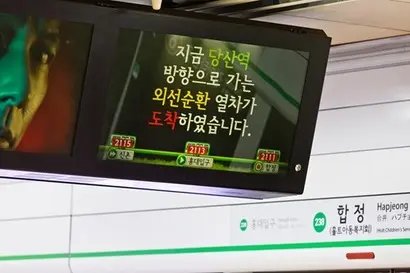
This is not the first instance of automation and single-person operation being applied to Seoul subway lines. Lines 5–8 and the privately operated Line 9 have been operated under an ATO system—where computers control the train automatically—since their inception, with one driver overseeing both movement and passenger boarding. However, this would be the first time it is applied to a 10-car line. Lines 5–9 consist of 8, 6, or 4 cars. Furthermore, the Gyeongui-Jungang Line (8 cars) and Suin-Bundang Line (6 cars), where KORAIL currently uses a single-person system, also have fewer than 10 cars. Lines 1–4, which use 10-car trains, and KORAIL's general railway lines have maintained a two-person operation system.
With 2 Million Daily Passengers, Is It Safe?
Although preparations for the unprecedented single-driver system are underway for Line 2, which has the highest number of passengers among Seoul's subway lines, the transition is unlikely to be smooth. Most notably, there is deep concern regarding safety. The labor union has begun collective action, including holding a protest press conference at the end of last month. Lee Seung-woo, a specialist member of the Seoul Metro Safety and Health Management Committee (research fellow at the Democratic Labor Institute), pointed out, "The single-person operation system is no different from Seoul Metro tearing down one of its own core safety walls."
In theory, the ATO system provides the technical foundation for a single driver to operate a train. Proponents cite benefits such as the ability to reduce intervals between trains during crowded rush hours and lower labor costs to improve management efficiency. Experts generally agree that the ATO system itself and safety between stations are sufficiently guaranteed.
The problem arises when the train stops or departs. Kim Young-seok, a professor of Railway Operation and Electrical Signaling at Dongyang University, noted, "While automatic operation systems are safe, there is no such thing as a perfect mechanical system. What happens while the train is stopped is the responsibility of the crew. Even if systems, AI, and crew members cooperate and complement each other, it is difficult to calculate for all the unpredictable behaviors of passengers and the situations that follow."
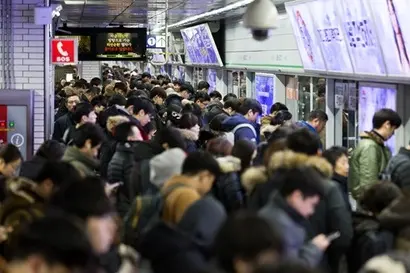
There is significant skepticism toward the transition, especially because it is being applied for the first time to large 10-car trains and because Line 2 is the most crowded subway line in Korea. The union explained, "Line 2 is the line with the highest number of station-related accidents, such as passengers getting caught in doors or slipping into gaps, as well as incidents inside trains. In the event of a service disruption or an unusual accident, it is impossible for a single crew member to follow safety protocols."
From 2022 to the first half of this year, Line 2 recorded an average congestion rate (passengers vs. capacity) of approximately 152% and an average of about 2 million daily passengers. It includes many of the busiest stations, such as Jamsil, Gangnam, Hongik University, and Sindorim, and has 24 transfer stations.
Professor Kim added, "As the number of train cars (length) increases, the field of vision narrows accordingly. In stations with curved platforms, blind spots emerge for the driver in the front cabin. A single-person operation system is bound to have limitations in effectively preventing such risks compared to a two-person system."
Experts emphasized that even when considering cost-cutting measures like staff reduction, safety should be viewed from the perspective of investment rather than expense. Kim Yang-soo, a professor of Railway Operation Systems at Songwon University, stated, "Train automation and subsequent workforce efficiency are appropriate directions in the long term. However, the crucial factor is that Line 2 is an incredibly busy line. Since the driver must take over the risks previously handled by the conductor, compensatory measures—such as reducing train congestion and deploying safety personnel at stations—are essential."