

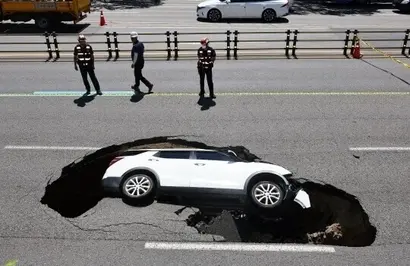
[비즈한국] A sinkhole occurred on a four-lane road in Yeonhui-dong, Seodaemun-gu, Seoul, on the 29th. A vehicle passing through the area fell into the sinkhole, leaving an elderly couple inside with serious injuries. The sinkhole measured 4 meters in width, 6 meters in length, and reached a depth of 2.5 meters. The Seoul Metropolitan Government is currently investigating the cause, considering various possibilities such as soil weakening due to rainfall, damaged water and sewage pipes, and the impact of nearby rainwater pumping station conduit construction.
Seoul Sinkhole Accidents Trend Upward Over Three Years
Seoul is the city where the most sinkholes occur in the country. An analysis by Biz Hankook of the Underground Safety Information System (JIS) ground subsidence accident reports (as of the 2nd) shows that a total of 63 sinkhole accidents occurred in Seoul from 2021 to August of this year. This is the second-highest figure among metropolitan governments nationwide, following Gyeonggi-do (117 cases). However, during this period, the number of sinkholes per 100㎢ was 10, the highest in the country.
Seoul sinkhole accidents have been steadily increasing over the past three years. The number rose from 11 in 2021 to 20 in 2022 and 22 in 2023, with 10 cases reported through August of this year. During this period, 22 sinkhole accidents resulted in vehicle or human casualties. Eleven vehicles were damaged after falling into the ground, and 18 people were injured. Fortunately, there were no fatalities.
Gangnam-gu and Songpa-gu are the districts in Seoul where the most sinkhole accidents occurred, with 9 cases each from 2021 to August of this year. The number of sinkhole accidents by district followed with: Seongbuk (8), Gangdong, Gangseo, Seodaemun, Seocho, and Yeongdeungpo (3 each), Gwanak, Guro, Dobong, Dongdaemun, Mapo, Eunpyeong, Jongno, Jung-gu, and Jungnang (2 each), and Nowon, Dongjak, Yangcheon, and Yongsan (1 each). There were no related accidents in Gangbuk, Gwangjin, Geumcheon, or Seongdong.
400km of Sewage Pipes Have Reached the End of Their Lifespan
Nearly half of Seoul's sinkhole accidents were caused by damage to sewage pipes. Over the past three years, the causes of sinkholes in Seoul were as follows: damage to sewage pipes (30 cases, 48%), followed by poor backfilling (10 cases, 16%), faulty excavation work (8 cases, 13%), damage to water supply pipes (7 cases, 11%), damage to other buried facilities (4 cases, 6%), poor construction of water/sewage pipes (1 case, 2%), and others (3 cases, 5%). In an announcement by the Seoul Metropolitan Government last October, sewage pipes also accounted for the largest share of sinkhole causes over the past nine years, totaling 107 cases (51.2%).
Facility aging is cited as the main reason for the damage to sewage pipes that leads to sinkholes. According to the Seoul Metropolitan Government, a total of 400km of sewage pipes will reach their useful life (30 years) this year. The amount of sewage pipes reaching their lifespan is about 100km per year and is expected to grow to a total of 3,957km by 2031. An official from the Seoul Water Regeneration Planning Division said, "We plan to reflect the related budget in the supplementary budget this May and conduct an 18-month investigation starting in September to inspect old sewage pipes and identify and repair defective sections."
The Seoul Metropolitan Government failed to prevent this accident even after conducting surveys of underground voids (empty spaces), which are the cause of sinkholes. The city has been using Ground Penetrating Radar (GPR) to perform regular annual inspections of all roads in Seoul (2,200km annually). It also conducted additional, enhanced special inspections (5,000km annually starting this year) for areas prone to ground subsidence. The area around Seongsan-ro in Yeonhui-dong, where this sinkhole occurred, was included in the regular inspection list and was checked this past May, but it is reported that no empty spaces were discovered at that time.
Cho Won-chul, Professor Emeritus of Civil and Environmental Engineering at Yonsei University, pointed out, "Water has viscosity that drags surrounding material as it flows. If water leaks underground due to damaged water or sewage pipes, or if groundwater enters, the soil is dragged along due to this viscosity. As soil is removed and an empty space is created, a sinkhole occurs. Areas around water and sewage pipes or underground utilities where the ground was dug up and backfilled are prone to water flow." He added, "Backfilling must be done thoroughly after excavation work, and aging water and sewage pipes must be strictly managed to prevent leaks. It is also important to identify and manage underground voids using GPR before and after the rainy season."
The Seoul Metropolitan Government stated, "We have surveyed a total of 5,787km this year, discovering and restoring 559 voids in advance. Through consistent GPR exploration, the discovery rate of voids and the number of ground subsidence accidents have shown a downward trend over the past 10 years." They added, "We will conduct extensive, full-scale inspections focusing on areas around this accident site and other newly discovered subsidence spots to create a safe road environment, and we will continuously identify and closely inspect areas with potential for subsidence, such as large construction sites, underground roadways, and excavation areas in Seoul."